Redefining obesity

New obesity treatments must factor in complexity of condition and connection to chronic diseases
By Claire Kowalick
What if we began treating obesity as a disease in the same way that we treat cancer, diabetes or other chronic diseases?
Obesity is the most pervasive chronic inflammatory disease in the United States, affecting more than 40% of American adults. Left untreated, it is associated with more than 13 types of cancer, Type 2 diabetes, liver disease, kidney disease and heart attack and heart failure.
A large part of the treatment gap stems from a decades-long misunderstanding that weight loss is simply a matter of balancing calories in and calories out. Research now shows the disease is far more complex than thought, influenced by genetic, environmental and behavioral factors.
Obesity as a medical condition
Obesity was officially recognized as a disease by the American Medical Association in 2013. Yet, 12 years later, its stigma as something that is one’s own fault remains. Many still perceive it as a failure of willpower rather than a medical condition requiring comprehensive care.
Researchers at The University of Texas at San Antonio’s Health Science Center are making significant advances in treating obesity and related metabolic conditions, with dedicated multidisciplinary teams helping patients work toward a healthier future.
“Obesity is a chronic inflammatory disease that needs long-term therapy. It is genetically associated, and multiple studies in the last 100 years have shown that for some people, diet and exercise are not enough,” said Carolina Solis-Herrera, MD, director of the Diabetes Center for Excellence, associate professor and chief of the Division of Endocrinology at the university’s Joe R. and Teresa Lozano Long School of Medicine.
“ Our ultimate goal is to build a comprehensive center, the largest in America, that helps hundreds of thousands of patients each year from both the U.S. and Mexico. Our dream is to one day have everything under one roof — an institute for diabetes, obesity and metabolic health.”
– Carolina Solis-Herrera, MD, director of the Diabetes Center of Excellence, associate professor and chief of the Division of Endocrinology
Four pillars of obesity treatment
Studies show the most effective long-term obesity treatments incorporate comprehensive care built on four pillars: diet, exercise, behavioral modification and medical intervention. This model produces better outcomes than medication alone or lifestyle changes alone.
The Health Science Center has expanded to meet the growing need for obesity and metabolic disease treatment. The Diabetes, Obesity and Metabolic Health Clinic at UT Health Gateway has grown from a small, four-room clinic seeing 100 patients a month to a 3,200-square-foot center treating more than 1,000 patients monthly. In summer 2025, the university announced that Solis-Herrera will lead the newly created Diabetes Center of Excellence, a multidisciplinary hub where researchers will collaborate and share cutting-edge findings.
“Our ultimate goal is to build a comprehensive center, the largest in America, that helps hundreds of thousands of patients each year from both the U.S. and Mexico. Our dream is to one day have everything under one roof — an institute for diabetes, obesity and metabolic health,” Solis-Herrera said.
She believes the future of obesity treatment is promising, driven by increasing momentum in research, drug development and evolving patient care.
“The more we talk about it, the more we disseminate the information, it will become a reality. We want patients to come to us, receive the treatment they need and achieve their goals,” Solis-Herrera said.

Breaking the cycle
According to Joseph Becker, MD, associate clinical professor in the university’s Division of Endocrinology, Department of Medicine, one major hurdle in treating obesity is helping patients move past feelings of guilt and shame so they can begin making positive changes.
“Patients come in defeated, like they have done this to themselves. Their family members do not understand, and society does not understand. They just want to give up. The hardest part is overcoming that initial psychological hurdle. Then we can say, ‘Let’s treat this like a chronic illness and decrease heart disease, lower blood pressure.’ Obesity is one variable in the equation, but we want to treat all aspects of it.” Prior to the American Medical Association declaring obesity a disease, it was often seen as the result of poor lifestyle choices.
“This puts a level of blame on the patient, that the disease and its complications were their fault. We realized this blame caused a sense of guilt and body shaming that led to a cycle of eating and less activity. We need to break the cycle,” Becker said.
“Patients come in defeated, like they have done this to themselves. Their family members do not understand and society does not understand. They just want to give up. The hardest part is overcoming that initial psychological hurdle. Then we can say, ‘Let’s treat this like a chronic illness and decrease heart disease, lower blood pressure.’ Obesity is one variable in the equation, but we want to treat all aspects of it.”
– Joseph Becker, MD, associate clinical professor in the Division of Endocrinology, Department of Medicine
Complex causes of obesity
The causes of obesity are complex, often involving a combination of genetic, environmental and behavioral influences. More than 1,100 genes have been associated with obesity, although only a portion of people with obesity have a genetic variant directly responsible. Certain medical conditions, psychological factors such as depression or mental illness, and some medications can also contribute to weight gain.
The body regulates weight through continuous communication among the brain, stomach and gut, balancing energy intake and expenditure. Two major factors in this process are stomach motility and gastric emptying.
When we eat, the stomach releases hormones that regulate appetite. The hormone ghrelin, for example, promotes hunger and increases stomach emptying and motility, which can drive increased food intake. Leptin, involved in fat distribution and oxidative stress regulation, drives feelings of hunger and satiety and is often present in abnormal amounts in people with obesity. Glucagon-like peptides (GLP-1s) stimulate insulin secretion through signaling in the brain and stomach. Becker said some individuals may even have a genetic predisposition for increased stomach motility and faster gastric emptying.
Consuming more food than needed, particularly carbohydrate- and sugar-rich foods, leads to the synthesis of free fatty acids that trigger inflammation, stress and lipid, or fat, storage in adipose tissue. This inflammation can create a cascade of metabolic disruptions, increasing the risk for high blood pressure, heart disease, insulin resistance, Type 2 diabetes and other metabolic disorders. Additionally, this inflammation can activate immunologic T-cells, potentially contributing to autoimmune diseases.
Growing toolbox of treatment options
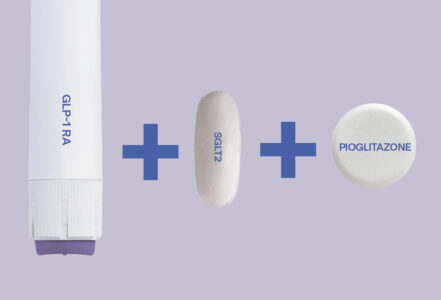
Today, patients have access to a broader range of obesity treatments than ever before. Lifestyle modification remains the cornerstone — emphasizing a low-carbohydrate, balanced diet and 30 minutes of activity most days of the week. In addition, there are now six U.S. Food and Drug Administration-approved medications for obesity: orlistat, phenterminetopiramate, naltrexone-bupropion and the GLP-1 agonists liraglutide, semaglutide and tirzepatide.
Becker notes that while the first three older medications are effective, they have limitations and may not be appropriate for patients with heart disease or high blood pressure. The newer class of drugs, GLP-1 receptor agonists (GLP-1 RAs), has stirred a revolution and an upswell of hope in obesity treatment.
“These are some of the best treatments to date for obesity. The newest compounds produce significantly better results with fewer side effects than earlier analogs,” Becker said.
GLP-1 RAs slow stomach emptying, leading to a prolonged sense of fullness and decreased hunger. They also stimulate insulin production and reduce glucagon secretion, promoting weight loss and improving insulin sensitivity. Dual-agonist medications like semaglutide and tirzepatide, which combine a GLP-1 RA with a glucose-dependent insulinotropic polypeptide receptor agonist (GIP), provide additional benefits.
“Obesity has a spectrum. That is one of the things we are doing here — defining those inflection points in the disease process that make someone a good candidate for medication or surgery. And that is a process.”
– Richard Peterson, MD, MPH, metabolic and bariatric surgeon, Division Chief of General and Minimally Invasive Surgery and Chief of the Metabolic and Bariatric Surgery Program at UT Health San Antonio and president of the American Society for Metabolic and Bariatric Surgery
Continuum of care
For individuals with the most severe obesity, bariatric surgery remains the gold standard.
“Obesity has a spectrum. That is one of the things we are doing here — defining those inflection points in the disease process that make someone a good candidate for medication or surgery. And that is a process,” said Richard Peterson, MD, MPH, metabolic and bariatric surgeon, Division Chief of General and Minimally Invasive Surgery and Chief of the Metabolic and Bariatric Surgery Program at UT Health San Antonio, the institution’s patient-facing, clinical care enterprise. Peterson is also president of the American Society for Metabolic and Bariatric Surgery.
The Body Mass Index (BMI), a calculation based on weight and height, remains the standard classification tool. A normal BMI ranges from 18.5 to 25. Peterson noted that the average BMI for bariatric surgery patients has climbed to 50, marking a significant increase in recent years. While medications offer powerful support, bariatric surgery is the most effective option for the treatment of obesity, said Peterson.
“Obesity is a chronic disease. This is not a disease where we try one therapy, and you are cured. There is no cure, but we can put it into remission, and surgery is the best chance for doing that.”
Studies suggest the most effective obesity medications can achieve up to 20% body weight reduction, while bariatric surgery can yield up to 40% weight loss. Long-term data shows 98% of patients regain weight within two years of stopping weightloss medications, compared to 85% of bariatric surgery patients who maintain weight loss five years post-surgery. Despite its success, bariatric surgery remains underutilized, said Peterson, with only 1% of eligible patients pursuing the option.
Thanks to newer, minimally invasive techniques, bariatric surgery is safer than ever, he added. Common procedures include sleeve gastrectomy, gastric bypass and gastric banding. Modern bariatric surgery is now considered as safe as, or safer than, routine surgeries such as appendectomy or gallbladder removal.
At UT Health San Antonio, patients benefit from an integrated team of primary care providers, dietitians, physical therapists, behavioral health experts and surgeons working together to deliver personalized care through a range of medical therapies, endoscopic treatment modalities and surgical options.
“That’s what we do best here. We are trained in the disease process,” Peterson said. “We have many specialists who work in collaboration, and with that comes better care.”
Viva la Gila!
 Blockbuster glucagon-like peptide-1 (GLP-1) agonist drugs for Type 2 diabetes and weight loss trace their roots to the Gila monster, a venomous lizard native to the southwest region of the United States. In the 1990s, scientists discovered that the animal’s saliva contains a hormone called exendin-4, which mimics the human hormone GLP-1, a key regulator of blood sugar and appetite. Unlike natural GLP-1, exendin-4 sticks around longer in the body, making it ideal for drug development. A synthetic form, exenatide, became the first GLP-1 receptor agonist approved by the U.S. Food and Drug Administration in 2005. Today, millions of people use GLP-1-based medications, all thanks to a slow-moving lizard with a powerful bite.