Bold research aims to halt liver disease before it turns deadly
By Claire Kowalick
Metabolic dysfunction-associated steatotic liver disease, or MASLD, is the most common form of steatotic liver disease marked by fat accumulation in the liver. Formerly known as NASLD, or non-alcoholic steatotic liver disease, or fatty liver, the new terminology marks scientists’ deeper understanding of underlying mechanisms of the disease.
In many MASLD cases, liver fat accumulation is linked to obesity, Type 2 diabetes and insulin resistance. While MASLD may begin silently enough, like a smoldering fire, it can combust into a far more dangerous condition.
Fat to fibrosis: A dangerous turn
In early stages, MASLD may not cause problems and is potentially reversible. However, when chronic liver fat accumulation leads to inflammation and damage to liver cells, MASLD turns into MASH, or metabolic dysfunction-associated steatohepatitis. MASH can cause inflammation, enlarged liver and fibrosis, or scarring. Over time, this can progress to cirrhosis, liver failure and potentially liver cancer. Most people with MASH do not experience symptoms until an advanced stage of the disease when pain, jaundice and fluid retention begin to appear.
“The liver can take a lot of abuse,” said Luke Norton, PhD, director of the Center for Molecular Metabolism and assistant professor in the Department of Medicine at the Joe R. and Teresa Lozano Long School of Medicine at The University of Texas at San Antonio. “But once fibrosis sets in, it becomes incredibly difficult to reverse.”
‘Perfect storm’ of risk in San Antonio
In the South Texas area, MASLD and MASH are alarmingly common. Norton said up to 90% of people with obesity also have MASLD. Among patients with Type 2 diabetes in San Antonio, nearly 60% have MASLD, and studies indicate up to 30% also have MASH.
This startling trend is not limited to adults. Pediatric MASH cases are on the rise as well, with San Antonio physicians reporting diagnoses in children as young as 8 years old.
How do you diagnose a disease with no symptoms?
Early detection is critical but can be difficult due to a lack of diagnostic tools. The most accurate MASH diagnosis requires liver biopsy to confirm inflammation and fibrosis. Imaging tools like FibroScan — a specialized ultrasound that estimates liver stiffness and fat — and MRI-based techniques offer non-invasive alternatives, but they are not widely available in most primary care settings.
“By the time most people are diagnosed, the disease has progressed,” Norton said. “We need broader screening and education, especially in communities with high obesity and diabetes rates.”
“By the time most people are diagnosed, the disease has progressed. We need broader screening and education, especially in communities with high obesity and diabetes rates.”
– Luke Norton, PhD, director of the Center for Molecular Metabolism and assistant professor in the Department of Medicine
Why liver fat matters
Beyond its actions on the liver itself, liver fat can be a sign of more wide-ranging metabolic dysfunction. Insulin resistance makes fat cells less responsive to storing glucose and lipids, and instead of storing these excess energy molecules, they begin dumping them into the bloodstream. The liver then becomes a catchall, taking in the excess fat. Once the liver can’t take any more, it triggers inflammation, impairs detoxification and throws off glucose metabolism.
“People think of fat as just being stored away,” Norton said. “But when it goes to the wrong places, like the liver, it starts actively doing harm.”
Treatments and the role of obesity
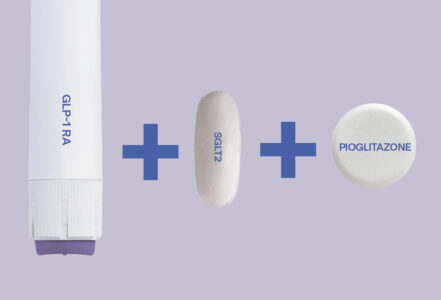
While there are few U.S. Food and Drug Administrationapproved medications specifically for MASLD or MASH, several drugs are showing promise in prevention and slowing of progression of the diseases. Glucagon-like peptide-1 receptor agonists (GLP-1 RAs), already used for Type 2 diabetes and obesity, can also help reduce liver fat. Pioglitazone, an insulin sensitizer and Type 2 diabetes drug, reduces blood sugar and may also potentially slow liver fibrosis.
The most powerful MASLD preventive measures include lifestyle interventions like exercise, a balanced low-carbohydrate, low-sugar diet and little, if any, alcohol. If caught early, Norton said these changes in diet, physical activity and weight management can make a difference.
“ Magnesium is a core ion. It is the first ion used by living organisms. Without it, ATP, the energy molecule in every cell, is unstable and inflammatory. Magnesium binds ATP, stabilizes it, and makes it usable. But when magnesium floods the mitochondria, the whole system gets thrown off.”
– Madesh Muniswamy, MS, PhD, Long-Endowed tenured professor of medicine in the Division of Cardiology
 Deep dive: Reprogramming at the molecular level
Understanding how liver disease first develops requires looking down to the mitochondrial level. For decades, Madesh Muniswamy, MS, PhD, professor of medicine at the Long School of Medicine’s Division of Cardiology, has studied mitochondrial metabolism, or how bodies convert sugar and fat into energy.
“Our lab is trying to understand why, at the cellular level, some people store everything they eat as fat, while others do not,” he said. Muniswamy’s lab, in collaboration with other institutions, has identified a crucial gene involved in a specific mitochondrial ion channel that regulates magnesium.
“Magnesium is a core ion. It is the first ion used by living organisms,” he said. “Without it, ATP, the energy molecule in every cell, is unstable and inflammatory. Magnesium binds ATP, stabilizes it and makes it usable. But when magnesium floods the mitochondria, the whole system gets thrown off.”
Using mouse models and human biobank samples, the team has shown that in people genetically predisposed to obesity, the mitochondrial magnesium channel is overactive and pulls excess magnesium into the mitochondria. This slows the burning of sugar and fat, and instead of being used for energy, nutrients are stored as fat across the body, including the liver. Over time, this accumulation reshapes the entire metabolic profile, essentially reprogramming the body to store fat rather than burn it.
This buildup can lead to MASLD, MASH and potentially liver cancer. In a one-year study — equivalent to 40 years in human life — mice lacking this magnesium channel gene that were fed a Western high-fat, high-carbohydrate diet quickly developed MASH and liver tumors.
“Dietary stress is driving this. In our studies, mouse models of obesity show an 80% decrease in mitochondrial number and function in liver cells,” Muniswamy said. “When that happens, there is nothing left to burn fat or sugar, and fat builds up.”
Muniswamy and his team have patented the discovery, launched a biotech company and are now focused on designing a drug that can partially close this channel, which would slow magnesium entry while allowing calcium to get through. Calcium, unlike magnesium, turns on the energy-burning pathways in the cell.
“By eliminating senescent cells, we saw dramatic improvements in liver structure and function. This gives us real hope for a new class of therapeutics.”
– Daohong Zhou, MD, tenured professor in the Department of Biochemistry and Structural Biology, director of the Target Discovery Core at the Greehey Children’s Cancer Research Institute, associate director for drug development at the Mays Cancer Center and director of the Center for Innovative Drug Discovery
Novel treatments bring new hope
As Health Science Center scientists uncover the complexities of metabolic-related liver disease, many also seek to understand how chronic liver damage from these diseases can lead to liver cancer. A growing number of studies suggest that chronic metabolic damage related to obesity and Type 2 diabetes can lead to hepatocellular carcinoma (HCC), the most common form of liver cancer. However, some surprising discoveries and a bold new treatment have paved the way for treatments that stop the disease progression, potentially halting cancer progression.
“Once fibrosis reaches a certain stage, it becomes a self-propagating disease, and current treatments cannot reverse it effectively,” said Daohong Zhou, MD, tenured professor in the Long School of Medicine’s Department of Biochemistry and Structural Biology. He is also director of the university’s Target Discovery Core at the Greehey Children’s Cancer Research Institute, associate director for drug development at the Mays Cancer Center and director of the Center for Innovative Drug Discovery.
Zhou’s research seeks to understand the role of senescent cells in this progression to cancer. These aged, non-dividing cells accumulate in damaged tissue and secrete molecules that promote inflammation and disrupt normal healing in the liver. His lab has found that clearing these cells using targeted senolytic agents in mouse models of liver fibrosis not only reduces inflammation and halts fibrotic progression but may also prevent liver cancer altogether.
“By eliminating senescent cells, we saw dramatic improvements in liver structure and function,” Zhou said. “This gives us real hope for a new class of therapeutics.”
Unlike earlier, broad-spectrum senolytics, the new agents Zhou is developing are more refined and designed to clear only harmful senescent cells in specific organs while preserving their beneficial functions elsewhere in the body.
“Some senescent cells are useful,” Zhou said. “That’s why we believe in developing senolytic drugs that only work in diseased tissue.”
This kind of precision therapy is crucial for complex organs like the liver, which must continue performing vital metabolic tasks even when compromised by disease.
“It’s always better to prevent than to treat late-stage disease,” Zhou said. “If we can reverse MASH or slow fibrosis, we may be able to stop liver cancer before it starts.”
His lab is now exploring combination therapies, such as pairing senolytic agents with metabolic drugs to maximize their protective effects.
“We’re using single-cell RNA sequencing to understand how tumor cells express different genes and how those influence their immune environment,” Sun said. “The hope is to identify molecular signatures that not only predict treatment response but can also be targeted to make ‘cold’ tumors responsive.”
– LuZhe Sun, PhD, professor and Dielmann chair in oncology in the Department of Cell Systems and Anatomy and associate director for shared resources at the Mays Cancer Center
Progress in immunotherapy
While prevention is best, many patients are diagnosed with liver cancer after it has already started proliferating. That’s where LuZhe Sun, PhD, and his team come in. Sun is professor and Dielmann chair in oncology in the Department of Cell Systems and Anatomy at the Long School of Medicine and associate director for shared resources at the Mays Cancer Center. He seeks to develop therapies that treat HCC and overcome resistance to current treatments.
One major challenge with HCC is the variable response to immunotherapy, including immune checkpoint inhibitors (ICI) such as pembrolizumab or atezolizumab that are common frontline treatments. Sun’s lab has developed mouse models of advanced liver cancer that mimic the way tumors develop in the human body. This allows him to test which tumors are immune “hot,” and likely respond well to ICI treatment, and which are immune “cold,” meaning they respond less or do not respond at all.
“We’re using single-cell RNA sequencing to understand how tumor cells express different genes and how those influence their immune environment,” Sun said. “The hope is to identify molecular signatures that not only predict treatment response but can also be targeted to make ‘cold’ tumors responsive.”
His lab is also exploring gene targets involved in fibrosis and tumor progression, including STEAP2, a protein that promotes liver copper uptake and activates proliferative signaling pathways. In collaboration with other university scientists, Sun is developing novel inhibitors that may help prevent fibrosis or even allow some reversal of liver scarring.
“If fibrosis is dynamic, meaning the fibers are constantly being built and broken down, then blocking that enzyme function could shift the balance toward healing,” said Sun.
Along with these efforts, his team is also investigating combinations of cell-cycle inhibitors and the mTOR inhibitor rapamycin, which have shown encouraging results in early studies.
“We’ve seen good responses in ‘hot’ tumor models, and the next step is to test their effectiveness in ‘cold’ tumors,” he said.
Progress in liver cancer treatment centers on understanding not just the disease, but also the liver’s unique biology. Unlike other organs, the liver metabolizes most drugs, complicating the use of many traditional cancer therapeutics.
“That’s why many chemotherapeutic agents are not used for liver cancer,” said Sun. “Any new drug must strike a delicate balance by being powerful against tumors but gentle on normal liver function.”
A better mechanistic understanding of liver disease and cancer, early intervention and targeted therapies could mean a future where liver cancer is no longer a dreaded diagnosis but a preventable, manageable condition.
“Liver disease is complex,” Sun said. “But with new tools, new understanding and a collaborative approach, we are closer than ever to real solutions.”