Better together

A new combination therapy shows promise for Type 2 diabetes
By Claire Kowalick
Just as there are many causes of Type 2 diabetes, its treatment may also require a multi-layered approach. Type 2 diabetes is not a single condition but rather the combined result of at least eight different disorders, referred to as the Ominous Octet in the 2008 American Diabetes Association Banting Lecture by Ralph DeFronzo, MD, professor of medicine, chief of the Diabetes Division in the Joe R. and Teresa Lozano Long School of Medicine at The University of Texas at San Antonio and deputy director of the Texas Diabetes Institute. “Not surprisingly, Type 2 diabetes is a heterogeneous disease with multiple genetic abnormalities,” said DeFronzo.
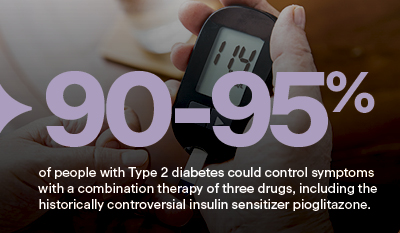
A combination therapy with three drugs, including the historically controversial insulin sensitizer pioglitazone, could control symptoms in about 90-95% of people with Type 2 diabetes. DeFronzo said a glucagon-like peptide 1 receptor agonist (GLP-1 RA) will correct six of the disturbances present in Type 2 diabetes individuals, sodium-glucose co-transporter 2 (SGLT2) inhibitor treatment corrects three of the metabolic abnormalities, and pioglitazone fixes four of the problems with some overlap with the GLP-1 RAs and SGLT2i.
“For the first time in 2024, the American Diabetes Association recognized combination therapy for treating Type 2 diabetes. You should no longer think about using a single drug. There are at least eight pathophysiologic problems, and one drug cannot correct eight problems,” he said.
History of pioglitazone
Pioglitazone is a pentacycline in a class of drugs called thiazolidinediones. Thiazolidinediones were originally developed as a potential cancer treatment, but early studies showed that the drug was more effective as an anti-inflammatory agent that lowered blood sugar levels by acting as a powerful insulin sensitizer.
The thiazolidinedione class has three main drugs — troglitazone, rosiglitazone and pioglitazone. These drugs activate the peroxisome proliferatoractivated receptors, which regulate how the body metabolizes lipids, and thus are theoretically good targets for treatment of Type 2 diabetes.
The first of these drugs tested for Type 2 diabetes and cardiovascular benefits of this “wonder drug” outweigh the risks and the side effects can be easily addressed with combination therapy, he added.
“ For the first time in 2024, the American Diabetes Association recognized combination therapy for treating Type 2 diabetes. You should no longer think about using a single drug. There are at least eight pathophysiologic problems, and one drug cannot correct eight problems.”
– Ralph DeFronzo, MD, professor of medicine, chief of the Diabetes Division in the Joe R. and Teresa Lozano Long School of Medicine at The University of Texas at San Antonio and deputy director of the Texas Diabetes Institute
Understanding the science
Unlike other thiazolidinediones that may be harmful to the liver and heart, pioglitazone shows cardioprotective qualities. In one coronary atherosclerosis study, people treated with pioglitazone for 18 months showed a resolution in coronary artery plaque. Carotid intimamedia thickness, which provides a measure of cardiovascular disease progression, showed a clear regression, and pioglitazone-treated study participants had fewer incidents of heart attack, stroke and death.
While one potential side effect of pioglitazone is weight gain, DeFronzo said that rather than being a negative association, this shows the drug is working to mobilize fat to less harmful areas of the body. People with Type 2 diabetes often have an abundance of visceral (intra-abdominal) fat, as well as fat in and around the liver, heart, skeletal muscle, kidneys and other organs.
Visceral fat is more dangerous than subcutaneous fat, which is fat on the outer layers of the body just under the skin. Fat within muscle cells leads to insulin resistance, increasing blood glucose levels. Importantly, fat within beta cells — the pancreatic cells producing insulin — can lead to decreased insulin production.
“Fat in your beta cells can kill your beta cells. We showed that pioglitazone also moved fat out of the beta cells, and insulin secretion went up dramatically,” DeFronzo said.
While shifting fat from the liver, heart, muscle, kidneys and pancreatic beta cells to the superficial subcutaneous fat depots where it cannot cause harm does not increase weight, pioglitazone also activates peroxisome proliferatoractivated gamma receptors in the hypothalamus of the brain and sends a signal that the body needs to eat.
Thus, in DeFronzo’s study, as participants gained weight, there was a drop in glucose levels, improvement in insulin sensitivity, enhanced beta cell function, increases in “good” cholesterol (high-density lipoprotein), reduction in triglycerides and a drop in blood pressure.
“We know that the weight gain associated with overeating brings out [Type 2] diabetes, so pioglitazone got a bad reputation because of this. The fact is that the weight gain associated with pioglitazone use is a cosmetic issue and not a metabolic one,” DeFronzo said. However, “no one likes to gain weight,” he said. By combining pioglitazone with one of the newer drugs used to treat Type 2 diabetes, such a GLP-1 mimics like semaglutide or tirzapatide, the weight gain can be prevented.
Pioglitazone can also cause edema, or fluid retention, but DeFronzo said this is not a sign of heart failure. A 2017 study found that the drug improved insulin sensitivity in the heart by 75%, augmented insulin sensitivity in skeletal muscle tissue by 71% and increased both cardiac ejection fraction and coronary blood flow by more than 10%. When pioglitazone is taken, an enzyme called nitric oxide synthase increases nitric oxide formation, a powerful vasodilator and antiatherogenic molecule. As blood pressure drops from vasodilation, this leads to less blood flow to kidneys and causes the kidneys to hang on to salt, leading to edema.
Getting past the blockades
DeFronzo said combination therapy for Type 2 diabetes has the potential to replace insulin therapy for many people.
In a three-year study called the QATAR study, participants with Type 2 diabetes who took pioglitazone and exenatide — a GLP-1 incretin mimic — saw A1c levels drop from an average of 10 to 6.1 without hypoglycemia, or low blood glucose level. The control group, which received insulin therapy, had an average A1c of 7.2 at the end of the study, and many participants experienced hypoglycemia. In a subgroup of participants with an average A1c of 15 and who had lived with Type 2 diabetes for 15 years or more, the A1c dropped as well to 6.1, and they remained under control throughout the three-year trial.
In a separate six-year trial of 320 participants with Type 2 diabetes treated with pioglitazone, metformin — a diabetes drug used for blood glucose control — and exenatide, about 75% of participants achieved an A1c of less than 6.5, while 70% of the subjects receiving “standard” therapy of metformin, sulfonylurea and insulin failed to achieve an A1c of less than 6.5 after 6 years.
Pairing pioglitazone treatment with an SGLT2i can halt the weight gain and edema and have additional cardioprotective effects. One study showed that a combination of pioglitazone, SGLT2i and exenatide led to lower blood glucose levels, weight loss and no edema.
A treatment for pre-diabetes?
Recent San Antonio-based studies by DeFronzo showed that people with insulin resistance had a much higher chance of developing Type 2 diabetes and that this risk starts in childhood.
Children born to parents who both have Type 2 diabetes have about an 80% risk of developing Type 2 diabetes themselves. This proved true even in children who were not overweight and who had normal glucose levels. In one study, DeFronzo found that, by their teenage years, many of the children were already just as insulin resistant as their parents.
“When you give them a glucose load, their insulin levels are astronomical. At a very early age they are severely insulin resistant but not diabetic because of their hyperinsulinemic response,” DeFronzo said.
When insulin is released, it binds to the insulin receptor and activates an insulin-signaling cascade. This activation leads to glucose being transported into the cell, especially in the liver and muscles. Muscle-biopsies of the parents with Type 2 diabetes led to the discovery of dysregulation in the insulin-signaling pathway.
Pioglitazone works on this pathway and therefore was studied for its potential to prevent Type 2 diabetes. At the end of the three-year ACT NOW study, prediabetic individuals with insulin resistance who were treated with pioglitazone had a 72% reduction in the development of Type 2 diabetes compared to prediabetic individuals treated with a placebo.
“Before you develop diabetes — in the prediabetes stage — that is when you really need to treat. The disease starts before people have high blood glucose levels. We need to go back earlier to start treatment,” said DeFronzo. In a recent eight-year study, DeFronzo demonstrated that insulin-resistant individuals with normal glucose tolerance were at high risk for future diabetes and cardiovascular events such as heart attack and stroke.
The only true insulin sensitizer
Even with these phenomenal findings, DeFronzo said only 3% of patients with Type 2 diabetes in the United States are prescribed pioglitazone. He hopes that the use of combination therapies to control for the “ill-perceived side effects” like weight gain and edema may shine a light on this powerful insulin sensitizer. DeFronzo’s research team is currently working on a formulation that may allow pioglitazone to work without activating peroxisome proliferator-activated receptor gamma in the brain, thus avoiding a trigger for the hunger signal.
Also on the horizon is the possibility of an oral GLP-1 mimic that could be paired with pioglitazone or with their newly formulated thiazolidinedione drug. DeFronzo explained that the oral tirzepatide-like GLP-1 drug reduces total body fat, and the new thiazolidinedione formulation controls insulin resistance, leading to a synergistic effect in reducing heart attacks and stroke.
“With a tirzepatide-like molecule paired with an insulin sensitizer, you would have the best treatment for a diabetic patient in the world. This has enormous potential because the insulin resistance is what is causing the cardiovascular disease,” DeFronzo said.
While lowering blood glucose is essential to preventing damage to the kidneys, nerves, eyes and other organs, it is the underlying insulin resistance more so than the high blood glucose level that is causing the cardiovascular problems. While GLP-1s have gained attention in recent years for their ability to quickly reduce weight, their metabolic and cardiovascular benefits may be even more important.
“Obesity and overweight affect approximately 65% of the U.S. population and is a major healthcare problem in that it causes cardiovascular disease, diabetes, gallbladder disease, pancreatitis and is associated with cognitive dysfunction. We want you to lose weight, yes, but we also want to correct the basic genetic etiology of the insulin resistance, and that is why we need new drugs in the insulin-resistance field,” DeFronzo said.
“It is an exciting time for the treatment of diabetes and obesity, and there is an explosion of new drugs on the horizon. However, we should not forget about an old one, pioglitazone, that can be used in combination with these newer antidiabetic, anti-obesity medications.”