The incretin revolution

Two scientists share their reflections on a new era emerging for treatment of Type 2 diabetes and obesity
By Claire Kowalick
For people living with Type 2 diabetes and obesity, the dual challenge of controlling glucose metabolism and body weight can be challenging with previous treatments. Newly formulated drugs that mimic members of the incretin family, such as the glucagon-like peptide-1 receptor agonists (GLP-1 RAs), are changing how we think about metabolic disease.
“These drugs work by regulating how the body manages glucose, and their impact has been transformational,” said Peng Zhao, PhD, an assistant professor in the Department of Biochemistry and Structural Biology at the Joe R. and Teresa Lozano Long School of Medicine at The University of Texas at San Antonio’s Health Science Center.
What are incretin-based drugs?
Incretin-based drugs have been around for about two decades and include peptides that mimic the body’s natural incretin hormones, particularly GLP-1 drugs, which stimulate insulin production in response to food intake. Because the peptides break down quickly in the body, these drugs require subcutaneous injection and cannot yet be formulated as pills.
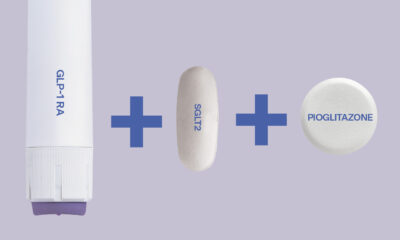
The earliest versions of GLP-1 RAs had short half-lives and required daily injections. Over time, pharmaceutical researchers extended the action of these drugs, now allowing for weekly dosing. Combining them with drugs like DPP-4 inhibitors, which block the breakdown of the body’s natural GLP-1, further enhanced their effect.
Explosion of interest in new formulas
Interest in these drugs has exploded recently due to dual incretin family agonists like tirzepatide, which activate both GLP-1 and gastric inhibitory polypeptide (GIP) receptors. In clinical studies, these incretin-based drugs have demonstrated weight loss of up to 20% of total body weight, marking a dramatic improvement over earlier formulations.
“This is important because weight loss has a much more sustained metabolic benefit than blood glucose reduction alone,” said Zhao.
The next generation of treatment may go even further, with triple agonist, or triagonist, drugs currently in phase 2 clinical trials that simultaneously target GLP-1, GIP and glucagon receptors. Each incretin pathway has limitations, but combination treatments may offer a more balanced metabolic effect, particularly in reducing ectopic lipid accumulation — fat stored around internal organs — which is a key driver of metabolic dysfunction.
The ultimate goal of scientists developing these drugs is to make an oral version that mimics multiple incretin family hormones. Several such drugs are in clinical trials.
Challenges remain for ‘miracle’ drugs
The prohibitive cost is a main deterrent to these newer GLP-1 RAs. Without insurance, these drugs can run as high as $1,000 per month, although some manufacturers offer direct-to-patient discounts of over 60%. Side effects during early treatment, such as nausea and vomiting, can be bothersome and cause some patients to abandon treatment. Recently, reports have also emerged about the potential links between GLP-1 RAs and rare thyroid cancers and pancreatic complications. Safety studies are still needed to investigate the long-term effects of continued use of these drugs.
Zhao’s lab is currently investigating how these treatments affect broader metabolic pathways such as adenosine monophosphate -activated protein kinase (AMPK), a critical regulator of energy balance that is often repressed in obesity and fatty liver disease.
“GLP-1 RAs seem to have an indirect but strong influence on AMPK activity,” Zhao said. “We are using molecular tools to explore how these treatments shift the entire gene expression profile related to energy metabolism and liver health.”
“GLP-1 receptor agonists are among the most revolutionary therapies in the treatment of obesity.”
– Shangang Zhao, PhD, assistant professor in the Department of Medicine
When the wonders cease
What happens when people stop taking GLP-1 RA drugs, and can we make their effects last? These are the questions Shangang Zhao, PhD, assistant professor in the university’s Department of Medicine, studies in his lab in what may be one of the most critical frontiers in obesity research.
“GLP-1 receptor agonists are among the most revolutionary therapies in the treatment of obesity,” Zhao said. “But they are not the final solution.”
Zhao’s recent studies explore how these drugs work far beyond their known ability to suppress appetite. In a mouse model, he observed that one of the most dramatic effects occurs almost immediately and happens not in the gut, but in the brain.
“In the first day after taking a GLP-1 RA drug, even before losing any fat, we saw a major reduction in leptin levels,” Zhao said.
‘Less is more’ when it comes to leptin
Leptin, a hormone produced by adipocytes, or fat cells, was once thought to be the key to curing obesity after its discovery in the 1990s. Scientists initially believed increasing leptin levels could suppress appetite and reverse weight gain. However, leptin is already elevated in people with obesity, sometimes as much as 10 times higher than in people without obesity.
Zhao said it appears that, instead of needing more leptin, the body becomes desensitized to the hormone. He suggests that part of the success of GLP-1 RAs comes from their ability to reduce leptin in the body, potentially by as much as 70% to 80%. He said this reduction could account for as much as half of the total effect of GLP-1 RA drugs.
“Less is more,” Zhao said. “In several disease models, including obesity and aging, partial reduction of leptin improves glucose tolerance, reduces liver fibrosis and extends metabolic health.”
Diminishing returns due to adaptation
However, once the drug is stopped, weight is rapidly regained, and mainly as fat. Zhao’s studies show that while initial use of a GLP-1 RA drug might reduce body weight by up to 20%, stopping and then restarting the drug later leads to diminishing returns. During his research, subjects lost only 15% of the weight on a second round of treatment and 13% to 14% on the third round. On top of this, weight loss included fat and muscle, but the weight regained was only fat.
“This is the body adapting,” he said. “It has mechanisms to preserve a set intake over time. If you eat 4,000 fewer calories during treatment, your brain tries to recover that exact amount once you stop.”
The side effects also intensify with repeated use. Mice that tolerated the drug at first became increasingly intolerant on subsequent rounds, with more mice in each group developing severe food aversion.
Zhao’s lab is now investigating how to make the beneficial effects of GLP-1 RA drugs more permanent. One approach could involve combining leptin-sensitizing agents with GLP-1 RAs to amplify effects while minimizing side effects. Another might target drug tolerance and help preserve lean muscle, which is typically lost during weight reduction.
While current GLP-1 RA drugs like semaglutide and tirzepatide are powerful, their impact varies widely across patients. Some individuals experience dramatic weight loss, while others experience little to none, even at higher doses.
“We need to understand why,” Zhao said. “The future lies in personalized treatments through biomarkers, different drug combinations and possibly even ways to extend the benefits of the drugs after stopping them.”
Despite their success, GLP-1 RA drugs are not the end of the story for obesity research but merely the beginning of a much longer conversation. As researchers push forward with trials of oral versions and triple-action drugs, what is evident, Zhao noted, is that these therapies are one of the most promising medical breakthroughs to date in managing the parallel epidemics of obesity and Type 2 diabetes.