
How one man’s resolve shaped San Antonio’s health and history
Pat Ireland Nixon didn’t go out of his way to stir up trouble. He simply followed his moral compass.
It was that compass that led a shy, sickly country boy down a path that would help change the course of San Antonio’s future.
Raised in Texas’ Guadalupe County, Nixon would later become one of San Antonio’s strongest advocates for responsible public health and leave an enduring educational legacy through the Bexar County Medical Library Association, which he founded to preserve older medical books for future generations. Today, many of the collection’s rarest books — with the oldest dating back to the 15th century — are housed at the P.I. Nixon Medical Historical Library at The University of Texas at San Antonio’s Health Science Center.
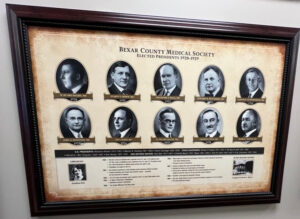
“Dr. Pat Ireland Nixon was far more than an accomplished physician,” said Melody Newsom, CEO and executive director of the Bexar County Medical Society, an organization Nixon helmed in the 1926. “He was a historian, author, collector and visionary who understood that preserving the past strengthens the future. His passion for medicine, literature and Texas history profoundly influenced both the medical profession and the documentation of healthcare in our state.”
Nixon’s character and sense of purpose were shaped by his childhood and later, mentors at Johns Hopkins University School of Medicine. Those influences would guide him toward a life’s work that helped shape San Antonio’s public health and preserve its medical history.
From open fields to city streets
Born on Nov. 29, 1883, in Old Nixon, Texas, a small community about 50 miles southeast of San Antonio, Pat Ireland Nixon was named after a man his father respected, then-Texas Gov. John Ireland.
Interestingly, The University of Texas at Austin opened its doors during Gov. John Ireland’s administration, the same year Nixon was born and decades later, the governor’s namesake would walk the university’s halls as a student.
One of more than a dozen children, the youngster grew up in a household where honesty, strength of character, integrity and hard work were valued.
His early years unfolded amid a carefree country life, where days were often spent hunting, fishing and exploring the outdoors. But when his family moved about six miles north to Luling, Texas, the transition to town life was fraught with some obstacles for the 12-year-old. A long bout with typhoid fever, followed by his father’s unexpected death in 1897, deepened the difficulty. Still, Nixon gradually found his footing, according to his autobiography, Pat Nixon of Texas.
Among the steady influences in his life was his older half-brother, James Wesley Nixon, MD, whose example left a lasting impression. He emphasized frugality and hard work and helped awaken in Nixon a desire to follow him into the field of medicine.
Nixon did well in his studies. While seeking his bachelor’s degree at The University of Texas at Austin, he met his future wife, Olive Gray Read of Mineola, Texas, at a church social.
After graduating, Nixon attended Johns Hopkins University School of Medicine in Baltimore. There, Canadian physician, Sir William Osler, MD, one of the “Big Four” founding professors at the school, sparked his affinity for historical texts and the collection of rare medical books.
“[Dr. Osler’s] love for literature and history was highly contagious,” Nixon stated in his autobiography. “Anything which I may have achieved along the line of medical history is traceable directly to the influence of Dr. Osler.”
While in Baltimore, Nixon remained in continual communication with Read. Through letters, the couple kept their relationship alive, understanding that their engagement would be a long one. Together, they looked forward to their future in San Antonio, a city growing into a major metropolitan center.
On Oct. 1, 1911, Nixon “timidly opened” his San Antonio practice. The next year, the couple married and later had four sons: Pat I. Nixon Jr., Robert Read Nixon, and twins Benjamin Oliver and Thomas Andrews Nixon.
‘A festering sore on the face of San Antonio’
Nixon was a humble and principled man, but as a caring doctor and citizen, he couldn’t ignore the unacceptable state of public health in the Alamo City and advocated for better conditions.
Not only were ailments like infant diarrhea and syphilis widespread, but for decades, San Antonio had “the highest tuberculosis mortality rate of any city of the country and the condition was accepted as normal,” Nixon stated in his autobiography.
In 1928, Nixon gladly accepted an appointment to the San Antonio Board of Health and would continue to serve on local health boards for the next two decades. During his time on the health boards, he pressed for stronger public health protections but faced some political headwinds.
By 1938, Nixon became more vocal about the city’s dire public health conditions, providing a raw description of the West Side “as a festering sore on the face of San Antonio,” a portrayal included in the Feb. 25, 1938, edition of the San Antonio Light, according to Nixon’s autobiography.
He also voiced his concerns at rallies and over radio broadcasts. Eventually, his advocacy, alongside the efforts of others, helped spur the city’s eventual shift to a council-manager form of government and perhaps most meaningful to Nixon as a physician, contributed to a decline in the city’s high incidence of disease.
Preserving the past, inspiring the future
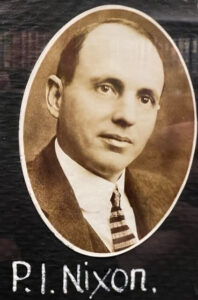
Recognized for his skill and dedication as a general practitioner and surgeon, Nixon’s legacy reached far beyond the practice of medicine, extending into the cultural and intellectual life of Texas. He was elected president of the Bexar County Medical Society in 1926 — an organization providing advocacy, professional support and leadership development for physicians.
A noted author of Texas history and the state’s medical history, including a book on the history of the Texas Medical Association, he helped found the San Antonio Historical Society in 1939, later serving two terms as its president. His reputation as a thoughtful historian grew through his leadership with the Texas State Historical Association, where he became known as one of the organization’s most effective presidents.
Across civic, scholarly and professional circles, Nixon’s influence was reflected in his service as president of the Philosophical Society of Texas in 1946 and the Texas Surgical Society in 1956.
Library collection keeps medical history within reach
In 1919, Nixon was instrumental in founding the Bexar County Medical Library Association, the charitable foundation affiliated with the Bexar County Medical Society, becoming its chairman a year later, according to his autobiography.
“Dr. Nixon recognized that today’s medical achievements become tomorrow’s history,” Newsom said. “Without his dedication to documenting the evolution of medicine in San Antonio, the development of the Texas Medical Association and the contributions of countless physicians, much of that history might have been lost. His legacy continues through the preservation of historical collections, the ongoing work of the medical library association, and the researchers, students, physicians and historians who continue to study and learn from these invaluable resources.”
The library’s holdings and collection of rare medical books increased with book donations and purchases with the association’s funds. Many of the books were acquired with income from the sale of Nixon’s books.
In 1961, the medical society constructed a larger building to accommodate its expanding library. As the association’s rare books grew in value and significance, protecting them from fire and theft became increasingly important.
When the library at the university offered to house the books, the medical society donated about 2,000 volumes from the collection to the university in 1970 and a special rare medical books library was established within the larger library. In 1983, a new library opened on the university’s campus and the P.I. Nixon Medical Historical Library was housed on its fifth floor in honor of Nixon’s diligent efforts to build the collection.
Today, the library has amassed a collection of over 6,000 volumes of rare books. The collection is particularly rich in the fields of ophthalmology, surgery and anatomy.
A legacy that earned lasting admiration
Nixon’s dedication to medicine, history and public service earned admiration from colleagues, scholars and civic leaders alike.
During a celebration for his 75th birthday in 1958 — the same year the UT System celebrated 75 years in existence — Harry Ransom, who would later serve as the UT System’s chancellor from 1961–67, provided a tribute honoring Nixon. “Texas medicine, and all the rest of us, are indebted to [Pat Ireland Nixon] for more than impressive history; we are indebted to him for humanity, for the grace of memory and the power of insight and the promise of vision,” Ransom stated, according to Nixon’s autobiography.
For half a century, Nixon helped shape the practice of medicine in San Antonio, diligently caring for his patients, affably working with colleagues and civically engaged in the welfare of his community. As he later reflected on the enduring ideals of medicine, he emphasized the importance of preserving public trust and never taking that confidence for granted.
“I have tried to make my contribution toward increasing the goodwill and confidence of the people in doctors,” he stated. “The people believe in us. We must not fail them.”
Nixon died on Nov. 18, 1965, 11 days before his 82nd birthday. In his commitment to helping others, he raised awareness and helped bring about better public health conditions in San Antonio, and through his love of books, he created a legacy for medical history, preserving the knowledge and ideals that continue to connect generations of physicians and learners to the profession’s past.
Learn more about the P.I. Nixon Medical Historical Library.