
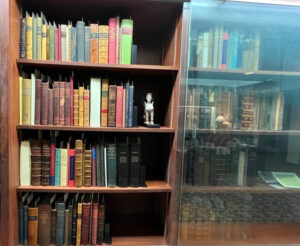
On the fifth floor of the Dolph Briscoe Jr. Library at The University of Texas at San Antonio’s Health Science Center, more than 6,000 rare medical books and artifacts line the shelves and rest behind glass, filling a small but remarkable library with the weight and wonder of medical history. The extraordinary collection offers visitors a tangible portal into centuries of discovery, and a firsthand reminder of how the past continues to shape medical education today.
Named for prominent San Antonio physician, historian and rare book collector Pat Ireland Nixon, MD, the P.I. Nixon Medical Historical Library reflects the physician’s lifelong devotion to preserving the stories, ideas and debates that shaped medicine. With the oldest book dating back to the 15th century, the collection invites visitors to trace the evolution of medical thought and practice, from once-accepted beliefs to the breakthroughs that redefined the field.
“This special library provides access to original and often rare primary sources,” said Diane Fotinos, senior curator for special collections and archives at the P.I. Nixon Medical Historical Library. “There is something uniquely meaningful about viewing these materials in person. Each volume or artifact preserves not only what people knew, but how they thought, questioned and cared for one another in their own time. Encountering these works firsthand creates a tangible connection to the people and ideas that shaped history — an experience that cannot be fully replicated in a digital environment.”
Where medical history comes to life
Nixon’s legacy of preservation has made the library more than a repository of rare texts; it has become a living resource for teaching, connecting today’s students with the physicians, anatomists and thinkers whose work helped shape modern medicine.
For faculty members like Laura Johnson, PhD, clinical associate professor in the Department of Cell System and Anatomy, the library offers a way to bring history off the page and into students’ hands.
As part of her anatomy course for master’s students, she discusses body donation and ethics and brings learners to the library to get a firsthand look at centuries-old texts to bring medical history to life.
“To have a resource like this is simply unparalleled because I have the opportunity to show students the real thing,” Johnson said. “I’m giving them this background. I’m giving this history. ‘Here’s the actual book that someone put together.’ It humanizes it for the student because it forces them to understand it’s not this theoretical concept, but that somebody had to innovate … and it was just a regular flesh and blood person, just like you and me.”
Johnson hopes that seeing these texts firsthand will empower her students to recognize their place in the legacy of learning and, like those who came before them, to see themselves as the medical pioneers of the future.
Kaitlyn Turner was among the students who visited the library while taking Johnson’s anatomy course, where centuries-old texts brought the history of anatomy into sharper focus.
“[The library visit] gave a ton of context to my own learning and it’s a great way to connect to this field in a way that’s different than what you’re experiencing in a classroom or in a clinical setting,” Turner said.
That kind of reflection is exactly what the library has inspired across generations of learners. In addition to Johnson, other faculty members have recognized the library’s power to deepen students’ understanding of the field by placing centuries of medical discovery directly before them.
For many years before retiring in 2017, Charleen Moore, PhD, professor emerita, Department of Cell Systems and Anatomy, taught the history of anatomy among other courses, taking her students to the historical library during their final class to see, touch and personally experience the books they discussed over the semester.
“To me, taking the students [to the library], showing them the history of medicine right in front of their eyes and looking at the books and reading some of the stories of the early physicians … I think just brings out the humanity as well as the skills developed over the centuries.”
Moore recalls her students being particularly excited about seeing Robert Hooke’s 1667 edition of Micrographia, a classic text that includes the first scientific observations made through a microscope.
Hooke first used the word “cell” in a biological sense to describe the microscopic structures he saw in the thick, spongy bark of a cork tree, the first time that cells were ever noticed, Moore said. “He realized these little cells helped explain the way cork could float and could be compressed as in our use of cork in sealing wine bottles,” she said, adding that her students really enjoyed that day with all the exceptional books at the library.
History unfolding before the eyes
On Johnson’s initial visit to the library, she was especially enthusiastic about seeing the rare first edition of Flemish physician Andreas Vesalius’ De humani corporis fabrica libri septem (On the Fabric of the Human Body in Seven Books). The groundbreaking book, published in 1543, helped advance the field of human anatomy.
“It’s so special to have the real … first edition Vesalius,” she said. “I’ve even taken visiting speakers who are anatomists from other institutions up there and they’re like, ‘whoa, I’ve never seen [a first edition] before.’”
Considered the crown jewel of the library’s collections, Vesalius’ book is among the most important in Western medicine. It marked a departure from the prevailing anatomical theory advanced by ancient Greek physician Claudius Galen, who relied on animal dissections because human dissections were prohibited during his lifetime. In 1939, Nixon was fortunate to purchase this first edition from Yale University for $765, according to his 1979 autobiography, Pat Nixon of Texas.
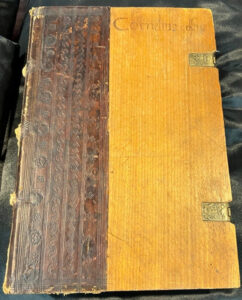
While Vesalius’ work stands out for its transformative impact on anatomical science, it’s one of many volumes in the Nixon Library that traces medicine’s long and layered evolution. The collection reaches even further back in time, with a second edition of De Medicina, published in 1481.
Authored by first century Roman medical scholar and author Aulus Cornelius Celsus, the wood-bound book is the oldest in the library’s collection and is believed to be the only remaining portion of a much larger encyclopedia by Celsus. Its text preserves medical and surgical knowledge from the ancient world and is considered the first complete medical work to survive after the Hippocratic writings.
In addition to books, the library also houses historic artifacts that harken back to the early days of medicine with medical instruments like the scarificator, a surgical instrument used in the 18th and 19th centuries to draw blood; a Civil War-era amputation kit; and trepanning hand drills with ridged, serrated ends to relieve pressure or bleeding in the brain.
With a book collection especially strong in ophthalmology, surgery and anatomy, the library welcomes about 100 visitors a year by appointment, including visitors from across the globe.
“You have scholars coming from all over the world that will want to use those books,” Moore said.
For Anand Karnad, MD, division chief for hematology and medical oncology, the campus is privileged to have this rare collection of historical texts. The professor of medicine thinks so highly of the library, he introduces it to internal medicine residents who take his two-week elective on the history of medicine to broaden their knowledge and exposure to the subject.
“It’s important because not all medical schools have this precious resource,” Karnad said.
“In my view at least, it is so important for medical students, certainly residents in training and fellows who are further along in their training, to have access to at least a fundamental knowledge of where we were once and from whence our knowledge came. The ability to … actually see, touch and feel manuscripts and artifacts from the late 1600s, 1700s and beyond, is … eye-opening and quite an inspiring thing to do.
“Also, the ability to learn from the giants in medicine and surgery … [and] to actually have access to their writings and to memorabilia is quite inspiring,” Karnad said.
Karnad has also served as president of the Friends of the P.I. Nixon Medical Historical Library — a group that fosters education and supports and participates in the History of Medicine Virtual Lecture Series each spring and fall. Recordings of past lectures are available in the library’s digital archive.
The group’s discussions have explored topics ranging from transplant surgery and aspects of obstetrics to the history of medicine as depicted in historic paintings like the first operation under ether and “The Gross Clinic,” Thomas Eakins’ famous 1875 painting of pioneering surgeon Samuel D. Gross, MD, demonstrating an operation while lecturing to medical students at Jefferson Medical College in Philadelphia.
The talks have also featured works related to Sir William Osler, MD, the Canadian physician who revolutionized the study of medicine and who was among the “Big Four” founding professors of Johns Hopkins University School of Medicine. It was Osler’s love for collecting historical medical books that inspired Johns Hopkins medical student Pat Ireland Nixon to start collecting books, ultimately leading him to create a medical library in San Antonio.
A medical library is born
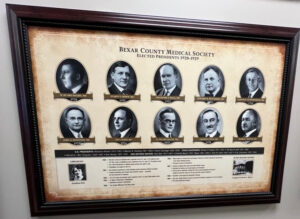
Long before the creation of the P.I. Nixon Medical Historical Library, Nixon founded the Bexar County Medical Library Association, the charitable foundation affiliated with the Bexar County Medical Society. Founded in 1919, the medical library association’s collection of rare books has been stewarded through the longstanding partnership between the medical society and the medical library association, said Melody Newsom, CEO and executive director of the Bexar County Medical Society.
“Together, [the library association] and [the medical society] have worked to preserve these important resources while ensuring they continue to educate physicians, historians and future generations about the rich history of medicine in San Antonio and Texas,” Newsom said.
In 1970, the medical society donated about 2,000 of the library association’s oldest and rarest volumes to the university to ensure the collection’s long-term preservation and accessibility for scholarly research, Newsom said.
The donated books were initially available in a room set aside for the rare book collection at the Health Science Center’s original library, which had been built in 1968. That space was officially named the Pat Ireland Nixon History of Medicine Room. At that time, the campus served 400 students, according to the September 1994 article Computer Methods and Programs in Biomedicine volume 44, issues 3-4, by Viginia Bowden who served as library director at the Health Science Center from 1985 to 2003.
As more schools were built on campus, there was a growing need for a larger library and in 1979, the Texas legislature authorized $9.5 million for a new library building that would be “designed to be the showplace of the campus — the jewel on the crown of the Health Science Center,” according to Bowden’s article published by Elsevier Science Ireland Ltd.
The new library opened in 1983 and housed the P.I. Nixon Medical Historical Library on the fifth floor, according to Bowden’s article.
The main library was later named after Dolph Briscoe Jr., who had served as Texas governor from 1973–79.
Over the years, the medical library’s collection has grown to 6,000 volumes through strategic purchases, donations and acquisitions funded through the Friends of the P.I. Nixon Medical Historical Library board, Fotinos stated.
The library also houses the university’s archives, with materials dating to the 1940s, before the university opened, including documentation on military discussions about the land and the need for an institution of this kind.
The archives have been accessed by many, particularly staff seeking photos and information for anniversary-related projects, Fotinos said.
The quiet art of preserving history
Since the P.I. Nixon Medical Historical Library’s inception, special collections librarians like Fotinos have carefully preserved its rare books and artifacts, providing the same meticulous stewardship a museum conservator would devote to safeguarding treasured texts and historical objects.
That scrupulous care extends to the room itself, which is kept dimly lit and carefully maintained at 65 degrees with 45% relative humidity to help protect the collection. When visitors view the older works, delicate pillows provide an added cushion of protection.
“It really gives you a sense of honor and wonder and majesty [that these texts and artifacts] are still intact after centuries,” Johnson said.
The special care and devotion shown in preserving the collection has not gone unnoticed by faculty members, who have expressed gratitude to the library’s staff for their dedicated stewardship of the collection, support of medical history presentations, facilitation of tours and commitment to the meticulous preservation of the library’s contents.
“I think they do very quiet, heroic work in preserving and maintaining the manuscripts there, in taking care of that space,” Karnad said.
That behind-the-scenes stewardship helps scholars connect the history of medicine with their own medical education, adding depth and context to what they learn today.
“We need people who are trained in books and libraries to be our curators of that knowledge,” Johnson said. “I can’t tell you the number of times that the librarians have helped me with my research and I am so grateful for their generosity and love of knowledge and breadth of knowledge. They’re so important to what we do as academics.”
The P.I. Nixon Medical Historical Library is open Monday through Friday, from 10 a.m. to 4 p.m. To make an appointment for a library visit, please email specialcollections@uthscsa.edu. To learn more about Nixon and his passion for preserving medical history, click here.