
Splish, splash
At Morgan’s Inspiration Island water park, high-tech, air-powered waterproof wheelchairs provide a place for people of all abilities to play. It is the only water park that offers these innovative wheelchair designs for users.
The 80-pound wheelchair designs are easy to modify and run on compressed air—perfect for mobility and easy use in the wet environment. The water park is a part of Morgan’s Wonderland in San Antonio, an ultra-accessible amusement park built to accommodate people with special needs.
“Mobility has always been my passion,” said Ana Allegretti, Ph.D., OTR, assistant professor of occupational therapy.
Before the waterpark opened in 2017, Dr. Allegretti and her occupational therapy students helped train park employees and volunteers on making adjustments to the three types of waterproof wheelchairs, which include rigid models for those who can propel themselves independently, a reclining style and pneumatic chairs powered by compressed air. The wheelchair valets learn how to seat guests and use accessories properly; each model can be modified to fit any accessories necessary to meet the guests’ needs.
The partnership between the School of Health Professions and the park has continued, and Dr. Allegretti offers training for the wheelchair valets and volunteers for the water park prior to the opening of each summer season.
Dr. Allegretti was recently selected as a Wall of Fame honoree at the park in recognition of her work enabling mobility.
“This is not just a water park that everybody can come to," she said. "It is so much more. The social interactions that happen are just beautiful.”

Ready, set, Go Baby Go!
On a recent Saturday afternoon, the hallways of San Antonio’s Children’s Rehabilitation Institute (CRIT) temporarily took on the look of a mini racetrack. The cheers coming from the spectators could have come from a racetrack, too, as parents and volunteers clapped, cheered and encouraged the young drivers. Bright red and shiny blue battery-powered toy cars zoomed around corners as their drivers mastered the course.
All the children behind the wheels of the toy cars were under the age of 5, none able to move independently. The little cars give a new sense of movement to children who can’t easily get around because of mobility impairments.
“My daughter can’t bear weight on her legs,” said Carlos Sanchez, father of 2-year-old Emery Lynn. “This car is going to help her get around more and gain a sense of independence.”
The fun she is likely to have in the car is a big bonus, too.
“Just to see the smile on her face is amazing,” added Sanchez.
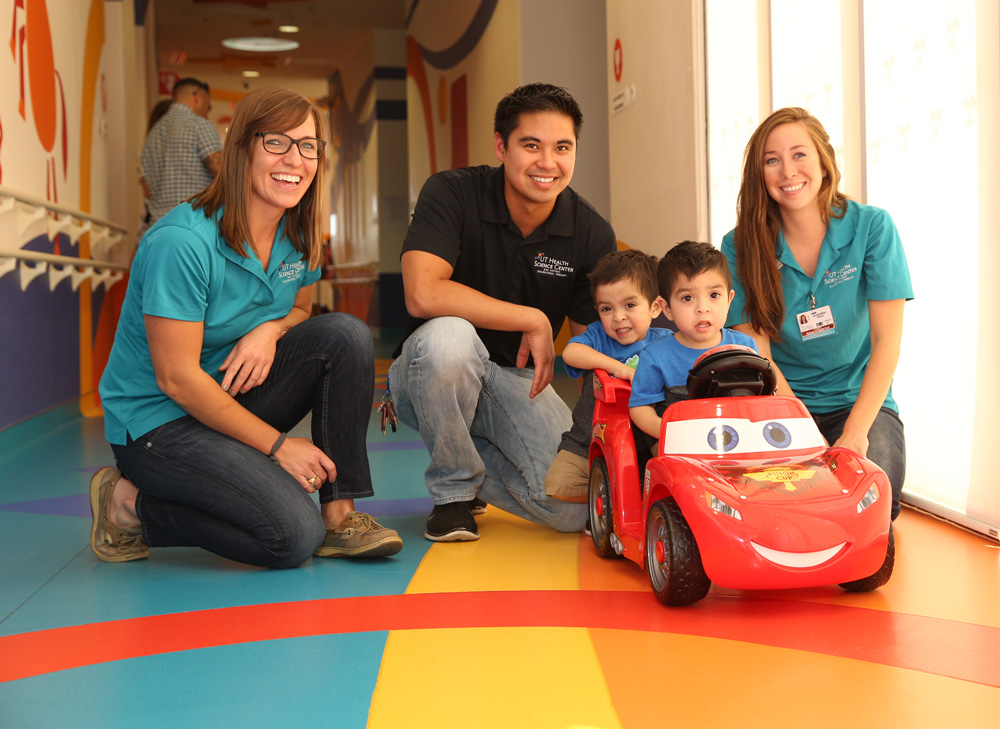
Emery Lynn and several other children are participating in Go Baby Go, a community-based research and outreach program that modifies off-the-shelf, plastic toy cars for children with conditions such as cerebral palsy, spina bifida, Down syndrome or muscular dystrophy.
“For many children, this is their first experience moving independently without being pushed in a stroller or carried by a parent,” said Ana Allegretti, Ph.D., OTR, ATP, assistant professor of occupational therapy at UT Health San Antonio.
Go Baby Go was created in 2006 by Cole Galloway, Ph.D., PT, professor of physical therapy and infant behavior specialist at the University of Delaware. The group’s mission is to get nonambulatory children on the move to help with crucial development skills like hand-eye coordination, spatial awareness, communication and cognition.
“Independent mobility for young children is very important,” said Dr. Allegretti. “They learn by exploring their environment—they scoot, crawl, walk, reach for toys, interact and talk with other children. They are constantly learning by simply moving around.”
After attending a Go Baby Go workshop in Nashville, Tennessee, Dr. Allegretti was inspired to bring the program to San Antonio. In 2015, she partnered with the Children’s Rehabilitation Institute, a pediatric rehabilitation center, to start the local chapter.
With a team of medical specialists from CRIT, Dr. Allegretti and occupational therapy students from UT Health San Antonio host workshops to teach others how to transform toy cars into a low-tech, low-cost source of power mobility.
Basic modifications are made to the seating area of each car using pool noodles, PVC pipes and kickboards to meet each child’s specific posture and stability needs. A large, red on/off button is added to the steering wheel and is used instead of pedal accelerators.
Azalya Hernandez, second-year occupational therapy student, said it just takes some creativity to adapt the cars to fit the needs of each child.
“As occupational therapists, we strive to help our clients achieve their best occupational performance through the use of their own environment,” Hernandez said. “For kids, their occupation is to play, learn, explore and be social.”
Costing around $500 each and paid for through an internal seed grant, each car takes about an afternoon to customize. The modified toy cars are a smaller and cheaper alternative to power wheelchairs, which can often cost several thousand dollars.
The toy cars are not medical devices, but are a way to make basic power mobility accessible to children who need it the most. Families who participate in Go Baby Go workshops can take the cars home free of charge. The team has purchased, modified and given away 20 cars to date.
In addition to hosting build workshops, Dr. Allegretti and her team are conducting research to measure the effectiveness and therapeutic benefits of the adapted toy cars.
“We are looking to see how the ride-on toy car influences social, language and motor skills in the children and will assess the improvements using standardized tests such as the Peabody Developmental Motor Scales and the Battelle Developmental Inventory, along with interviews with parents,” said Dr. Allegretti.
Recently, the team finished up a four-month study with their first cohort of 10 children. The results have been promising.
One family reported that their son’s head control improved after using the car for 30 minutes a day in addition to occupational and physical therapy.
“Her son loved being in the car and in order to drive the car, he has to keep his head up,” Dr. Allegretti said. “Now, his head and neck control has improved, he is eating solid food. His first word was car—he just loves it.”
Another family reported that they have seen a significant increase in their daughter’s self-esteem since she received her car.
“It is very rewarding to see a child go from waiting for others to ask them to play to initiating play with their peers,” Dr. Allegretti added.
Because of Go Baby Go, Jacob Ledesma, a 3-year-old with cerebral palsy, now has a way to keep up with his twin brother, John.
“For me, the car is about Jacob playing and feeling normal,” said John Ledesma, father of the twin boys. “It will help him feel like he is part of the group instead of behind it.”
Cynthia Ledesma, Jacob’s mother, added she is looking forward to seeing her son work on fine motor skills while using the car.
“He has some trouble with hand-eye coordination so I can’t wait to see him learn to use the buckle, get in and out of the car and begin to correlate that when he pushes the button, the car will turn,” she said.
The goal of Go Baby Go is to reach as many children with limited mobility as possible. Videos are posted on YouTube by Dr. Galloway’s team and instructions on how to adapt toy cars are available online. More than 40 chapters in the United States and abroad host workshops for families, teachers, clinicians and community members.
Brian Zita, a second-year occupational therapy student, believes the project is truly making a difference.
“Go Baby Go gives children a means to participate in many purposeful activities they wouldn’t otherwise be able to do without wheeled mobility,” Zita said. “The children aren’t seen as a ‘child in a wheelchair’ but as a child with a really cool toy.”
Go Baby Go is just the first step in providing mobility and a way to let kids be kids, added Dr. Allegretti.
“Imagine if all kids with mobility impairments could get a Go Baby Go car—their lives would be changed because of this project,” she said.

Cancer-fighting boost
Researchers at the Cancer Therapy & Research Center were awarded more than $5 million in grants from the Cancer Prevention and Research Institute of Texas to help in projects ranging from examining the on/off switch of a cancer-fighting molecule to preventing liver cancer in a majority Hispanic South Texas population.
“I’m not surprised, but I’m delighted,” said CTRC Director Ian M. Thompson Jr., M.D. “These grants demonstrate the breadth and depth of our researchers’ talents at every level.”
More than $3 million will go toward a core facility grant for single cancer cell analysis. Tim Huang, Ph.D., professor and chairman of molecular medicine and deputy director of the CTRC, said the grant, announced in May, will allow the CTRC to acquire key pieces that will complete the services already offered by the core facility. Those services include isolating and studying single cancer cells from urine and saliva to develop non-invasive methods for detecting cancer.
“This will give cancer researchers from throughout the region and beyond access to the latest analytical tools operated by a highly qualified technical team, helping them to develop new ways to diagnose, monitor and treat cancer,” he said.
Three CTRC researchers received $1.9 million to support their work in liver and colon cancer prevention and harnessing the body’s defenses to prevent recurrence of cancer.
The awards come on the heels of $6.6 million in research and product development grants given to researchers by the state-funded agency in February. Those included $4.6 million to support researchers’ work ranging from reducing chemotherapy’s painful side effects to unmasking resveratrol’s potential in managing prostate cancer, and a $2 million product development grant to support a new brain cancer therapy’s transition from a research project to a viable treatment option.
The product development grant is for NanoTX Therapeutics, a company formed to accelerate clinical trials of a highly promising nanotechnology that inserts radioactive isotopes into tiny fat particles, allowing concentrated radiation treatment precisely in the tumor. The process allows doctors to give far higher doses of radiation than current technology while minimizing side effects to healthy tissue.The grant will also help the young company develop a management infrastructure and tackle the regulatory process involved in commercializing a new technology.
Taking it to heart
Researcher felt cancer firsthand
Nevertheless, that’s where he finds himself today, with a special focus on survivorship issues: specifically, the cardiac problems that can plague cancer survivors decades after a recovery.
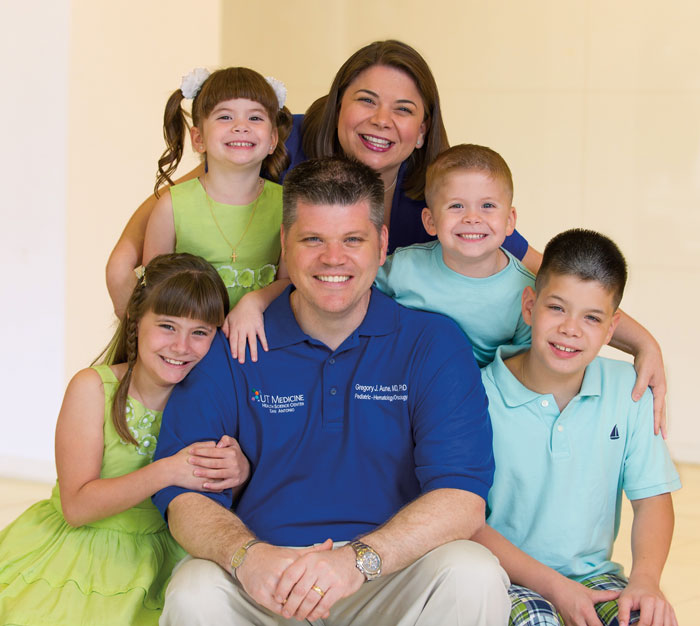
More than 20 years after the sports-loving high school kid was diagnosed with Hodgkin’s disease, Gregory Aune, M.D., Ph.D., is a pediatric oncologist in the Long School of Medicine at the UT Health Science Center San Antonio. He’s establishing a lab that approaches chemotherapy-induced heart problems from two perspectives: that of pediatric oncologist and laboratory cancer scientist. He is also the first graduate of the pediatric hematology-oncology fellowship made possible by the Greehey Pediatric Fellowship in Hematology Oncology endowment.
Things would have been different for Dr. Aune without that diagnosis. He might have gone into coaching or journalism instead of medicine. He would not have donated sperm in anticipation of the harsh cancer treatments that would destroy his fertility, and he would not have the two sets of twins who romp with him and his wife, neonatologist Christine Aune, M.D.
But as a 16-year-old he suffered through 10 months of chemotherapy, losing 80 pounds and a year of school. He developed severe abdominal pain from chemotherapy-induced paralytic ileus, a serious shutdown of his digestive system.
Dr. Aune says he behaved like many teenagers receiving cancer therapy and was not eager to talk about his symptoms. He waited a week to tell anybody about the abdominal pain. After that he had to receive his nutrition intravenously for several months.
So over time, as much as Dr. Aune had once wanted to get away from that environment, "all that toxicity got me thinking that there has to be a better way to do this."
It’s also given him a deeper understanding of what his young patients are going through, even when they try to keep it inside.
"I’m saying, ‘What’s going on in there? I know you’re not telling me stuff.’"
Dr. Aune focused on medical research throughout college, medical school, and graduate school. Later, when he gave a talk during his pediatric residency at Johns Hopkins on the health problems related to cancer survivorship, he was stunned at how many people approached him to say they hadn’t thought about those issues before. With 13 million adult and pediatric cancer survivors in the United States today and 20 million projected by 2022, both groups face significant and special health issues. To Dr. Aune it was obvious.
He continued his work, coming to the Health Science Center in 2008 to begin fellowship training in pediatric hematology-oncology. About that time he began to suffer from increasing exhaustion and shortness of breath. For a while he blamed his fatigue on the demands life puts on two busy physicians with four small children. Then he was diagnosed with critical aortic valve stenosis.
During the pre-surgical work-up to replace his aortic valve, his cardiologist insisted his coronary arteries would be clear because of his young age of 35. But with his knowledge of survivorship studies, Dr. Aune was not surprised to learn he also was suffering from severe coronary artery disease.
That life-threatening experience steered Dr. Aune’s research from experimental cancer therapeutics into an area of emerging importance - the basic science of cardiac disease in pediatric cancer survivors. But building momentum for this new area of research is challenging in a world focused on cures.
"The world of oncology and cancer research is set up to keep doing what it’s doing now, and what drives it is developing new medications to treat cancer," Dr. Aune said. "That has worked fantastically well in pediatric cancer - survival rates are so much higher now - but there needs to be some thought about the huge numbers of survivors.
"With a more basic understanding of how chemotherapy damages normal tissues such as the heart, we can begin to develop new medicines that protect vulnerable organs from the damage that results in late health effects in survivors."
Dr. Aune’s lab has developed a method to use advanced echocardiography to study the hearts of pediatric mice. He and his fellow researchers will use this as a tool to study cardiac function in mice that are given chemotherapy at a young age. "This is our model for the cardiac problems we see in childhood cancer survivors," he said.
It’s easy for Dr. Aune to talk about survivorship as a scientist and a physician. It’s harder to think about the health risks from a personal perspective. It would almost be better, he said, if he didn’t know.
"But I think it takes someone with that perspective to actually change how we practice."
Alumnus serves, saves in Boston attack

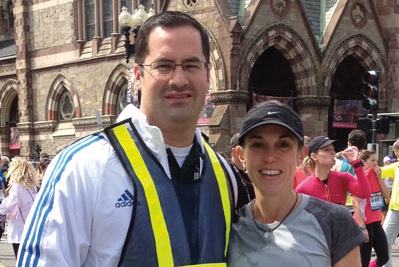
San Antonio cardiologist and UT Health Science Center alumnus Jorge A. Alvarez, M.D., and his wife, Rebecca, are avid runners. They enjoy the spirit and excitement of participating in various runs and marathons. Oftentimes Dr. Alvarez volunteers in a medical tent where he treats runners for minor aches and exhaustion while Rebecca runs.
But routine injuries and fatigue turned into life-threatening lacerations and catastrophe during the Boston Marathon April 15. That afternoon, Dr. Alvarez was stationed as a medical volunteer near the finish line and proudly greeted his wife when she crossed.
Twenty minutes later, their celebration turned to turmoil when a thunderous boom exploded nearby. Two bombs detonated near the finish line.
Instinctively, Dr. Alvarez, who was not hurt, rushed toward the scene - a ubiquitous fog of smoke and confusion. Blood and the wounded were scattered about. He immediately tended to the gravely injured while others hurried to offer help.
"I remembered the mantra ‘life over limb’ taught during clinicals in medical school," Dr. Alvarez said. "I used anything I could find - hoses, tubes and my belt - as tourniquets."
Authorities quickly cleared and secured the area. Dr. Alvarez was among the last to leave the scene as he helped move the wounded to a safe location nearby where he continued to attend to their injuries and waited for emergency responders to transport them to hospitals.
Later, Dr. Alvarez was tearfully reunited with his wife at a hotel nearby. She was unharmed.
Ultimately, dozens of lives were saved because of Dr. Alvarez’s quick and selfless response and the help of other volunteers.
"It’s what we are trained to do," he said. "The root of being human is compassion and that is what we are called to give."
Although his actions are considered heroic, Dr. Alvarez shies away from praise. "A hero wears a cape," he said. "I wear a white coat. The white coat means I’m here to help. I’m here to serve."
Natalie Gutierrez contributed to this story.

One day at a time
CTRC lifts spirits, nurtures patients
It’s 8 a.m., and the phone is quiet for now. Mary Jackson burrows into the annual "Surviving & Thriving" conference for cancer survivors.
She handles typical conference details: booking a site, planning activities and choosing speakers. But her job does not end there: She must anticipate the needs of patients with a range of cancers at various stages of illness and recovery.
"Some people who come to the conference are pretty sick," said Jackson, director of Patient & Family Services at the UT Health Science Center’s Cancer Therapy & Research Center. "So there are a lot of little details you have to think about."
That is what Patient & Family Services is all about: helping cancer patients and caregivers with nonmedical aspects of illness, whether by offering practical guidance or boosting spirits.
"There are so many things that go on in a cancer patient’s life, and every cancer patient is unique," Jackson said. "Patient & Family Services helps them get through all those complications and beyond."
"Surviving & Thriving" illustrates the office’s vital, and intensely personal, mission - cultivating strong bonds of mutual support among patients. Because that support is so important, Jackson seeks out funds to cover those who cannot afford to attend: "I try to take everybody."
Personal touch
Outside Jackson’s door, things are getting busy.
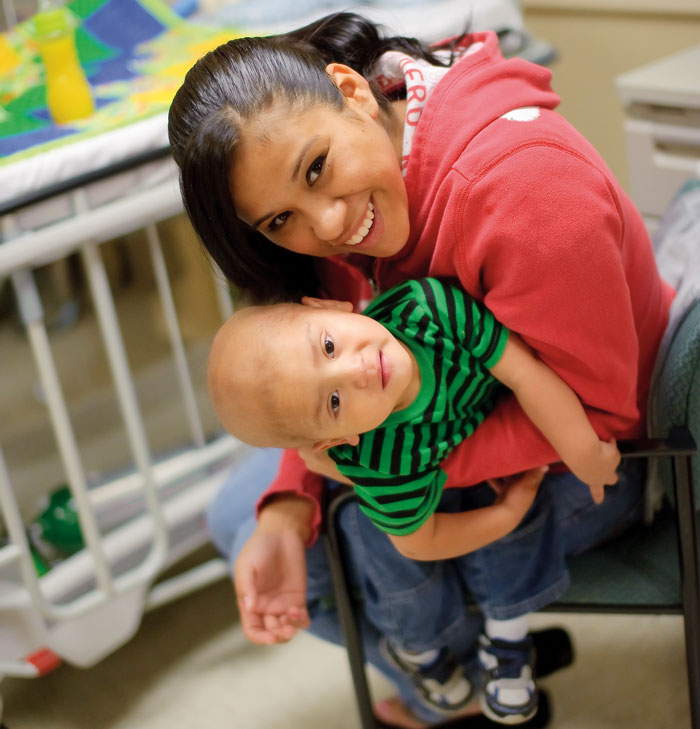
Upstairs in Radiation Oncology, 22-month-old Haistin Sky Garza wakes up after a leukemia treatment. It’s 8:30 a.m. His mother, Sierra, sits beside him with a clipboard, listing his favorite things. Lupita Martinez, the Patient & Family Services social worker, will send the list to the nonprofit Songs of Love Foundation, which creates personalized songs for seriously ill children.
The toddler opens his eyes and looks around in confusion. His mother enfolds him in her arms and returns to her list, which makes her laugh.
"He likes R&B — he does the fist pump," Garza said, mimicking the boy, who watched her with a smile spreading over his face.
"Write that down!" Martinez said.
In the Patient & Family Services office, phone calls are coming faster. Secretary Irma Contreras routes calls to the appropriate section: transportation services, nutrition, counseling, food pantry or social services. She may schedule an appointment with psychotherapist Tyler Burnett or ask Martinez to straighten out a Medicaid problem.

Logging miles, delivering hope
Outside the building at 9 a.m., George Longoria starts the CTRC’s 1999 Ford Escort, going to pick up a patient who cannot drive to radiation treatment.
The odometer reads 116,996 - and has turned over once already. The other vehicle, a van, has more than 400,000 miles. The two drivers, who also help with deliveries and valet parking, logged 80,000 last year. All those miles put them in close touch with patients.
"You get attached to them," Longoria said. "I treat my patients just like my parents."
Herminia Cervantes is ready when Longoria reaches her house. She is receiving six weeks of daily radiation for a brain tumor, and the mid-morning trips are difficult for her family.
When family members do accompany a patient to the CTRC, they find resources for themselves as well, including counseling, massage and art therapy.
Art of healing
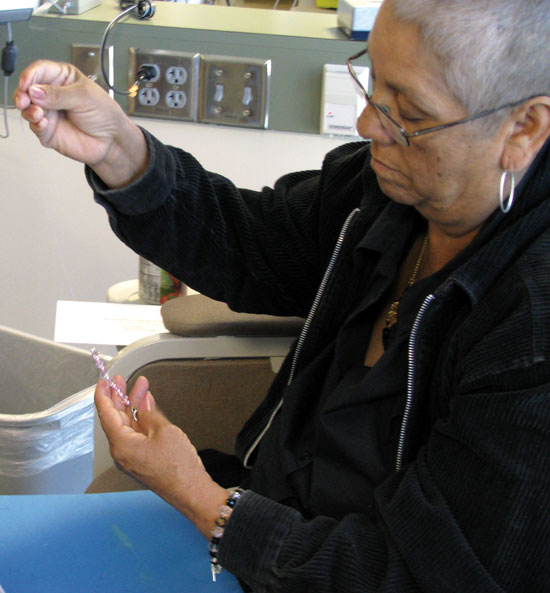
In the chemotherapy room, Romana Gutierrez channels nervous energy into making a pink beaded bracelet as she waits for her brother, Reynaldo Alvarado, to receive treatment.
"He’s tranquil. I’m nervous. I need something to do," Gutierrez said. "When I do this, I don’t think about anything else but putting the beads on."
Artist-in-residence Katherine Brown visits the CTRC twice a week, armed with supplies for everything from beading to watercolor. She is funded through a one-year grant from the LIVESTRONG Foundation.
"When people focus on the art, they’re not focused on their own pain," Brown said. "It takes their mind off of being ill and puts them in a more positive mood."
Brown understands how wearying the fight against cancer can be: She was treated at the CTRC.
"When I was diagnosed with a brain tumor, my children were just petrified. I remember my son telling me, "Mom, I’ll give you my money to help you,’" Brown said. "I said, ‘Honey, I don’t need your money. Just draw me something.’ He picked a sculpture to draw that I treasure. And it helped him to go to his own zone."
Curative cooking
Patients and caregivers wrestle with changing dietary requirements: Chemotherapy patients may struggle with nausea, or an esophageal cancer patient may be limited to a liquid diet. Patient & Family Services registered dietitian Jenny Guerra meets one-on-one to discuss individual needs and holds free group demonstrations focused on healthy, simple cooking for the family.
Said Guerra: "Sometimes, when people come in, they have no idea what their options are."
Comfort over a cure
Meanwhile, Lupita Martinez, the social worker, prepares to meet with a patient and family about hospice. Doctors call her if they have done everything possible to heal a patient and it’s time to focus on comfort over a cure.
First, doctors walk through possible treatments and explain that there is nothing else to do. Then Martinez discusses options with the patient and family.
"We tell them about comfort measures we can offer at home," said Martinez, who worked in hospice before coming to the CTRC. "We let them know they’re not going to be alone."
She does not hesitate to reach out to families during challenging times: "This is something we can do to help. You just have to remember going in, we have done this before - but this is the first time they’re hearing it."
For information about Patient & Family Services, call 210-450-5570.
Dr. Rios returns to South Texas roots, serves citizens through seat on Texas Legislature
Tara Rios, D.D.S., knew she wanted to be a dentist when she was just seven years old. Regular dental checkups she received as a child piqued her interest in the dynamic field.
"The more I learned about dentistry, the more I wanted to pursue it," the Corpus Christi native said. "The concept of having your own business and being in the health care field seemed fascinating to me." In 1993, she embarked upon a four-year journey through dental school.
"I chose the UT Health Science Center San Antonio because of the amazing faculty," she said. "I felt incredibly at home on the campus."
Dr. Rios graduated in 1997, and after practicing for several years as a dentist in the Rio Grande Valley, she became interested in forensic dentistry and pursued a forensic odontology fellowship at the Health Science Center. During her first month in the program, she and the other fellows were recruited to serve on the 9-11 World Trade Center Odontology Team. The group identified many of the victims of the Sept. 11, 2001 attacks.
"It was trial by fire," she said "We received practical, hands-on skills."
After the tragic events of Sept. 11, Dr. Rios returned to her home in South Padre Island. She successfully won a seat on the town's Board of Aldermen, and continued to practice dentistry in Brownsville. "The experiences I gained during my fellowship opened my eyes to the connection between politics and public policy as a direct correlation to our lives," Dr. Rios said. She served for two terms, but her work as a public servant was far from complete.
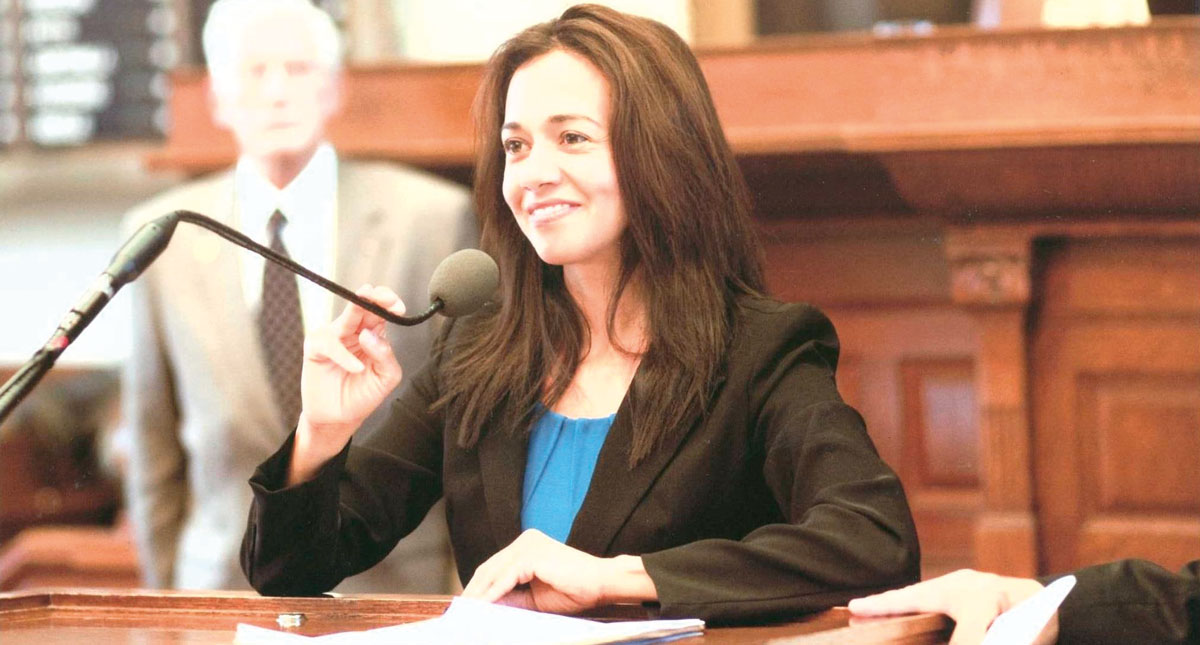
Today, she is the state representative for district 43, which includes Kenedy, Brooks, Jim Hogg, Kleberg, Willacy and part of Cameron counties, and is the only dentist in the Texas House of Representatives. In addition to her legislative work, she continues to see patients at her general practice. She has volunteered on the Dentists Who Care Foundation, an organization which prevents dental disease among local residents through dental care mobile units.
Dr. Rios also served on the board of the Family Crisis Center, which works to end domestic violence, and on the Cameron-Willacy County Infant Fatality Review Committee.
"I'm able to serve the citizens of Texas because of everything I learned in professional school at the UT Health Science Center," she said. "My education and experiences have allowed me to understand the problems and find solutions for the betterment of our community."