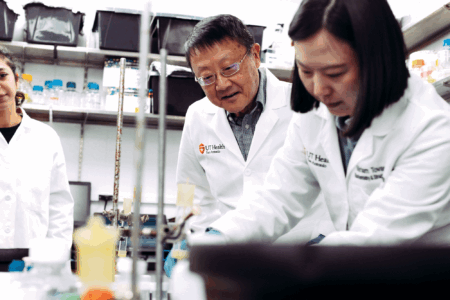
UT Health San Antonio awarded $12.6 million grant for cancer research, understanding drug resistance
Mays Cancer Center Annual Report
“This investment in research is a commitment to pioneering treatments in cancer care. The funding supports our mission to make significant strides in bringing hope and fighting cancer.”
– Lei Zheng, MD, PhD, executive director of Mays Cancer Center.
The University of Texas Health Science Center at San Antonio received a collaborative $12.6 million program project grant from the National Cancer Institute to define the functions and regulation of BRCA1, BRCA2 and related tumor suppressor genes and find new ways to combat cancer.
The grant supports a multidisciplinary research framework that aims to enhance the understanding of drug resistance mechanisms and drive the development of new therapeutic approaches.
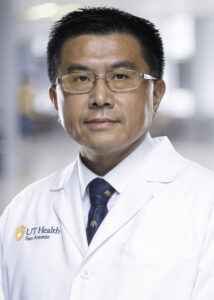
“This investment in research is a commitment to pioneering treatments in cancer care,“ said Lei Zheng, MD, PhD, executive director of Mays Cancer Center. “The funding supports our mission to make significant strides in bringing hope and fighting cancer.”
Spearheading the initiative is Patrick Sung, DPhil, a world-leading expert in the roles of BRCA1 and BRCA2 in DNA repair. Sung is the director of the health science center’s Greehey Children’s Cancer Research Institute and the Robert A. Welch Distinguished Chair in Chemistry. According to Sung, mutations in BRCA1 and BRCA2 can lead to breast, ovarian, prostate, pancreatic and other cancers.
“Receiving this grant is a testimony to our ability to collaborate and do impactful work as a multidisciplinary team,” said Sung, who is also associate dean for research and professor of biochemistry and structural biology at UT Health San Antonio. “This support will continue to enhance synergy among project investigators.”
According to Sung, current treatments, such as FDA-approved PARP inhibitors (polyADP ribose polymerase) and platinum-based chemotherapy, are generally effective for most patients. However, many patients eventually build resistance to these drugs when disease recurs. Understanding what causes drug resistance is crucial in determining appropriate treatment options and for developing new therapies.
The research program is organized into several components, including an administrative core, three shared resource cores and three projects. The administrative core manages the overall program and ensures maximal synergy among different elements of the research program. The shared resource cores provide state-of-the-art tools and expertise to facilitate research progress. The research projects address specific questions to help achieve the program’s objectives.
UT Health San Antonio will lead all components except for project 1, which is led by Dipanjan Chowdhury, PhD, and Panagiotis (Panos) Konstantinopoulos, MD, PhD, from the Dana-Farber Cancer Institute in Boston.
The program’s overarching goal is to create an effective connection between basic mechanistic cancer science and clinical translation.