Breaking new ground with BRCA1 research at UT Health San Antonio
Mays Cancer Center Annual Report
A study led by the UT Health San Antonio sheds light on a novel role of breast cancer gene 1 (BRCA1) in tumor suppression for breast and ovarian cancers.
Individuals with inherited mutations in BRCA1 are predisposed to breast, ovarian and other cancers. BRCA1 helps prevent cancer by repairing damaged DNA, but how it does so is yet to be determined.
The damage in question is the DNA doublestrand break, where both strands of DNA are broken and can lead to cancer if not repaired or repaired inaccurately. The new research shows that BRCA1 pushes a DNA break toward an accurate DNA repair mechanism (called homologous recombination, or HR). It also promotes subsequent steps by spurring the activity of “end resection enzymes” that process DNA ends to prepare them for HR.
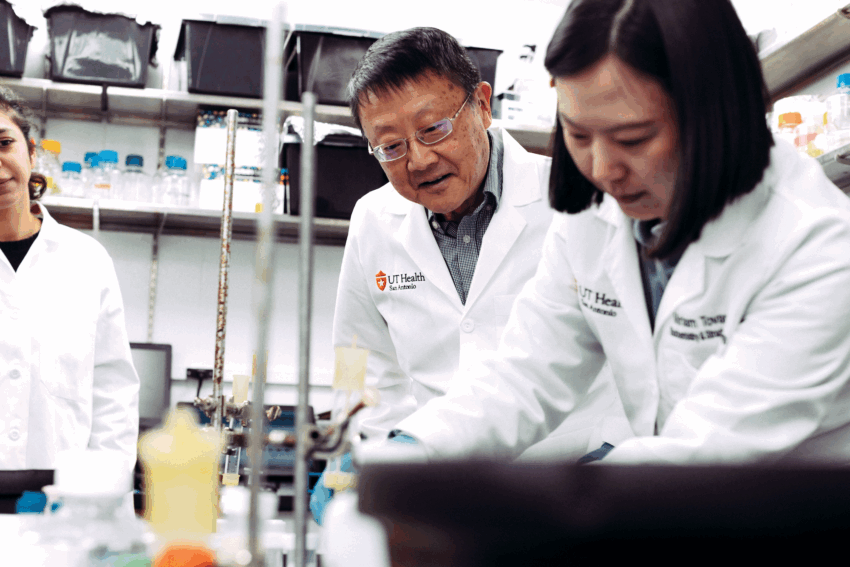
“Our biochemical analysis with purified BRCA1 protein helps illuminate its role in DNA end processing,” said Patrick Sung, DPhil, associate dean for research at UT Health San Antonio and director of its Greehey Children’s Cancer Research Institute. He is a senior author of the study.
Sandeep Burma, PhD, is a professor and vice chair (research) of neurosurgery at UT Health San Antonio and its Mays Cancer Center. He is a senior and co-communicating author of the study. He said BRCA1 has been understood to prevent cancer by enforcing a decisionmaking step when the cell is faced with a DNA break – whether to repair using what’s called an “erroneous” mechanism (non-homologous end joining, NHEJ) or an “error-free” mechanism (homologous recombination, HR). BRCA1 acts to channel DNA breaks into HR for repair.
The new findings explain the tumor suppressor function of BRCA1 through promoting key steps in error-free repair. By generating finely crafted mutants of BRCA1 that are deficient in interaction with DNA but normal in all other aspects, they were able to pinpoint exactly how BRCA1 promotes error-free DNA repair.
The findings have important implications for understanding how dysfunction in BRCA1 leads to the complex multi-step process by which normal cells transform to cause cancerous growth in the body (oncogenesis). It also helps inform therapeutic options for breast and other cancers harboring specific mutations in BRCA1.