Mentors, missions and the making of a nurse

Guided by experienced preceptors, School of Nursing students gain hands-on training through a unique nurse-led care model serving the San Antonio community
by Orith Farago
Students at UT Health San Antonio’s School of Nursing are receiving critical hands-on training in outpatient care by participating in clinical rotations via Wellness 360, the school’s ambulatory clinical practice. The practice’s 14 clinical sites, which include four adult, seven pediatric and three behavioral health clinics throughout San Antonio, are all based on a progressive practitioner-run model.
As part their hands-on experience in the clinical setting, students work with preceptors, or mentors, who provide the perfect blend of expertise and guidance in a variety of specialties — from pediatrics and family care to psychiatric mental health and adult gerontology acute care.
“At UT Health San Antonio, many of the nurse practitioners also teach, so they’re excellent teachers,” said Alina Lundblade, BSN, RN, a student pursuing her Doctor of Nursing Practice degree, or DNP, to become a family nurse practitioner. Family nurse practitioners specialize in preventive and primary care services.
“They’re really eager to work with us. You may be doing something with one and the other one may walk in and say, ‘Hey, there’s a really interesting patient, or I’m going somewhere interesting tomorrow. Do you want to come with me?’ So, you get really unique opportunities to learn and see things differently. It opens up your perspective, so down the road, when you’re faced with things, you’re better prepared,” said Lundblade.
These real-world clinical rotations are also beneficial for the students’ mentors, said Brittany Lents, MSN, APRN, CPNP-PC, a nursing clinical assistant professor. Lents served as Lundblade’s mentor at the pediatric Wellness 360 clinic, located at the School of Nursing.
“I believe [mentoring] is really helpful for us on the clinic side because our students [enable us] to reach more patients,” Lents said. “Our students, a lot of times, have great past experiences that they bring as a benefit into the clinical experience. So, I always learn from students, and I love that aspect of being a preceptor.”
Providing needed services
Thanks to partnerships with the Housing First Community Coalition — a nonprofit organization that seeks to develop housing for San Antonians — and Health Resources and Services Administration grants, nursing students can see firsthand how the Wellness 360 nursing model helps those in need.
“Our clinics mostly serve [the] uninsured, underinsured population,” said Maria Saldiva, DNP, APRN, FNP-C, assistant clinical professor at the School of Nursing. Lundblade is currently doing a clinical rotation at a Wellness 360 clinic where Saldiva is the primary nurse practitioner.
“If the patients do not have insurance for Wellness 360 services, their services are covered through grants and other funding. That’s really important for the students to see that we can access funds and grants to be to be able to serve the community in Bexar County and beyond,” Saldiva said.
Nursing students enrolled in a postgraduate program — whether pursuing a doctorate or postgraduate certificate — are required to be licensed nurses to participate in these graduate-level programs.
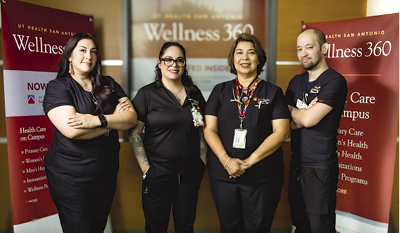
“Many of our [graduate] students have been nurses who have been working in the hospitals around here for a long period of time, and they’re still working in those hospitals,” said Kenneth Miller, PhD, MJ, RN, CFNP, FAAN, FAANP, associate dean for ambulatory services at the School of Nursing. “When they finish their degree, most of them go back to the same hospitals they were working at and become primary care providers there, or they’ll go out into the San Antonio area and work in clinics.”
Students pursuing their Bachelor of Science in Nursing degrees also rotate through the School of Nursing’s ambulatory practices, particularly the pediatric practice, said Heidi Worabo, APRN, FNP-BC, FAANP, associate professor, clinical.
“Many of our [graduate] students have been nurses who have been working in the hospitals around here for a long period of time, and they’re still working in those hospitals.”
— Kenneth Miller, PhD, MJ, RN, CFNP, FAAN, FAANP
Building experience for the future

Despite her experience as a registered nurse in pediatric oncology at Methodist Children’s Hospital, Lundblade still had butterflies when she started her clinical rotations through the university’s ambulatory practices, she said.
“It took me a few days, and then I realized how equipped I already was, and how I already knew how to talk to patients and to recognize things that I didn’t realize I already knew how to do as a registered nurse,” Lundblade said.
During Lundblade’s pediatric clinical rotation with Lents, she, like other students training in the clinical setting, experienced firsthand the role of a provider by reviewing patient charts, conducting wellness exams, making diagnoses, determining treatment plans and completing patient charts — all under a learning environment guided by a trusted mentor. Through clinical rotation experiences at different Wellness 360 locations and with different mentors, Lundblade has built an expanded toolkit of knowledge for her future as a family nurse practitioner.
“[This real-world experience] is changing the way that I think and it’s building off of what I already know,” Lundblade said. “It’s making me look at [nursing] differently and use what I already know differently, and it will make me a better provider.”