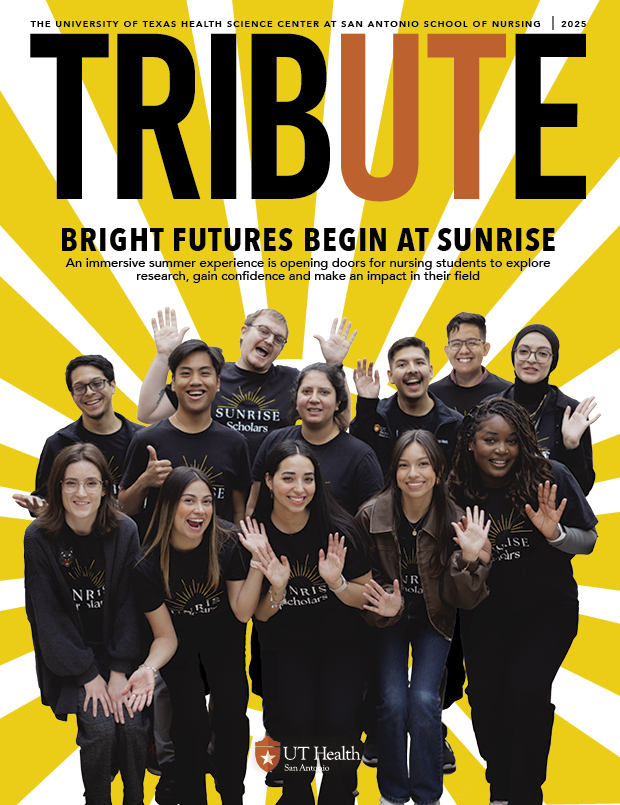
Bright futures begin at SUNRISE
An immersive summer experience is opening doors for nursing students to explore research, gain confidence and make an impact in their field
By Kristen Zapata
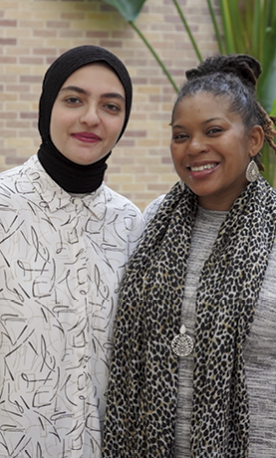
For many undergraduate nursing students, research may seem like an advanced academic pursuit — something reserved for those chasing doctoral studies or aiming for careers in academia. But at the UT Health San Antonio School of Nursing, one mentorship-driven program is changing that perception.
Through the Summer Undergraduate Nursing Research ImmerSion Experience (SUNRISE), faculty mentors are guiding students beyond the classroom, giving them hands-on experience in discovery research, evidence-based practice and quality-improvement projects.
The program begins with an orientation that introduces students to research activities and helps them build communication, networking and presentation skills, along with a sense of belonging. Each week, students participate in structured development sessions that strengthen their abilities while nurturing personal and professional growth. The program helps students contribute meaningfully to health care advancements, made possible through the combined support of dedicated faculty mentors, program leadership and the school’s Student Success Center.
A faculty member who embodies the spirit of this initiative is Kelly McGlothen-Bell, PhD, RN, IBCLC, FAWHONN, an assistant professor and nurse scientist with a deep commitment to both research and mentorship. For her, guiding students is not only about academic growth, but also about empowering them to see themselves as researchers and changemakers in their communities.
The power of mentorship
Bell’s journey with the School of Nursing began in 2010 as a BSN student, where she was first introduced to the value of research. Mentored by faculty members who shaped her understanding of nursing’s role in health care innovation, she carried those lessons into her PhD studies and now applies them as a mentor herself.
“For me, mentorship is about paying it forward,” she said. “I was fortunate to have amazing mentors who helped me understand how research drives better outcomes for families and communities. Now, I have the opportunity to do the same for my students.”
That impact goes beyond the classroom. According to Sara Mithani, PhD, RN, director of SUNRISE, the goal is to introduce undergraduate nursing students to experiences that prepare them for leadership in both clinical practice and research.
“Nurses make a big difference with hands-on patient care, but they also play a crucial role in shaping policies and advancing evidence-based practices,” Mithani said.
SUNRISE allows students to gain exposure to research methodologies, policy development and the process of health care improvements, making them well-rounded professionals before they even graduate.
Research with a purpose
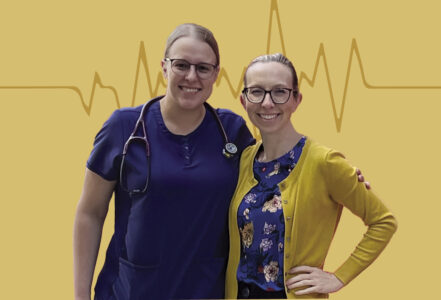
One of the most compelling examples of this mentorship in action is Bell’s work on breastfeeding among families impacted by opioid use disorder — a project she is undertaking alongside Deana Naser, who just graduated this May.
“Deana had a strong interest in breastfeeding and maternal health,” Bell shared. “She wanted to understand how opioid exposure in utero affects an infant’s ability to breastfeed and how we, as health care providers, can better support these mothers and babies.”
Through the SUNRISE program, Naser has played an active role in analyzing data, reviewing infant feeding behaviors and co-authoring research publications with Bell. More importantly, she has learned how ethical, community-driven research can find gaps in patient care protocol and improve it.
“Most studies talk about what health care workers see in infants with neonatal opioid withdrawal syndrome, but no one really asks the moms,” Naser said. “They’re the ones taking their babies home, experiencing the full picture. Our research gives voice to their experiences, helping us understand how to better support them as caretakers.”
Through this experience, Naser has gained clinical insight and a deeper appreciation for the learning process — one that thrives under Bell’s strong mentorship.
“Dr. Bell and I would have a brainstorming session, after which she’d allow me to take the lead and bring the idea to life,” she said. “I get to do it, and she gives feedback, which to me is the perfect way of learning. I can try and figure it out, get the feedback I need and then fix it. She’s always supportive — everything is constructive. I always feel like it is a very safe learning space. She’s just always there as a resource for me.”
The opportunity to prepare to publish research as an undergraduate is a rare and valuable experience, setting students apart as they move into their careers.
“If you had asked me a year ago if I’d see myself writing a full paper, I would have said, ‘No way.’ But now, here I am, leading the paper I’m working on. It makes me feel like I really can do what I set my mind to,” Naser said.
Overcoming imposter syndrome
While the academic rewards of research are clear, the personal growth students experience through mentorship is just as significant. Many students struggle with imposter syndrome — feeling as though they don’t belong in the research world.
“One of the biggest challenges students face is seeing themselves as researchers,” Bell explained. “Many think research is something reserved for ‘other people,’ but in reality, we are all researchers at heart. Nursing is about asking questions, seeking solutions and improving patient outcomes.”
By working directly with faculty mentors, students like Naser safely develop confidence in their abilities, realizing that they, too, can contribute to groundbreaking research that shapes the future of health care.
“Starting anything new is always a challenge, and you never really know what you are doing in the beginning,” Naser said. “Then the self-doubt starts: ‘Is this really something I could do? I am sure there are more experienced people who would do this easily.’ Those thoughts are always at the back of my head. But Dr. Bell has been great about that — she’s always supportive, always encouraging. And I’ve learned that research isn’t black and white. It’s not about getting a ‘right’ answer, it’s about figuring things out and making discoveries. That realization has helped quiet that imposter syndrome.”
This aspect of the program is particularly important given the wide range of backgrounds and experiences of students at the School of Nursing. Its population reflects the richness of South Texas, with many coming from families with limited access to educational resources.
“We want students to feel like they belong in the world of research,” said Angela Watts, PhD, director for student success. “That sense of belonging is what keeps them engaged and encourages them to push forward.”
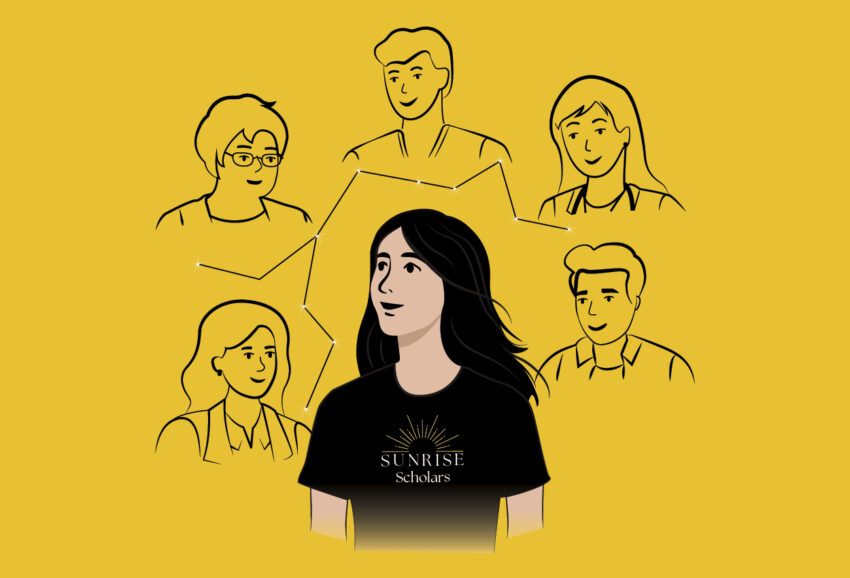
“The power of mentorship is not just in one guiding light, but in the constellation of support that surrounds a student. It is the village of mentors — including peers, professionals and community leaders — who collectively shape students’ experiences and opportunities.”
— Sara Mithani, PhD, RN, director of SUNRISE
Sustaining the future
Despite its success, the SUNRISE program faces an uncertain future. The APOYO: Supporting and Advancing Student Nurses in South Texas grant from the U.S. Department of Education, which provides the program funds, will expire in two years, leaving a funding gap that could impact the ability to continue SUNRISE
at its current scale.
“Currently, the APOYO grant fully funds the SUNRISE scholars,” explained Vanessa Bográn Meling, EdD, MBA, associate dean for admission, student success and engagement and principal investigator of the grant. “This covers their stipends, research materials and travel for professional conferences. However, once this grant ends, securing new funding will be essential to continue providing these transformational opportunities.”
Another area lacking funding? Faculty mentors. While faculty members dedicate time and expertise to guiding students, they receive no additional financial support for taking on mentees.
“We hope to secure ongoing funding not only for our students but also for the dedicated faculty mentors who make this program possible,” Meling added. “Their mentorship is essential, and investing in faculty support would enable us to grow the program and create even greater opportunities for both students and researchers.
With continued funding and growing interest from students, the SUNRISE program is poised to expand its reach and impact.
“The power of mentorship is not just in one guiding light, but in the constellation of support that surrounds a student,” Mithani noted. “It is the village of mentors — including peers, professionals and community leaders — who collectively shape students’ experiences and opportunities.”
For faculty members like Bell, the goal remains clear: Empower students, build confidence and ensure the next generation of nurses is equipped to lead.
“If you mentor students, the work continues,” she said. “It’s not about personal recognition — it’s about making sure that the next generation of nurses and researchers have the skills and passion to keep improving health care for our communities.”
SUNRISE students show innovation, collaboration
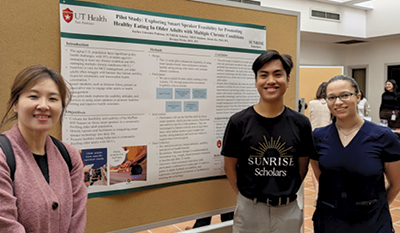
The School of Nursing’s Office of Nursing Research and Scholarship hosted its annual Faculty and Student Research Showcase in January, bringing together undergraduate and doctoral students and faculty in an inspiring display of scholarship and innovation.
This year’s event was particularly noteworthy, marking the first time that nursing students from the Summer Undergraduate Nursing Research ImmerSion Experience (SUNRISE) presented their research alongside faculty mentors.
SUNRISE is an eight-week paid research mentorship program designed for undergraduate nursing students in their fifth and sixth semesters on the traditional Bachelor of Science in Nursing track. While the program provides students with a structured introduction to research, faculty members like Jisook Ko, PhD, RN, see its benefits extending well beyond the classroom.
“In this program, I’ve found that students are more motivated than I expected,” said Ko, an assistant professor and nurse scientist. “They come in with curiosity, and as they engage in research, they realize they have real contributions to make. The showcase is a chance for them to see how their work fits into the bigger picture.”
Jaybee Pedrosa, now a rising eighth-semester nursing student and Ko’s first SUNRISE mentee, said the experience has been transformational.
“The SUNRISE program has been one of the most meaningful parts of my nursing education at UT Health San Antonio. It gave me a space to explore the power of research in shaping better patient care while also helping me grow both personally and professionally,” he said.
A platform for growth
The Faculty and Student Research Showcase was provided as an opportunity for students to present their work and a place to gain confidence, engage in interdisciplinary discussions and envision the future of nursing research.
“My student Jaybee was thrilled to present his work and even won Best Student Research Poster,” Ko said. “He told me, ‘I made it, and I’m really proud of myself!’ Moments like that reinforce why these opportunities are so valuable.”
For many researchers, presenting their work can feel intimidating, but the showcase offered a safe and supportive environment for them to practice and refine their skills.
“Attending national conferences can be expensive, and not all students have the resources to go,” Ko explained. “But this event provided a space where they could share their findings, receive feedback and gain motivation for future projects.”
Pedrosa echoed this sentiment, noting how the event deepened his understanding of the role research plays in advancing nursing practice.
“Participating in the showcase deepened my appreciation for how research is truly at the heart of nursing. It’s not just about data or numbers — it’s about asking the right questions, thinking creatively and finding new ways to solve real-world problems,” he said.
Looking ahead
With continued enthusiasm from students, faculty and leadership, the School of Nursing research showcase is proving to be a cornerstone event for creation, collaboration and mentorship in nursing science.
“I hope we can hold this event more than once a year,” Ko said. “Seeing students engage with each other’s research, learn from faculty and feel a sense of achievement — it’s an experience that can truly shape their academic and professional futures.”
Ko said that, thanks to programs like SUNRISE, students learn the value of nursing research and are actively contributing to it, gaining the skills and confidence to drive change in health care long after they graduate.
SUNSHINE Trip to D.C.
 SUNRISE scholars often leave the program with a broader perspective on what a nursing career can be. Through site visits and hands-on experiences, students meet nurses working in research, policy and hospital administration — roles they may have never considered before.
“We took [the 2024] SUNRISE cohort to Washington, D.C., where they met nurse scientists at the National Institutes of Health, witnessed research in action and even spoke with a nurse working for a U.S. senator,” shared Vanessa Bográn Meling, EdD, MBA, associate dean for admission, student success and engagement. “The experience was transformative. Several students told us, ‘I never realized I could be part of shaping public policy as a nurse.’”
This exposure is intentional, designed to expand students’ career aspirations and highlight the full scope of nursing’s impact.