
San Antonio is becoming a national model for caregiver care, and it started with one family’s journey.
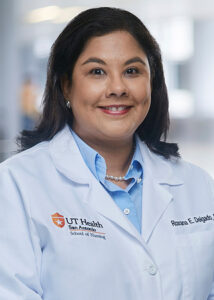
Before becoming a tenured professor and director of UT San Antonio School of Nursing’s Caring for the Caregiver program, Roxana Delgado, PhD, MS, was a researcher and military spouse who found herself standing in a neurorehabilitation medical room, watching her husband relearn how to tie his shoes.
Army Sgt. 1st Class Victor Medina, an active-duty soldier, had just survived a traumatic brain injury after being wounded by an improvised explosive device in Iraq. He would spend three years in intensive rehabilitation.
Delgado, then a doctoral student and U.S. Department of Defense research contractor, quickly became his advocate, his support system and, unbeknownst to her, his caregiver.
But like many spouses, parents, siblings and friends thrust into the role, she didn’t identify as one. Not right away.
“I was just a loving wife doing what I promised to do,” she said. “It wasn’t until a friend told me, ‘You’re a caregiver,’ that I began to understand the full weight of it.”
That revelation would change the course of her life and, eventually, the lives of thousands of caregiving families across South Texas and beyond.
Reborn through a personal mission
When Delgado was appointed director of the Caring for the Caregiver Program in 2023, she brought with her a prolific research background and national policy expertise. She also brought the valuable lived experience of someone who had walked the caregiver road.
The program was initially founded in 2017 with a focus on dementia and Alzheimer’s disease caregivers, supported heavily by research and pilot studies. But in 2023, under Delgado’s leadership, it expanded with intention.
“My first question when I came on board was, ‘Can I expand it?’” Delgado recalled asking School of Nursing Dean Sonya Hardin, PhD, RN, APRN, FAAN. “I wanted to make it inclusive of all caregivers — regardless of condition, age or relationship — and to build more than a research enterprise; one also established in service and advocacy.” Hardin was extremely supportive, said Delgado.
Today, the program stands on three pillars: evidence-based research, innovative services and policy advocacy. Its reach has grown to support caregivers navigating a wide range of diagnoses from traumatic brain injuries and mental health conditions to Parkinson’s disease, cancer and chronic illness.
Services that heal, connect and empower
At the heart of the program is a growing menu of offerings designed to address caregiver burnout, loneliness, health digital literacy and emotional well-being.
The Gardening Rooted in Occupational Wellness, or GROW, formally called the Dementia-Friendly Gardening Workshop, is a unique collaboration between UT Health San Antonio and the San Antonio Botanical Garden that blends horticulture, respite care and community connection.
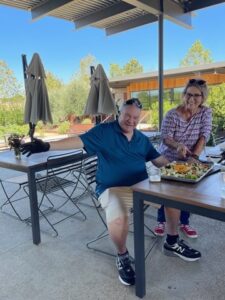
For Mable Goldsmith, who joined GROW after her husband was diagnosed with dementia, the garden became more than a therapeutic activity. It became a lifeline.
“My husband loved to garden, and so did I,” Goldsmith said. “Being out there brought us both so much joy again. In joining this community of fellow caregivers, we miss each other when we don’t have a session. It’s given us life after isolation.”
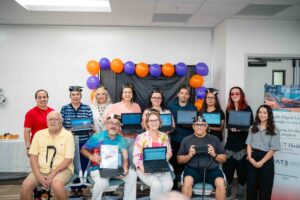
Another standout initiative is the health digital literacy program, supported by the Elizabeth Dole Foundation and in collaboration with Older Adults Technology Services by AARP, which equips caregivers with skills to navigate modern health systems. Through hands-on instruction, participants learn how to use patient portals like MyChart, communicate with health providers and access telemedicine, which are skills that are increasingly essential, but guidance in developing them is often overlooked.
Monthly Memory Café gatherings are also offered to provide safe, joyful spaces where caregivers and care recipients can engage in meaningful experiences together. Some of these offerings are now delivered asynchronously, ensuring caregivers can access them in their own free time, without the added pressure of coordinating to attend an in-person event.
Behind each initiative is a strategy to extend dignity, knowledge and human connection.
“Everything we do is about increasing the capacity of the caregiver,” Delgado said. “Not just in knowledge or skills but in hope.”
“Now I’m a docent at the garden,” Goldsmith added. “I give tours, sell plants and stay connected. It helped fill the gap after I retired and became a full-time caregiver. The program didn’t just help us; it gave me something of my own again.”
Building the future of caregiving
Caring for the Caregiver is now a hub for capstone projects and graduate student internships across public health, occupational therapy and nursing. These students, under Delgado’s mentorship, are helping create lasting caregiver programs, including GROW, which started as a graduate student’s project.
These student-led initiatives are critical to the program’s growth and sustainability, Delgado said. “They allow us to innovate and expand our reach through fresh perspectives.”
In fact, the graduate student who created the gardening program was later contracted by the botanical garden to continue the work, solidifying the program as a permanent partnership between the university and the community.
Delgado’s long-standing project with the Elizabeth Dole Foundation is about to unveil its newest milestone: the Caregiver Integrated Care Framework, which will work to include family caregivers in its Veterans’ care team and treatment planning. The framework promotes the integration of caregivers as valuable members in the ecosystem of care, according to Delgado.
“This is about making the caregiver a recognized part of the care team,” said Delgado. “They know the patient’s day-to-day better than anyone. Why wouldn’t we tap into that? Caregivers often hold critical information about the patient’s habits, pain levels, mood shifts and medication responses,” she added. “Including them doesn’t just improve patient care it transforms it.”
‘You are not alone’
Led by Delgado and supported by a multidisciplinary team of program managers, researchers, faculty and community partners, Caring for the Caregiver brings together their expertise to deliver on its mission.
For Delgado, success isn’t measured merely in metrics or journal citations. It’s when a caregiver tells her team that they feel seen. When someone walks into a room weighed down by responsibility and walks out with connection, community and confidence.
She sees it with her husband, too. Medina is now a certified rehabilitation counselor, founder of a nonprofit and living proof that recovery is possible.
“We always said we didn’t want to ask, ‘Why us?’ but through faith, ‘What for?’” she said. “Our tragedy had to have purpose. And it did.”
Delgado dreams of creating a physical caregiver lounge within San Antonio’s South Texas Medical Center, a space with computers, coffee and comfort where caregivers can rest, learn and find community while their loved ones receive care.
She also hopes to secure Medicare reimbursement and community partnerships to establish a Caregiver Academy, a national model for caregiver training and advocacy, all housed at UT Health San Antonio.
“We want to be the place people think of when they think of caregiving,” she said. “Not just in San Antonio. Nationwide.”
More than anything, Delgado wants every caregiver to know they don’t have to walk the journey alone.
“Too often, the entire focus is on the patient,” she said. “But the moment a provider looks you in the eye and says, ‘How are you doing?’ That changes everything.”
Nationally recognized for caregiver support
Caring for the Caregiver, a flagship program of UT San Antonio’s School of Nursing, earned a 2024 Maude’s Award for excellence in supporting family caregivers of individuals with dementia.
Presented annually in Seattle, Maude’s Awards celebrate innovations that improve quality of life for people living with Alzheimer’s disease and their care partners. Only three organizations were selected nationwide in the “Supporting Care Partners” category.
“This mission-driven, multiservice program provides education to support the transition into the caregiving role,” said program director Roxana Delgado, PhD, MS. “Our approach enhances caregiver knowledge, confidence and capacity to perform complex care tasks.”
Award-winning services include:
- Health Digital Literacy for Family Caregivers.
- Memory Café quarterly social events.
- Essentials of Caregiving educational series.
- Virtual dementia training.
- Dementia Friendly San Antonio Advisory Council.
Caring for the Caregiver was honored alongside ARTZ Philadelphia and Alzheimer’s Los Angeles, receiving a $25,000 award for its demonstrated success and community impact.
For more information or to connect with the Caring for the Caregiver team, fill out the online survey here.