
Practice-ready from day one: Preparing nursing students to fill a hiring demand
With academic excellence, immersive training and strong local hiring demand, the School of Nursing is preparing graduates to meet the moment — and the future
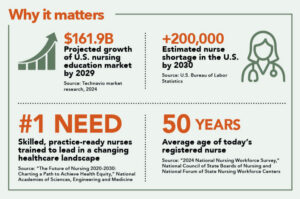
The need for skilled nurses in Texas is urgent — and growing. As health systems contend with rising chronic conditions, aging patients and workforce turnover, employers are looking for more than a nursing license. They need nurses who are ready to step in, contribute, grow and lead.
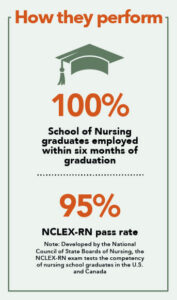
The School of Nursing has long been known for its rigorous curriculum and deeply immersive clinical education within a complex care environment. Today, it’s also a powerful engine for South Texas’ nursing workforce, producing graduates who are sought after for their readiness, resilience and professionalism.
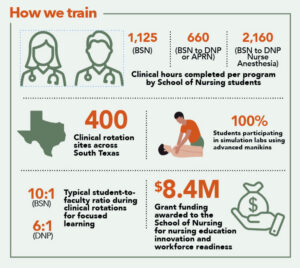 “We focus on preparing nurses who are competent and confident from the moment they enter practice,” said Sonya R. Hardin, PhD, RN, APRN, FAAN, dean of the School of Nursing. “We’ve aligned our curriculum to meet the needs of employers — and, more importantly, the needs of patients.”
And employers are noticing.
A pipeline with purpose
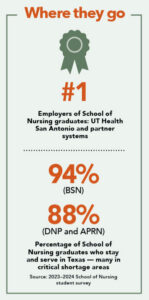
In San Antonio, few institutions understand the value of a practice-ready nurse better than the South Texas Veterans Health Care System. As one of the region’s largest healthcare employers, the Veterans Administration hires dozens of the university’s School of Nursing graduates each year, many of whom stay to grow their careers.
Since 2013, 179 School of Nursing graduates have completed the VA’s Registered Nurse Transition to Practice Program with a 100% first-year employee retention rate and a 98% retention rate after the second year. That’s proof of both the school’s rigor and its reputation, said Celida Martinez-Vargas, DNP, MSN, RN, chief nurse of nursing education and research at the VA.
 The longstanding partnership between the school and the VA has been nationally recognized with the Exemplary Academic-Practice Partnership Award from the American Association of Colleges of Nursing. Established in 2003, the collaboration centers on elevating veteran care, strengthening nursing education and developing a future-ready workforce.
Faculty appointed jointly by the VA and the university co-developed the national curriculum, an initiative designed to transform how new nurses grow from entry-level to professional competency.
Wesley Richardson, PhD, MSN, RN, CNL, and Vicky Dittmar, MSN, RN, employees of the Audie L. Murphy Memorial Veterans’ Hospital and full-time faculty of the School of Nursing, co-authored the original proposal and designed both the clinical and didactic components of the program. Today, they continue to co-lead its national expansion and accreditation efforts.
Other impactful elements of the partnership are the use of dedicated education units and nurse practitioner residency tracks, where students are immersed in clinical training within VA facilities. Under the mentorship of experienced preceptors, students apply didactic knowledge in real time, gaining confidence and clinical judgment in a setting designed for professional growth.
It’s a symbiotic relationship, and one rooted with patients top-of-mind.
“Our health system depends on nurses who are ready to lead on day one,” Martinez-Vargas said. “And this school delivers. We’re getting the best, and the best is what our veterans deserve.”
Where education meets readiness
 “I still remember my clinical rotations. I felt prepared,” said Julissa Hance, BSN, RN, CMSRN, EBP-C, a 2020 graduate of the school’s Bachelor of Science in Nursing program. “We were expected to think critically and communicate clearly to our patients. Being able to provide that service and my education to our veterans is why I came back to the VA.”
That sense of preparedness became real during a moment that had nothing to do with dispensing medication or charting but had everything to do with patient care. One day, Hance and her classmates stopped to assist a patient in a wheelchair who had reached a section of sidewalk approaching the VA entrance that lacked a ramp.
“It seemed like a small thing at first,” Hance recalled, “but it was a barrier — literally and figuratively — to patient safety and accessibility.”
The group reported the issue to Richardson, their faculty instructor, who turned the moment into a powerful lesson in advocacy.
“He didn’t just say, ‘Thanks for letting me know,’” Hance said. “He walked us through the process of reporting the issue properly and explained why it mattered.”
Within weeks, the hospital determined that section of sidewalk was not ADA compliant and began construction to fix it.
“That was the moment I understood the power of our voice as nurses,” Hance said. “We made a difference for that one patient, but also for every patient after them.”
Now working as the nursing excellence and shared governance coordinator at the VA, Hance sees that moment as foundational to how she approaches leadership and systems change.
 “The program taught us what to do as nurses and how to think as leaders,” she said. “That’s what makes a nurse practice-ready. You don’t hesitate when a patient’s condition changes or when a system needs to be better. You act.”
Through high-stakes simulation, complex case studies and a culture of excellence and accountability, Hance and her classmates learned to approach care holistically, never losing sight of the bigger picture.
“We were held to high standards, but we were never alone,” she said. “Faculty and clinical instructors made it clear they expected excellence and that they believed we were capable of it.”
Education that grows with you
That early lesson in advocacy sparked a deeper calling for Hance.
“After that experience, I realized I wanted to help improve the systems,” she said.
Now pursuing her PhD in nursing science while continuing her role at the VA, Hance represents a growing number of nurses advancing their careers beyond the bedside, supported by a school that fosters long-term development.
“Our goal is to prepare nurses who contribute to the profession at every level,” Hardin said. “That includes the clinical environment, but also research, policy, education and systems change.”
 Through faculty mentorship, grant support and dedicated pathways for doctoral education, the school empowers nurses to investigate challenges and design solutions that shape the future of care. Martinez-Vargas has seen the impact firsthand.
“We’re seeing more graduates return to us as leaders — unit-based, organizational and academic,” she said. “Their education sets them up to practice nursing, but to also guide the evolution of the profession.”
Hance’s doctoral work reflects that mission. It focuses on improving the nursing practice environment by exploring how frontline nurses perceive their work environment and understanding what contributes to a healthy work environment that drives positive nursing workforce outcomes.
“My research is directly tied to what I do every day,” Hance said. “And I wouldn’t have that lens without the foundation I received at the school and through the VA.”
That kind of growth is exactly what the school aims to cultivate.
“Our graduates are strengthening the workforce,” said Hardin. “Training new nurses, shaping research and leading from every seat at the table.”
Meeting the moment and the future
As the nation’s healthcare needs continue to evolve, so does the role of the nurse. Nursing faculty are keenly aware they must prepare students to meet today’s standards while equipping them to define tomorrow’s.
The school’s nationally ranked Doctor of Nursing Practice program, new nurse anesthesia program, expanded simulation center and growing research opportunities are already forming a new generation of leaders prepared for the complexities ahead. And that commitment to innovation won’t stop as the university enters its next chapter.
“We’re preparing nurses to be thinking professionals who can grow and advocate throughout their careers,” said Hardin.
As new technologies like artificial intelligence and interdisciplinary approaches with fields such as engineering reshape the future of care, the school is actively exploring ways to integrate those frontiers into nursing education.
That forward-looking mindset resonates with alumni like Hance, who sees major shifts on the horizon.
“In the next five to 10 years, I believe nurses will take on even more leadership, both at the bedside and at the systems level,” she said. “The ability to lead and promote shared governance, interpret research and advocate for change will be critical. It’s about being ready for day one — and for everything that comes after.”