Building public health proficiency: Students focus on making a difference
Master of Public Health students reflect on what they’ve learned and how they’re helping shape this leadership pipeline program to serve South Texas
Brenda Nieves’ passion for public health was years in the making. From a young age, her parents instilled in her a drive to help others.
And she has.
Nieves has consistently sought the best outcomes for patients and those in need — from her job as a 911 operator, to her work within a family medicine practice, to her current role as a training specialist at UT Health San Antonio’s practice operations, working with the clinical practices to ensure efficient and high-quality operations on behalf of patients.
So, it seemed only natural for Nieves to gravitate toward the Master of Public Health program in the Kate Marmion School of Public Health.
“What drew me into the public health field is being an advocate for the community,” Nieves said.
“Working with a family medicine doctor for quite some time, you get attached to your patients. Some don’t have insurance and don’t know how to navigate getting enrolled into programs. And so being able to guide them and help them is what drew me into public health.”
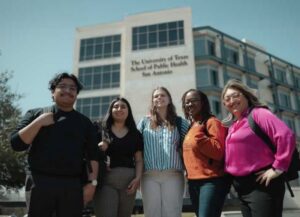
As part of the inaugural cohort of 35 students in the school’s master’s MPH program, which launched in August 2024, Nieves and her classmates are setting the tone for the future of public health education in Texas and looking to make a difference in a field focused on improving population health outcomes.
Leaning on life experience
For Kelechi Adejo, laying the foundation for future cohorts is an important aspect of being a member of the inaugural class.
“There’s that sense you’re the one paving the way,” Adejo said. The occupational therapy assistant and mother of three moved from Columbia, Missouri, to start the master’s program to help impact policies that provide health access.
It was a stint living in rural Tennessee that gave Mary Sanchez a firsthand look at healthcare shortages in rural communities and led to her desire to work in healthcare.
“There was a huge lack of access,” she said. “So, for patients who might not have the best caretakers or access to funding to get caretakers, what does their life look like?”
As an operations manager for language services at University Hospital, Sanchez said she has been able to take what she is learning in her classes and apply it to her day-to-day work at the hospital.
“It’s been really fulfilling and helpful,” Sanchez said.
Like Sanchez, Audrey Cordova, who recently graduated with her bachelor’s degree in public health and is now in the MPH program, saw firsthand how the lack of access to healthcare services outside of Brownsville, Texas, had affected her grandparents.
“That motivated me to [ask] why is it that rural communities are having this issue? Why aren’t there enough doctors? Why aren’t there enough clinics? The closest ER to [my grandparents] was 30 minutes away,” said Cordova.
Tracey Barnett, founding chair and associate professor of the school’s Department of Quantitative and Qualitative Health Sciences, notes that a shortage of primary care physicians serving in rural areas can mean higher rates of preventable illness and a reduction in the quality of life and health in general. By raising awareness about the lack of services in rural communities, the school’s MPH program is equipping students to potentially help fill the gaps in these communities, Barnett said.
A profound rural public health need
- According to the Texas Comptroller, as of 2020, 16% of the state’s population was living in rural communities.
- Across the state’s 254 counties, 37 lack a single primary care physician, according to the Texas Department of State Health Services.
- Data compiled by the American Public Media Research Lab identified 71 Texas counties without a hospital, and the Texas
Organization of Rural and community Hospitals has calculated that 26 Texas rural hospital closures have occurred in 22 communities since 2010. - According to U.S. Census Bureau data, the Lone Star state has the highest percentage of uninsured individuals under the age of 65, at 18.8% as of 2022.
A unifying bond
Representing a broad spectrum of students — from recent undergraduates, to parents, to working professionals who appreciate the three-hour evening classes held three nights each week — members of the inaugural class share a special bond.
“I think we have that bond as a class to get together and help each other as much as we can and encourage each other,” said Nieves, who also serves as treasurer of the school’s public health student organization and as a representative of the student government.
The students also feel connected in this shared experience with their professors, appreciating their support and encouragement as the first students of the program.
That mutual respect has “increased our trust relationship with our instructors,” said Adejo. “They have been very gracious with their time, with their knowledge, with their mentoring.”
Impacts on patient care
The inherent passion to help others is a common attribute among the inaugural MPH cohort. After she graduates, Adejo looks forward to delving deeper into how public health policies affect healthcare access.
As a trauma-informed care advocate, Sanchez said her public health education is providing a broader view of patients’ needs.
“I think being a public health student is another [tool] that I have to help the patients get to where they need to go, but also understand where they’ve come [from],” Sanchez said. “I’ve learned so much about the resources available in the city. What can I connect them with? What resources can I provide them with to help make their lives easier? That’s all because I’ve been learning so much with our program.”
As Nieves looks to her future, she’s excited about how her degree will open more opportunities to help others.
“That’s my drive — being able to see how we can help others have a healthier future and help their children as well.”
Learning plus doing: A formula for success
The Master of Public Health applied practice experience, required of all MPH students, provides 180 hours of on-the-job learning and opportunities to build relationships with community partners.
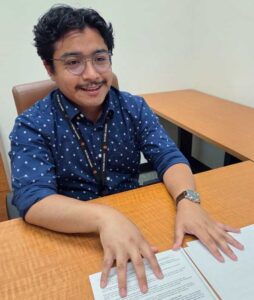 For Luis Gutierrez, his firsthand experience working at the Glenn Biggs Institute for Alzheimer’s and Neurodegenerative Diseases provided invaluable opportunities to put his program studies into practice by helping analyze data collected by the South Texas Alzheimer’s Disease Research Center to determine how factors like employment, diet, sleep and social support can influence cognitive decline, while also considering biological factors like genes and brain imaging scans.
“Thanks to this practicum project, I’ve met a lot of doctors who are in this field who practice neurology and imaging, and that’s what I want to do now,” he said.
Gutierrez had already secured a work-study role as a research assistant at the Biggs Institute when he first started the MPH program. In this role, he supported a long-range study that contributes data directly to the National Alzheimer’s Coordinating Center, a centralized data repository and collaboration and communication hub for the National Institutes on Aging Alzheimer’s Disease Research Centers Program.
As part of his applied practice experience, Gutierrez also met directly with participants and their spouses, adult children or caregivers, guiding them through the informed consent process, which addresses the risks and benefits of treatment. He also administered detailed questionnaires to assess family history and conducted and scored the Clinical Dementia Rating, a standardized tool used to assess the severity of dementia based on both cognitive performance and daily functioning.
A mission to help others
Since childhood, Gutierrez has set his sights on pursuing a medical degree. As someone living with scoliosis who has undergone numerous X-rays, he became acutely aware early on of the important role radiology plays in the field of medicine.
Since starting the MPH program, Gutierrez has taken an active role in shaping the culture for future program cohorts, becoming the first president of the school’s student association.
“I feel like we’re pioneers. As students, we’re laying down the foundation of what other students after us will experience,” he said.
Gutierrez, who expects to complete the MPH program in May 2026, has many options and paths from which to choose, including his ultimate goal of pursuing a medical degree.
“As long as my life is in healthcare, I’m going to be really happy.”