
Beyond the White Coat
Even Albert Einstein, the father of the theory of relativity, a pillar of modern-day physics, had another, less obvious side.
If he wasn’t a physicist, he once declared, he would have been a musician.
"I often think in music," he said. "I live my daydreams in music. I see my life in terms of music. I get most joy in life out of music."
Was this just a frivolous diversion for Einstein? Is it just fun and games for the surgeon who photographs wildflowers, the autism researcher who plays the cello, the occupational therapist who’s a clown or the dentist who throws clay? Is it simply a way to blow off steam? Or could it be something much deeper, much more essential?
Turns out that to stay healthy, these creative minds require multiple creative outlets, they say. Even more significantly, clowning around or jamming in a jazz band complements and enhances the careers of health professionals and researchers. It refreshes and renews, adds joy and fulfillment.
These "sides," or alter egos, can be called avenues of self-expression, celebrations of multidimensional characters. But, truth be told, they simply make them better.
Adults are way too serious.
Instead of playing, adults spend all their time working, Kimatha Oxford Grice grouses. They work so hard, she said, that they’ve forgotten how to play.
And that’s just not OK for her.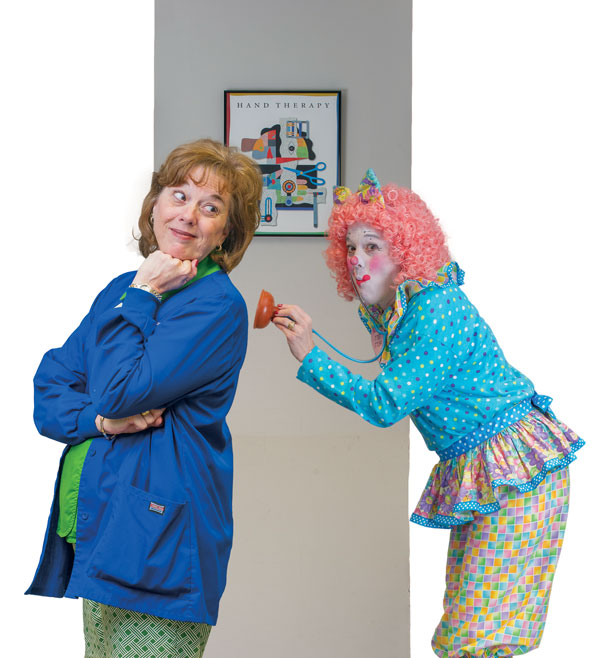
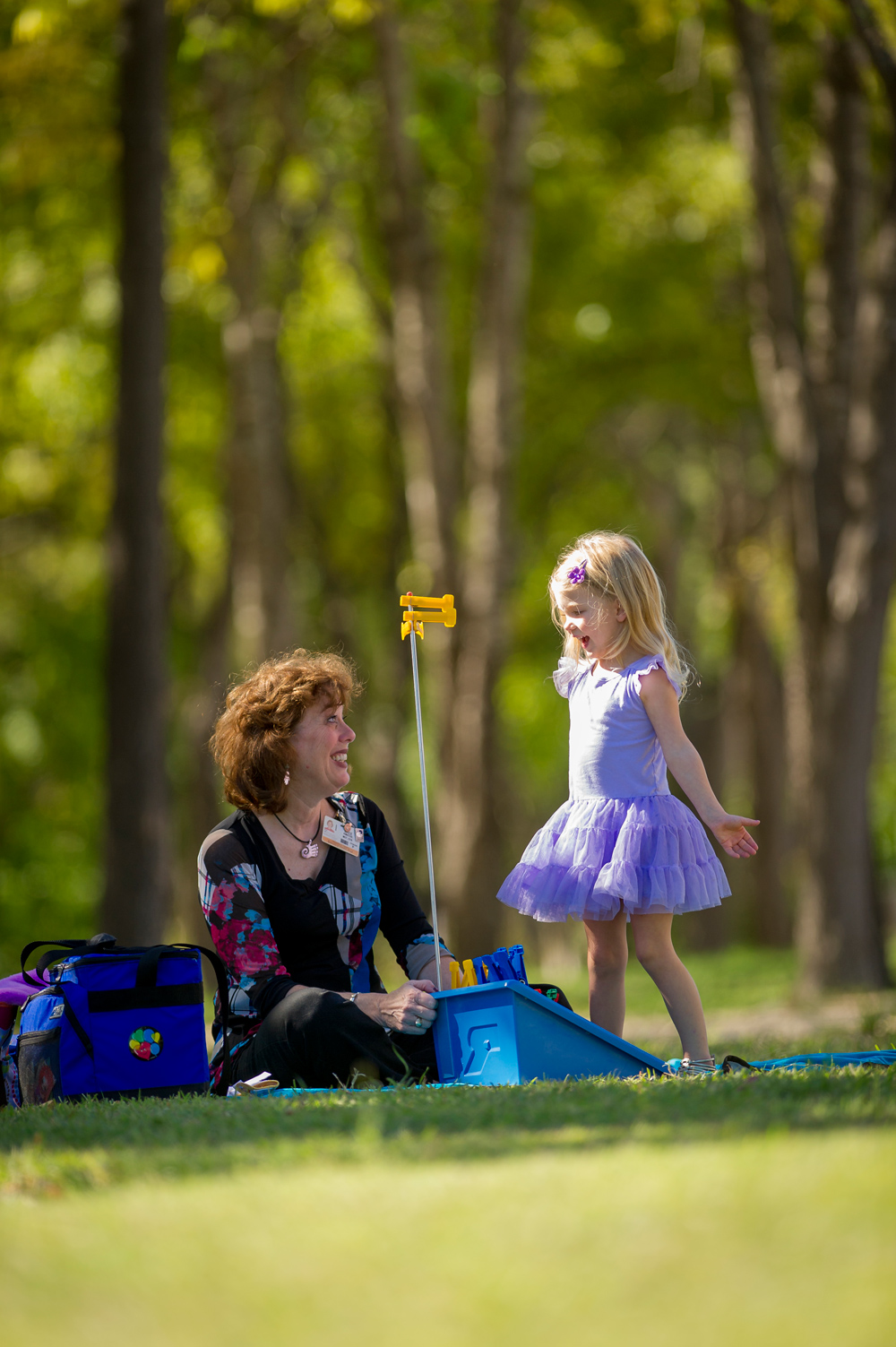
Dr. Grice, O.T.D., OTR, CHT, is an associate professor of occupational therapy who occasionally teaches class at the Health Science Center as Professor Feather Brains. That is, when she’s not clowning around in a pink wig and colorful dress as Tutti Frutti, her true alter ego.
"[Constant work is] just not healthy," she said. "The theory that is the basis of occupational therapy is to live awell-rounded life. You have to have leisure interests, things you do that make you have fun and keep you healthier. Being a clown fits me."
Since she was young, Dr. Grice has been fascinated with clowns. After becoming an occupational therapist, she realized something. As a therapist, she is always making her patients do something that’s uncomfortable, sometimes even painful. What if she could do something that was fun? Even better, what if she could use that fun to help her get patients to do those uncomfortable things?
Her transition into the world of clowning didn’t happen overnight. Clowning, after all, is a serious business that takes planning, character development, schooling, the building up of supplies and skills.
But once she started full-force, she couldn’t stop. Dr. Grice has been clowning since 1991, bringing Tutti Frutti into the lives of her patients, hospitalized children and adults, charity events, birthday parties, nursing homes and community events.
"As a hospital clown, I felt it was a way to give back, and in that setting I got to be in a totally different role. I could go in and play and be funny and do something that wasn’t uncomfortable for patients," she said.
Clowning isn’t just a recreational outlet to help keep her sane. It’s also like a shot of adrenaline to her spirit. And on a practical side, it’s also made her a better therapist. Dr. Grice works as a certified hand therapist at the Hand Center of San Antonio. She often digs into her clowning prop bag to get her patients to do hand exercises by balloon twisting and making puppets talk.
"Occupational therapists do whatever it takes to get a patient to do what you need them to do," she said. "That’s why clowning andOT go so well together. I like to play."
And humor in medicine is important, she said. So important, in fact, that for 14 years she has taught an elective at the Health Science Center called Laughter is the Best Medicine: An Interdisciplinary Elective about Humor, Healing and Healthcare. That’s where Professor Feather Brains makes her occasional cameos dressed in bright purple hair, round black glasses and white doctor’s coat.
"I see clowning as a ministry," she said. "It’s a God-given talent that I’m using to help people."
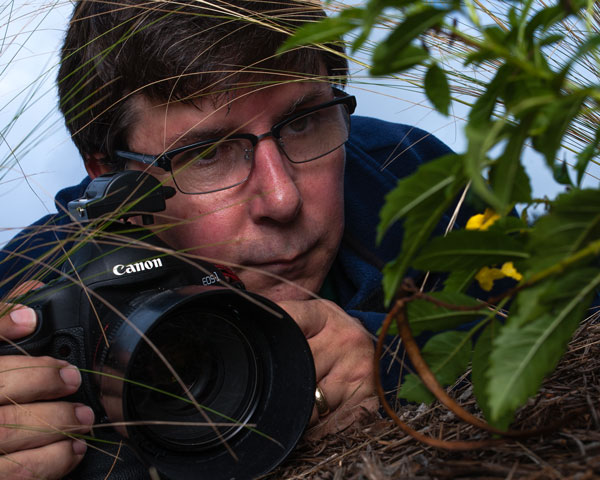 Bluebonnets formed an ocean of blue along the side of the highway last spring. It was an irresistible sight for Ronald M. Stewart, M.D., chair of the Department of Surgery and recreational photographer.
Knowing a flower is best photographed at ground level, he pulled over, grabbed his camera and made his way into the field, finally nestling among the flowers to find the best vantage point.
Like surgery, photographing a flower takes concentration and time. Stillness. Quiet.
The minutes ticked by as he lay on his side. Suddenly, his concentration was shattered, first by an EMS unit with sirens, then by a police officer approaching. Turns out, his stillness was mistaken for something quite different—an injured person in need of help.
"I told her, it’s all fine. I’m taking pictures," he laughed.
Dr. Stewart has been taking pictures since he and his wife, Sherri, were given a camera as a wedding gift in 1982, first in the operating room as a resident and later at his children’s sports games. Nature photography, especially that of wildflowers,
soon followed. 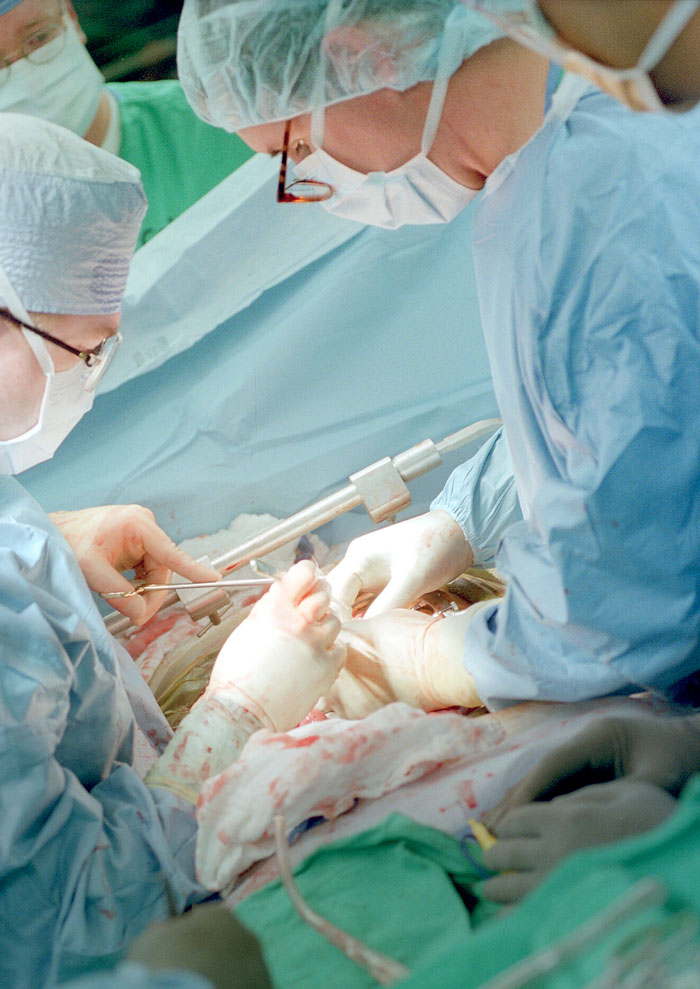
"My photography follows what I would call a normal sort of surgery performance improvement process," he said. "You think they’re pretty good until you start comparing them to somebody else’s and then you realize they’re not very good. Then you begin gradually tweaking them over time, doing your best, then looking back to see how you could do it a little bit better."
He’s perfected his style to the point that dozens of his photographs can be seen throughout the Health Science Center’s Medical Arts & Research Center and University Health System’s University Hospital.
Photography isn’t very different from surgery, he said. Both require concentration, as well as precise steps and careful technique, although there may be different approaches to accomplish the same goal. And depending on the operation, surgery can be peaceful, as can lying in a field of flowers.
"There’s an art to both, and there is peace in the complete immersion and flow," he said.
Yet photography allows him something that is unique: the ability to stop and enjoy something that he might otherwise be too busy to see. Beauty is always around, but sometimes it takes a change in perspective, or lighting, to see it, he said.
"It’s an outlet that is relaxing and gives you time to think," he said. "One of the things that we’re really short of in the modern world is any quiet time for reflection or thinking in a non-directed way. I think for me, photography gives me that."
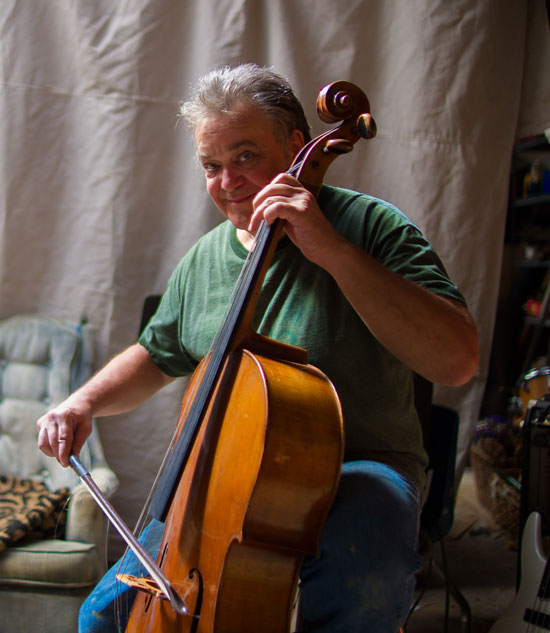 Every now and then, Raymond Palmer, Ph.D., would ditch a day of high school. He’d wait for his mother to leave for work, then he’d go straight to the garage.
He just had to play a little music.
He’d spend the entire day in that garage, playing the piano, determined to figure out one more Beatles or Jethro Tull song.
"Music is just something I have to do," he said. And while he played through his undergraduate days, that eventually faded away as he advanced his higher education career, first getting an associate’s degree in physical education,then bachelor’s and master’s degrees in psychology, a nursing degree, and then eventually a Ph.D. in preventative medicine.
Once he became an assistant professor, he just didn’t have the time anymore.
"I became real down, almost borderline depressed. Something big was missing from my life. I was cranky and unsatisfied," he said. On a trip to the music store one day, where he was surrounded by gleaming guitars and other instruments, he felt an inner joy for what felt like the first time in years. After affirmation from his wife, Cindy, he knew: It was time to start playing music again.
"My existential crisis was over," he said. "Sometimes you have to give something up because you don’t have time to do it all. And sometimes the things you give up are the things you love and that’s a mistake. You should not do that. That was music for me."
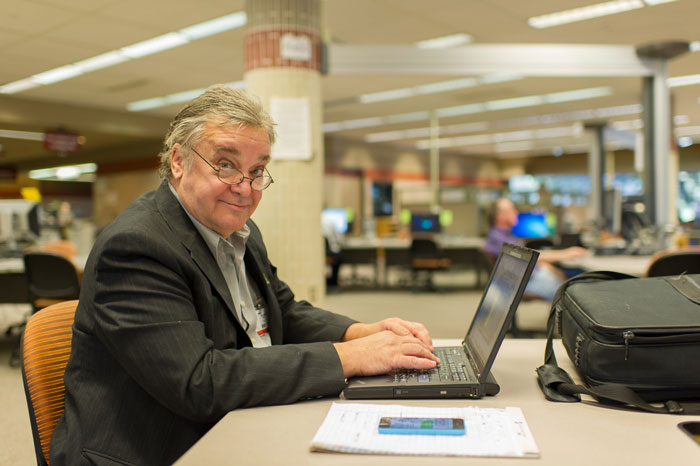 Dr. Palmer, who now is an associate professor in the Department of Family & Community Medicine, is probably best known for his work on environmental neurotoxins and autism. But outside of work, he’s surrounded by the arts. He lives south of downtown in an area popular with art enthusiasts. His home is an 11,000-square-foot industrial space that is part art gallery and studio, brewery, concert venue and residence. Once a month, he hosts musical groups who play in what he calls his "intentional listening room," a performance space that seats about 35 music lovers. He also plays a modified cello in what he jokingly refers to as a "rhythm and ooze" groove band and keyboard in a jazz band that plays gigs around town.
"I have a friend who once asked, ‘What are you doing in this left-brained academic world? You are so right-brained,’" he said. "There is this whole idea that the left side of your brain is analytical and verbal and the right side is artistic and kinetic, but realistically, we’re all a combination of both."
Each side works in concert, assisting the other, he said. And music and science aren’t so different, anyway, he added. As a biostatistician, his job is to take data, synthesize it, follow the information and discover associations, which he then presents in a digestible way. He has to perform the statistical analysis, understand what it reveals and, working with a team of other scientists, translate the information to grant-funding agencies. His work researching autism sprouted from a question he had about the causes of the disorder and the desire to find some answers.
Similarly, as a musician, he follows an inner voice, develops sounds, notes or a rhythm that sounds good, then lets them evolve into a groove. It develops and grows. He and his bandmates create music that will stir the audience and speak to them in different ways, translating emotion through music.
In both music and science, there is passion to discover and enlighten, he said. And he needs both to feel complete.
"Your work life doesn’t fulfill the multidimensional aspects of yourself," he said. "There is more to all of us than just one dimension. It doesn’t always have to be the arts, it could be reading, gardening, physical activity or whatever your passion is. It makes you a better person."

He’s too much of a dentist to be considered bohemian. But that doesn’t keep Keith V. Hill, D.D.S., FAGD, from trying, he said.
By day, he’s in Health Science Center clinics leading and supervising a team of 25 students through dental procedures. But on most evenings, after he gets home, he grabs his backpack and bike and rides to a local haven for ceramic artists—the Alamo CityPottery Workshop.
There, the fridge is stocked with beer and shelves are lined with pottery projects in the works. And Dr. Hillhas his own wheel, where he throws clay and molds it into art.
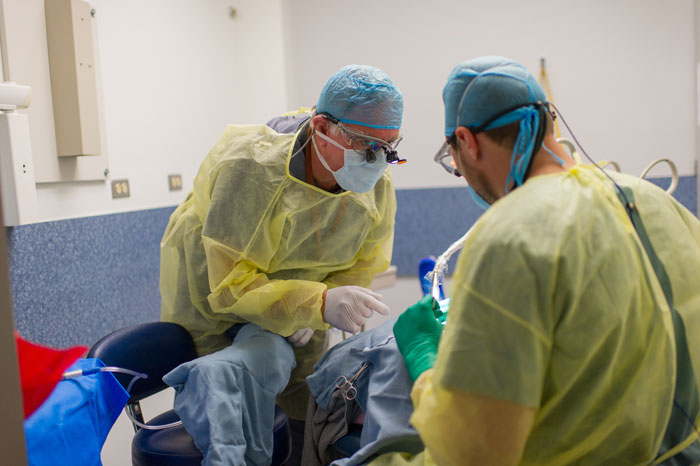 After 38 years in dentistry, the last seven spent teaching, dentistry is what he thinks about before sleep takes over. It’s his first thought in the morning. As he’s driving home from work, he's thinking about different techniques to share with his students.
"I think it’s true about any medical profession, it can become all you’re about," said Dr. Hill, assistant professor in the Department of General Dentistry. "You need multiple diversions to break the train of thought and give your brain a rest, give your body some rejuvenation, recreation and do something completely opposite of what you are engaged in."
At the point where dentistry became all-consuming, Dr. Hill decided it was time to find an outlet. He never thought of himself as artistically inclined, but he saw his father find joy in oil painting. Art, he mused, could be one way to break away from the rigidity of his profession and bring some peace to his overworked brain.
"There are very exacting protocols to accomplish a dental procedure and we’re very rigidly trying to achieve perfection in everything that we do," he said. "The only way I knew to find release or a mode of expressing my individuality was to start doing some artwork, and I had always been fascinated with ceramics."
After more than a dozen ceramics classes in the span of about five years, Dr. Hill’s distraction has become more than a hobby. It’s become his therapy. To date, he’s created upwards of 300 bowls. Some are painted in vibrant colors in homage to the multicultural city he lives in, others are textured and glazed in soothing earth tones. He uses the paintbrushes his dad used, and feels an emotional connection to the man who introduced art into his life.
Dr. Hill used to give away his bowls to students at Christmastime as gag gifts. Today, students and colleagues alike ask him for his pieces. They decorate the School of Dentistry, often sitting atop desktops and shelves. He’s also started selling his artwork, participating in local art shows and sales through the pottery workshop.
Though dentistry must be exact, art is fluid and flexible. He has learned that imperfections can lead to beautiful and functional art. Flexibility is one of the things he likes the most about ceramics.
"Dentists tend to be terribly critical of themselves, even when a procedure has been successful. When you create something away from your profession, it helps you be a little bit more flexible and not be so hard on yourself. It helps me be a little more tolerant, and recognize that in anything we do, there are going to be flaws and imperfections. Even with great success, even with something that looks beautiful.
"And it has added something else that’s important. It has added to my mental health."
Living BOLD
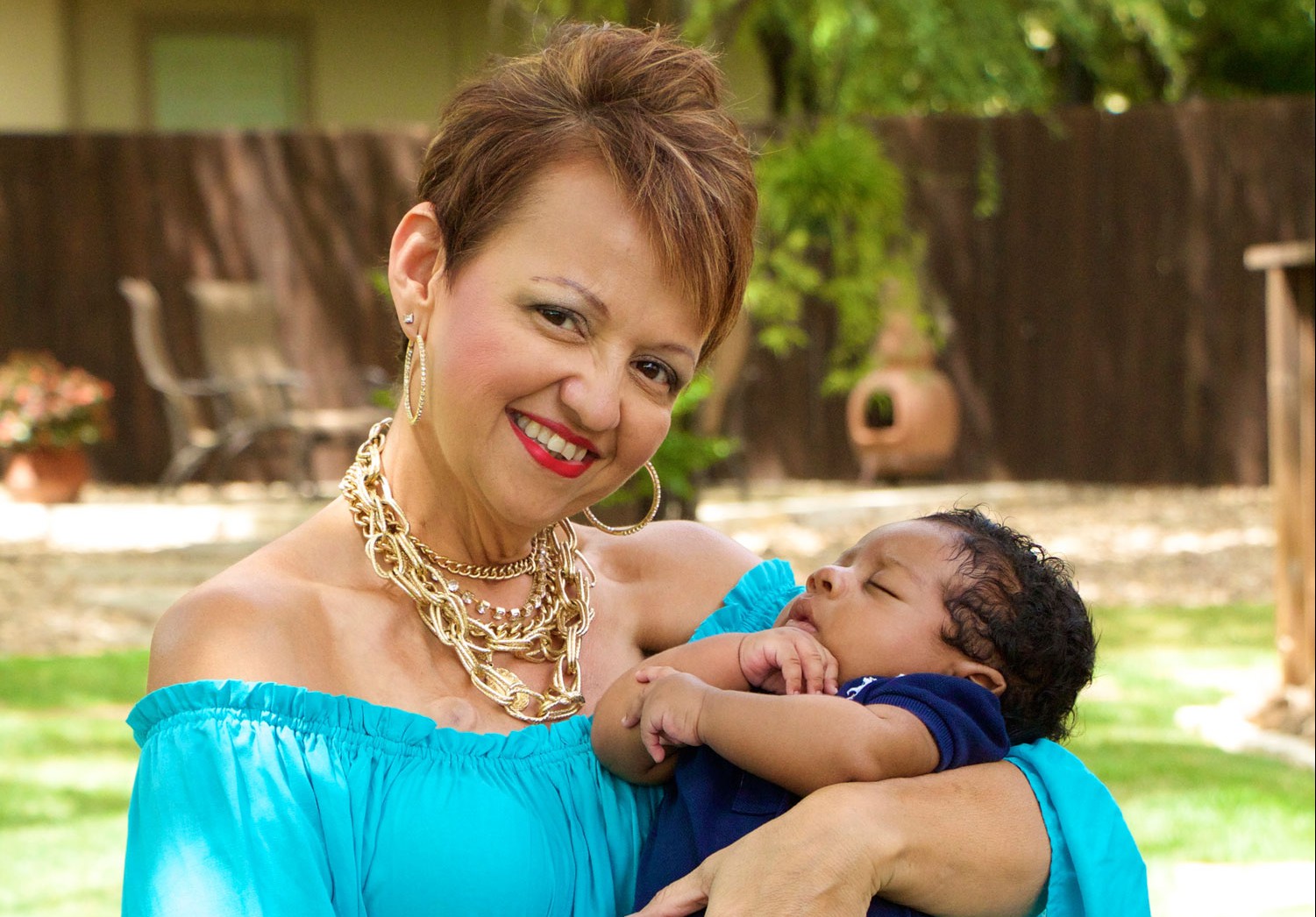
She calls herself a cactus, with thorns to protect her and the resilience to withstand anything. A Texas prickly pear cactus can survive snow, drought and injury. When a cactus gets cut, it scars and keeps growing. And it produces life in the delicate yellow flowers that sprout along its hard ridges.
After three bouts of cancer, Julie La Fuente Louviere is cut and scarred, but she’s still going.
"It rains, it thunders, it’s cold and it’s hot. The nopal is still standing," she said. "And it’s standing with pride, with its needles out. Nothing is going to make it weak."
Louviere was 29 when she was diagnosed with breast cancer. After a mastectomy, she began chemotherapy. Five years later, she heard the word every cancer survivor dreams of hearing: remission. Then came more good news. Despite the damage to her ovaries caused by the chemotherapy, she was pregnant with her second child.
But the excitement was short lived.
Just into her second trimester, the cancer came back, this time in her liver and bones.
"It didn’t look good," she said. She was given two months to live. Doctors advised her to terminate her pregnancy and begin intensive chemotherapy. She refused.
"I said, ‘God won’t give me anything I can’t handle.’" She became the first woman documented in medical books to undergo chemotherapy while in advanced pregnancy. She was told her baby would have a slew of health problems. But on Valentine’s Day 1998, her daughter, Alis, was born—healthy despite the odds.
And eventually, Louviere’s cancer disappeared.
"She’s my miracle baby," she said. "In a way, I believe it was my daughter who saved my life."
Louviere’s story of survival is one of 26 featured in Nuestras Historias: Mujeres Hispanas Sobreviviendo el Cáncer del Seno (Our Stories: Hispanic Women Surviving Breast Cancer), a collection of essays by Latina breast cancer patients and survivors.
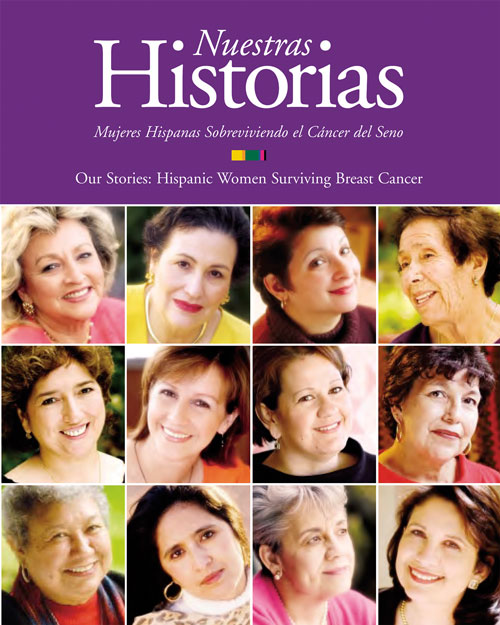
The 114-page book, written in both English and Spanish, was produced in 2004 by Redes En Acción, a national Latino cancer research network funded by the National Cancer Institute and based at the Institute for Health Promotion Research at the Health Science Center. Louviere said she never hesitated when asked to share her story.
"Not only was my story going to give hope to some lost soul that was out there, but it was going to be given in two different languages," she said. "And to me, if God had me here for a reason, maybe that was the reason. If I could help my own race and my own women to understand this disease and understand there is hope after breast cancer and know that you can be a mommy and a wife, and you can be a sister, and you can be a loving aunt fighting this disease and still making cookies for the neighborhood children, it would all be worth it."
Like a picture taken a decade ago, the stories are frozen in time. But in the 10 years since the book was published, much has changed. Of the 26 original authors, 10 have died. And once more, Louviere is battling yet another bout with the disease—for the third time.
The numbers speak loudly as to why the book was written. Breast cancer is the leading cause of cancer death among Latina women, and the number of cases is steadily increasing. The purpose of the book was to put faces to the startling statistic, and offer hope, comfort and advice for others battling breast cancer, said Sandra Lorena San Miguel, research instructor for the Department of Epidemiology and Biostatistics and the institute.
"Latina women put themselves last," she said. "Their needs are so primary—howto putfood on the table that day. They don’t see the long term.
"We wanted to produce something for women that they could relate to so they could go out and face their fears and say, ‘We can do this.’"
Since it was printed in 2004, the book has won several awards and has been distributed for free to breast cancer patients, survivors and their families. It also lives online, and has been used by othersupport programs to help patients as far away as Wisconsin.
Most importantly, it has been shared by the authors who participated, and passed down to their nieces, daughters and grandchildren. Now a new generation of Latinas can be armed with the knowledge that the participants themselves felt they lacked, Louviere said.
"The book made me feel like I could help people," Louviere said. "It made me feel like we were a group of not only cancer warriors, but Latina warriors. And we needed to get heard. And we did."

Battle scars
The cover of Nuestras Historias is a mosaic of women’s faces. There is strength, resolve and beauty. There’s no visible sign of cancer.
"For the women who read this book, I think it shows them that not all cancer patients look a certain way. You can see us looking fabulous," said Tanya DelValle, who was also featured in the book. At the time of her diagnosis in 1997, she was 27 years old, the youngest breast cancer patient in San Antonio. "It also shows you the very real side of this. It does take some lives. But it shows that you are a survivor from the minute you’re diagnosed, not from when you’re done with chemo. It can happen at any age, yet you can still survive."
DelValle’s survivor story began when she was in the prime of her life. She was engaged, and working as a coach and a biology teacher at a local high school. A routine visit to the doctor revealed her lump, but neither her doctor nor DelValle were concerned. At that time, there weren’t many women in their 20s who had cancer.
The lump continued to grow, and when doctors tried to drain the cyst, nothing but cells came out. Immediately, more tests and a biopsy were scheduled. Then, just before Thanksgiving, she got the devastating news: It’s malignant.
In a flash, her life changed. She joined survivor groups, and other women fighting breast cancer became her best friends. Her sense of security was shattered as she watched those friends die.
"I changed a lot," she said. "I saw life through a different lens. I appreciated things a lot more. I have always been a pretty happy person, but I found an inner strength that I didn’t know existed."
She focused on the women she saw hitting and passing the all-important five-year milestone that signals remission.
"I remember looking at them and going, ‘I am going to be you one day,’" she said.
When San Miguel asked her to write her story for Nuestras Historias, she had finally passed the milestone. Along with the scar from her lumpectomy, she wore another battle mark, a tattoo of the Energizer Bunny playing a drum with a pink ribbon on it to symbolize her promise to keep battling against cancer.
"I became that woman that other women look to and say, ‘I’m going to be you one day,’" she said. "I loved that chance to give them hope."
And she’s now living her dream, she added, despite the challenges that cancer threw her way. She is married to her best friend, Rudy, and surrounds herself with family and friends.
The incidences of breast cancer are highest for non-Hispanic white women,yet it is Latinas who are less likely to survive for five years after diagnosis. Latinas are 2.3 times more likely to be diagnosed at a later stage because they delay or forego routine wellness checkups.
"Latina women typically hold back. Even when they find a lump, they don’t see a doctor," San Miguel said. "There are resources in thecommunity, but a lot of times they don’t follow through because of fear."
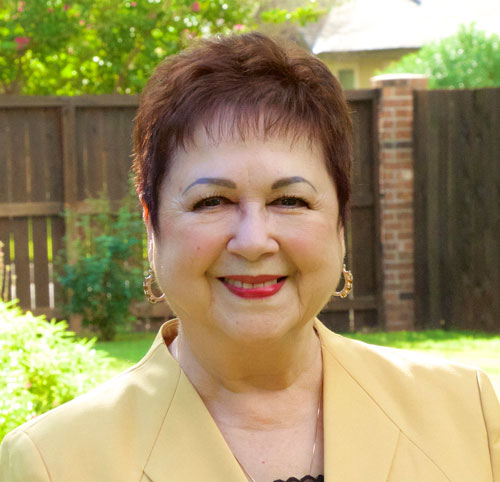
When Sylvia Beilstein felt the small lump in her breast, she kept it a secret from everyone, even her husband. At the time, he was unemployed and health insurance had not yet kicked in through her employer. She took a gamble and waited.
Once she saw the doctor, the rest happened quickly.
"I had to have a full mastectomy because they didn’t know how much cancer had gotten loose and traveled throughout my body," she said. That was 31 years ago.
Soon after her diagnosis, Beilstein’s mother was diagnosed with breast cancer. And five years ago, her daughter, Laura, found out she, too, had the disease.
For Beilstein, who is called the Mexican Lucille Ball by her family because of her propensity for fun and laughter, the moment her daughter was diagnosed was a turning point. Out came Nuestras Historias. She used it to give Laura hope and to remind her that she wasn’t alone.
"In some way or another, we women can relate to each other," Beilstein said. "The more women are made aware, the more they will examine themselves."
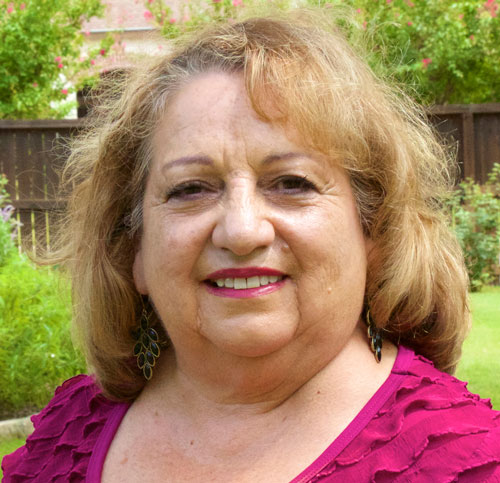
Women need to be educated, and they need to feel empowered, said Bea Vasquez, who helped San Miguel find survivors to share their stories for Nuestras Historias, and who also is a 15-year breast cancer survivor featured in the book. The cancer diagnosis didn’t stop her from being active in the community or from raising one daughter and six foster children.
"The fight is a hard one, but we are going to fight and not be afraid," Vasquez said. "And if it comes back, we are going to fight with even more power."
A decade of milestones
Ten years after its original release, Nuestras Historias remains an important project in the lives of the participants. It gave them a chance to share their knowledge and experiences. It let them deliver hope to strangers who were going through the turmoil that a cancer diagnosis brings. And it identified them as survivors, even in the grip of illness.
"When people think of women going through chemotherapy, they think she’s gray, she’s bald, she’s fragile," Louviere said. "They never see she’s vibrant. They never see she’s a fighter. They never see the port that means that she’s a warrior. They never see the charisma, the attitude, the willingness to fight. They don’t see that the person has her lips done and her makeup done because she’s enjoying that day, that moment, and she’s not taking it for granted."
But that’s what the book did, Vasquez said. It captured the women in the beauty of life.
"To see all these women featured, with beautiful haircuts and makeup, one breast missing, two breasts missing, no breasts missing—and to see them feeling good about themselves, that’s what the book portrays," Vasquez said. "It was important that we show that you can be a cancer survivor and still look beautiful and still get up in the morning and still feel good about yourself."
There are other lessons in the book as well. Like Louviere’s nopal, the essays urge all women to keep growing by learning more about cancer, to spread hope like the flowers that blossom along the cactus’ ridges, and to boldly live life.
Though Louviere was given an expiration date years ago, she hasn’t stopped living. This year, she reached a milestone she never thought she’d see.
"Turning 50 years oldwas the biggest thing ever. I wanted to turn 50 so bad," she said.
And then the second-biggest thing happened. She became a grandmother, or, as she calls herself, "Glama."
"It was the frosting on the cake," she said. "Before cancer, I was very materialistic. I never had time to smell the flowers. The new me enjoys everymoment that there is. Traffic, the heat. I just enjoy that God has given me the energy for today."
For 22 years, Louviere has been a cancer patient. Like the nopal, she’s scarred, but she wears the wounds of cancer proudly.
"I have learned the power of prayer," she said. "I have learned that life is way too short. I have learned that when God throws you lemons, you make a little lemonade, and I’ve learned that it’s OK to feel sad some days.
"I have learned that it’s OK to wear a bikini and have all these scars on your body. You call those your warrior scars. And I’ve learned that it doesn’t matter where you start, as long as you finish. And you finish with your head up, your shoulders back and with a smile."
But, she quickly adds, she’s not finished yet.

Creating a community
First McFee Scholars begin their journey to become physicians
Fifty years ago, Arthur McFee, M.D., like all Harvard medical students at the time, was a resident of Vanderbilt Hall. For four years they ate together, studied together, worried together. They mentored each other and supported each other through the rigors of medical school.
"We had breakfast, lunch and dinner together all four years," he said. "By virtue of that fact alone, there’s a certain amount of commonality forged."
Today’s medical students often live separately, off campus, and that presents a different challenge, he added. The communication and mentoring opportunities that come naturally with roommates have to be created.
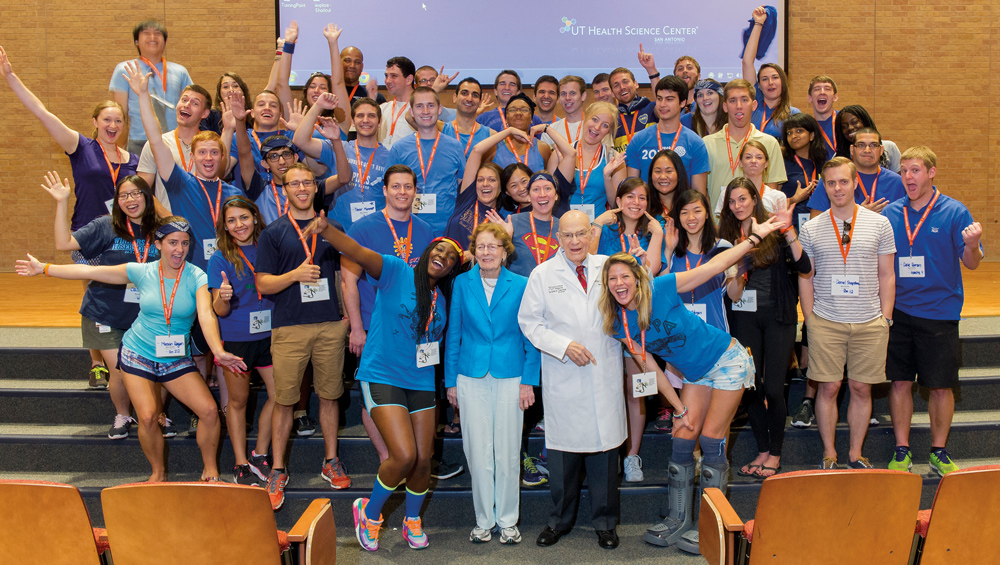
At the Health Science Center, those opportunities come in the form of the Veritas, a student advising system. Created in 2006, Veritas takes incoming students and clusters them into 20 groups within five color-coded societies: Green, Red, Blue, Yellow and Purple. Each group is led by a clinical faculty member and upper-level medical students who act as mentors and peer advisers. Students remain with their groups throughout their medical school careers.
Through group and one-on-one activities, the students learn about critical issues such as choosing the best career, study strategies and professionalism in medicine.
There also are retreats, outdoor competitions such as tug-of-war, and social hours to help build camaraderie.
"It’s the opportunity to be with one another and talk to one another and communicate and go back and forth," Dr. McFee said. "I realized that was something that, when I was a student, we took for granted because of the way things were set up."
With that realization, Dr. McFee, professor emeritus of surgery and one of the founding faculty members of the Health Science Center, and his wife, Iris, have designated $75,000 to create the Dr. Arthur S. McFee Society Endowment for Student Academic Enhancement. The money supports the Blue Society, and the students will now be known as McFee Scholars.
"We have been associated with the medical school since 1968," Dr. McFee said. "It was my first and only academic appointment and with it came the privilege of starting a new school from scratch and watching it grow.
"We are grateful to the school for the opportunities it has given us to share in its development. We regard the support of this endowment as a payback for an investment that the school made in us 40 years ago."
Christine Andre, M.D., Veritas director and associate professor of medicine, said the gift will be used to support general Veritas activities.
"I am so grateful to Dr. and Mrs. McFee for their generous endowment and genuine interest and involvement in the students who are the future of medicine," she said.
One of those students, Karli Silverberg, a first-year medical student and one of the first McFee Scholars, joined about 220 other first-year students at a pep rally the morning after receiving their white coats—the rite of passage for students beginning the journey to become physicians. With tortilla tosses and other icebreaker exercises, Silverberg was introduced to her fellow classmates, and the group of peers who would soon become her friends and mentors.
She said entering medical school is daunting, but being a part of a group of students who are sharing the same experiences makes it easier. "It’s really important to have a group like this," she said. "I think it contributes something special. I feel like I’m part of a community."
Lion's Heart
Hearst Foundations’ gift supports congenital heart disease patients and their families
When Lyla Grace Santos was born, her parents, Matthew and Amy, noticed she was breathing rapidly. But everything looked fine—born at 41 weeks, she was a solid 8 pounds, 7 ounces.
Two hours later, she was blue.
Within hours, arrangements were made to fly her from her Fort Hood, Texas, hospital to San Antonio’s University Hospital, where, at just 2 days old, she would undergo open-heart surgery to repair the constriction in her heart.
As they were wheeling her from the helicopter, the song The Lion Sleeps Tonight was playing on a nearby television in University Hospital. From that moment on, Lyla became the Santos family's lioness, and she was about to undergo the fight of her life.
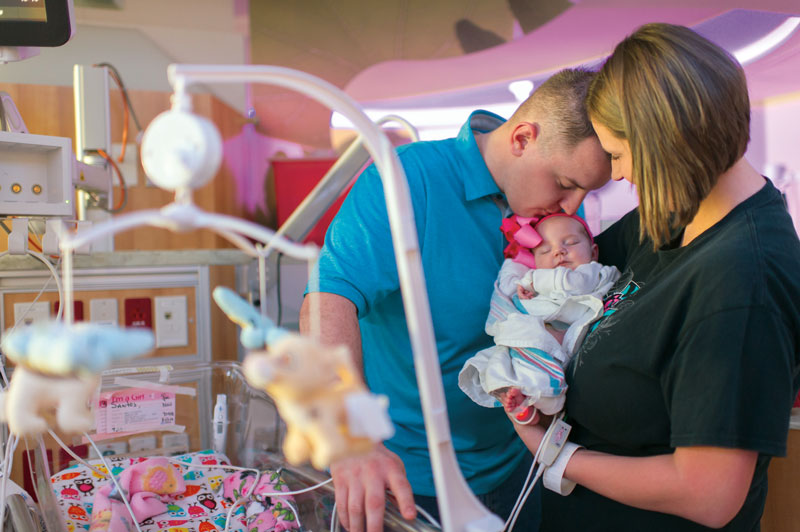
Nearly a month later, Amy Santos cradles her daughter as a tube carries milk through Lyla’s nose to her belly. Her husband works to install a lion mobile over her temporary crib, a radiant warmer in the neonatal intensive care unit. They’re tired and missing their 4-year-old son, Logan, who is staying in Fort Hood with relatives, but grateful that Lyla is alive and hopeful that soon the family of four will be home together.
"We didn’t expect this to happen," said Matthew Santos, explaining that their son originally went to visit relatives as the due date grew closer. What began as a two-week adventure has become a prolonged separation, and the toddler often asks if they’re still a family.

"He didn’t understand at first," Matthew Santos said. "He got to see her the night she was born, and then she went into the NICU and he hasn’t seen her since. He sends videos every day showing her how much he loves her."
That’s not the only challenge. When they were told their daughter would need emergency surgery and would be flown out of their city by helicopter, there was a confusing whirlwind of activity—at one point, the Santoses didn’t even know what city they were in, much less where they would stay.
"We got here and we didn’t know what we would do or how long we would be here. We didn’t even know her exact diagnosis," Matthew Santos said.
This confusion is typical for families who have just been told their newborn has a critical heart condition, said S. Adil Husain, M.D., director of pediatric cardiothoracic surgery and associate professor in the Department of Cardiothoracic Surgery in the Long School of Medicine.
"The stresses are unimaginable," said Dr. Husain, who leads the university’s Congenital Heart Program, which delivers specialized, coordinated care to babies with congenital heart defects. Around 350 heart surgical procedures are performed each year through the program.
"Forty percent of our work is done on babies who are less than a month old when they need an operation," he added. "In addition, about 40 percent of our patients are from outside of Bexar County, so we have a significant number of families who have to temporarily relocate to San Antonio while their newborn child is undergoing a very complex heart operation."
Dr. Husain is the inaugural holder of the William Randolph Hearst Endowed Chair in Congenital Heart Disease. The chair was created through a $350,000 gift from the Hearst Foundations to the Health Science Center to help attract and retain leaders in pediatric cardiothoracic surgery and to ensure excellence of care for South Texas children with congenital heart disease. The Hearst Foundations’ leadership gift was matched through a gift from the Greehey Family Foundation for this lifesaving program and the pediatric surgical team that it supports. The vision is to continue building the Hearst chair to reach $1 million in the endowment.
"When someone has just had a baby, they’re excited, but then they find out their baby has complex heart disease and requires a major heart operation. It’s a medical challenge, a psychological challenge and a familial challenge on all levels," Dr. Husain said. "Our entire team and program are committed to not just the neonate, but also to the entire family unit."
While there are more than 40 types of congenital heart defects, one of the most complex is single ventricle disorder, in which the heart has only one adequately sized functional pumping chamber instead of the two chambers that are found in a normal heart. Typically, this condition requires a series of three invasive surgeries in the first two to three years of life. As recently as two decades ago, this disorder was fatal. Today, 60 to 70 percent of children born with single ventricle heart defects survive all three surgeries due to improvements in surgical techniques and the emergence of multidisciplinary teams to care for these fragile patients.
But relocating, even temporarily, puts a strain on the family. Because of that, "We’ve done a lot in our program to treat these families in a unique way," Dr. Husain said.
And with the Hearst Foundations' gift, even more will be possible. Already, it has been the catalyst for expansion of the Health Science Center’s congenital heart disease program. The program’s priorities include creating bilingual education modules to explain congenital heart disease, the required surgeries, the sequence of care and the expected outcomes. Other priorities are providing social work evaluation, psychological family support and patient navigation, and helping families identify housing and other services during lengthy inpatient treatment periods. Funds will also go toward telemedicine support for inter-stage follow-up care of patients outside the San Antonio area.
Longer term, Hearst endowment funds will allow Dr. Husain and his team to track programmatic outcomes to help in research. And, with the growth of the program, medical students and residents will have more opportunities to experience the medical and surgical care provided, so a pipeline of future health care providers will be cultivated in this field, Dr. Husain said.
"Our team is exceptionally passionate about this project," Dr. Husain said. "It has been wonderful and gratifying to have the support of the Hearst Foundations. They have become a valuable partner in our mission to ensure excellence of care for South Texas’ most vulnerable patients and their families."
George Irish, vice president and Eastern director for the Hearst Foundations, said the gift recognizes the groundbreaking work being done.
"What Dr. Husain and his team at the Health Science Center are doing is really impressive," he said. "They cover an extensive service region and care for critically ill babies in the first days of their lives. Not too long ago these infants would have perished, but the doctors here have a very high success rate of saving them so they can go home with their parents. The Hearst Foundations saw this as an investment in the future of health for children and their families."
 Under the dim blue lights of the NICU, the Santoses talk quietly about going home. They don’t know when Lyla will be well enough to leave the hospital, but both agree they’ll stay as long as they have to. Their lioness will not be rushed.
They know more now about Lyla’s illness, hypoplastic aortic arch, or narrowing, of the aorta, and they have a clear idea of what lies ahead for their daughter. It has been a long journey of discovery, and they say they are happy that the Hearst Foundations' grant will provide invaluable assistance to other families who may someday travel the same path.
Already, the resources and support Lyla’s doctors and staff have provided are more than they could have hoped for, Matthew Santos said.
"It’s overwhelming to me, to tell the truth. I can’t ever repay what they’ve done for us. We’ll be forever grateful."