
Art and science of learning
For months, they were the focus of conversations on campus - the buzz in every building. Students and faculty waited patiently, containing almost giddy excitement, for the unveiling of the new Library Classrooms.
On Jan. 4, the doors opened. You could almost hear the "oohs" and "ahs." Mouths nearly hung open and eyes danced in delight as students poured into the main entrance of the new Library Classrooms, located on the second floor of the Briscoe Library.
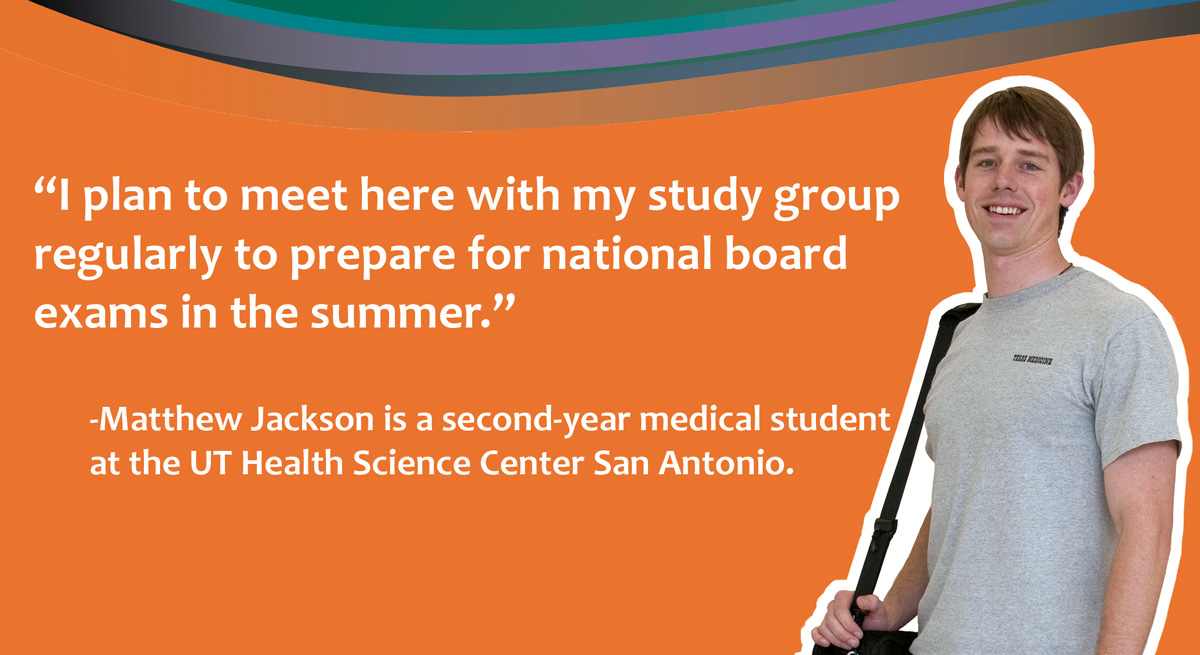
"Exciting, versatile and modern," are the three words second-year medical student, Matthew Jackson, used to describe the area. "I'm really impressed with the design and the stark contrast to our previous multipurpose laboratories," he said.
The renovated facilities, which took more than two years of planning and one year of construction, replace what were known as the multidisciplinary classrooms located on the second and third floors in the C corridors in the Long School of Medicine building. What began as a dream in the minds of many faculty members several years ago became a reality when UT Health Science Center President William L. Henrich, M.D., MACP, who was dean of the Long School of Medicine at the time, initiated the plan and advocated for construction to begin in 2008. The completed facilities are now available for use by all faculty and students from every school at the UT Health Science Center.
The renovated area encompasses more than 16,000 square feet of classroom and individual, group-study and meeting space and can hold up to 300 students and faculty at any given time. At a cost of $4.2 million, the rooms don't disappoint. Brightly colored walls and contemporary lighting lead to a corridor of classrooms equipped with the latest in high-tech teaching and learning systems. Three large master classrooms feature built-in lecterns that house a control system including a DVD unit, computer interface, document camera and an 18-inch LCD touch-screen monitor that serves as a preview and writing surface for electronic annotation capabilities. This allows a presenter the ability to make notes over computer-generated images displayed on a 50-inch screen for viewing by the entire classroom. Plans are under way to enable the uploading and sharing of classroom presentations to Blackboard, the online system faculty and students use to communicate coursework and assignments.
Faculty members indicate the rooms are distinctive from multidisciplinary classrooms at other universities throughout the country because they combine electronic work stations and wet lab space.
"Our old multidisciplinary classrooms were constructed as part of the original medical school teaching rooms more than 40 years ago," said Nan Clare, M.D., who served on the Library Classroom Planning Committee.
Dr. Clare is the senior associate dean and associate dean for academic affairs in the Long School of Medicine.
"They became outdated over time and inflexible for teaching methods used today," she said. "It's wonderful to have a brand new space especially designed to accommodate desks equipped for digital technology, and sinks and cabinets for our microscopes and specimens, all within the same room."
Frank Weaker, Ph.D., professor in the Department of Cellular and Structural Biology, is a co-course director for Dental Histology and course director for Structures of the Head and Neck that is taught to first-year dental and dental hygiene students. He also lectures and is a lab instructor in the Dental Gross Anatomy courses.
"Because we have so many students in medical and dental histology courses, we used to have to spread them out over two floors in our previous lab space. This can be a logistical nightmare for faculty to keep track of students and to disseminate information during labs," he said. "It's refreshing to have everything we need, including the blood labs, located on one floor in a modern, vibrant and flexible new working environment."
In addition to the10 classrooms, the area features a video-conferencing room as well as three study/meeting rooms each with 42-inch plasma displays and touch-control panels on the walls. All rooms feature collapsible walls for increasing or decreasing the size of meeting space. Furniture is adjustable and moveable for further flexibility and comfort. An abundance of power outlets with network drops, wireless networking and digital signage line the walls leading to a multipurpose charting station and three seating/waiting areas.
Jackson said he intends to spend a great deal of time using the facilities. "I plan to meet here with my study group regularly to prepare for national board exams in the summer. The new space is convenient and it's easy to find a comfortable and functional area to spread out my notes. It certainly will make my life less stressful."

Briscoe Library Computer Classroom now open
Students and faculty now have access to the newly remodeled computer classroom conveniently located among the renovated Library Classrooms. The classroom, which can accommodate up to 25 students, is equipped with new desktop computers and video-teleconferencing capabilities. Librarians offer courses in database searching skills, locating evidence-based literature, records management, bibliography management and scholarly applications for social technologies such as Facebook, Twitter and various Web feeds.
 To schedule computer-related training in the computer room, call (210) 567-2450 or send an e-mail to askalibrarian@uthscsa.edu.
The Library Classrooms, located on the second floor of the Briscoe Library, are open to students, faculty and staff 24 hours a day, seven days a week. Access after 7 p.m. is available with a Health Science Center key card. To reserve a classroom or study room, call (210) 567-2655 or send an e-mail to scheduling@uthscsa.edu.
To receive training on the new annotation system, contact Jimmy Chamberlin, laboratory supervisor, at (210) 567-2306 or chamberlin@uthscsa.edu.

Dr. Thompson answers the call
It didn't take long for Ian Murchie Thompson Jr., M.D., to get a glimpse of how much his life was about to change as the new executive director of the Cancer Therapy & Research Center (CTRC) at the UT Health Science Center. On March 12, William L. Henrich, M.D., MACP, Health Science Center president, announced the permanent appointment.
Dr. Thompson had been serving as the interim executive director since Oct. 23, 2009. The executive-level change was announced after Dr. Henrich accepted the resignation of Tyler Curiel, M.D., M.P.H., as executive director of the CTRC. Dr. Curiel, a professor of hematology and medical oncology and renowned researcher in ovarian cancer, expressed a desire to devote full attention to his laboratory and clinical research.
After the announcement was made, literally hundreds of people called Dr. Thompson's office requesting time to meet with him about various issues. Dr. Thompson ruefully acknowledged, "God still gives you only 24 hours a day and you do have to sleep a little bit of that."
The void created by Dr. Curiel's resignation as executive director prompted a decision to restructure the executive team and to bring in leaders "superbly equipped to hit the ground running for the sake of the community and cancer center patients," noted Dr. Henrich.
Dr. Thompson's ability to manage multiple roles with successful results convinced Dr. Henrich that Dr. Thompson was the right man for the job.
"I've been extremely fortunate in my career to have many opportunities and many folks who have looked after me. It's time for me to do that for other folks."
- Ian M. Thompson Jr., M.D.
Hitting the ground running
During the first few days of his new post, Dr. Thompson demonstrated little need for sleep and boundless stores of energy. He maintained his previous responsibilities while finding two and a half days a week to run the cancer center.
"When Ian joined our urology faculty, it was a division of the Department of Surgery," Dr. Henrich said. "Ian grew it into a robust department. As chairman, he has increased the faculty four-fold. He has doubled the number of residents, has added fellowships and created a fine research team."
In addition to managing the steadily growing department, Dr. Thompson continues to thrive as a busy physician and surgeon. As a researcher, his work is recognized for changing global clinical practice. He is supported by two endowed chairs: the Henry B. and Edna Smith Dielmann Memorial Chair in Urologic Science and the Glenda and Gary Woods Distinguished Chair in Genitourinary Oncology. As a scholar, he has authored more than 400 journal articles and books. Recently, one of the leading cancer research groups, the American Society of Clinical Oncology, cited one of Dr. Thompson's papers as "one of the 15 most significant cancer research advances in 2009."
"I want him to bring the same kind of success to the CTRC he has brought to the Department of Urology," Dr. Henrich noted. "Take a premier cancer center and grow it so the people of San Antonio and South Texas will have the very best cancer center. We want people here to say, 'I don't need to leave South Texas if I have cancer.' We want people in other parts of the U.S. to say, 'If I have cancer, I want to go to CTRC for the very best treatment.'"
Dr. Thompson views this challenge as a privilege. "I've had the good fortune to be in organizations that are on the cusp of growth. I've been extremely fortunate in my career to have many opportunities and many folks who have looked after me. It's time for me to do that for other folks," he remarked.
One CTRC administrator considers Dr. Thompson to be a mentor. "He has an uncanny ability to ask the difficult question without letting people dodge it, and without being confrontational or dictating what the answer should be," said David Raney, chief administrative officer for the CTRC. Raney also appreciates Dr. Thompson's collaborative management style. "He's brought intothis venture an attitude of excitement. People want to push ideas forward."
Goals for growth and faculty recruitment
Establishing a strong financial base for the CTRC is Dr. Thompson's first priority. He and other executives have taken a number of steps to manage costs and increase revenue. "These measures will position us to add new, accomplished faculty members who will allow growth in the overall cancer programs," Dr. Thompson said. With more physicians in multiple specialties, the CTRC can see more patients and treat a wider variety of cancers. More physicians attract more referrals through networking with university and community physicians. They also can open more clinical trials that make new investigational treatments available to patients.
"We are currently concentrating our recruitment efforts on oncologists who will strengthen or establish strong clinical programs in four major disease groups: breast cancer, gastrointestinal cancers, lung cancer and genitourinary cancers," Dr. Thompson reported. "We also will further strengthen our programs in hematologic cancers, sarcomas and neurologic cancers. Alongside these superb clinicians will be a growing cadre of researchers in the basic sciences, providing new insights into improved care. We have scientists who have made discoveries that are begging to be taken into the clinic."
Dr. Thompson believes he is hard-wired to succeed because success means better care for patients.
"It's more than just the technical operation of infusing a drug or delivering radiation. We also want to help people understand that there's a range of treatments and that we can help them choose which one is right for them. We want to take care of their body and their soul," Dr. Thompson said. "Part of our responsibility is to give folks hope and to support them emotionally. We invest heavily at this institution in the person's whole being. Finally, and most importantly, we must invest in cancer prevention. My philosophy is: 'If we're not in the business of preventing cancer, essentially putting ourselves out of business, we're in the wrong business.'"
Proven leadership
Education and training
- B.S. - U.S. Military Academy, West Point
- M.D. - Tulane University School of Medicine, New Orleans
- Internship, residency - Brooke Army Medical Center, San Antonio
- Urologic Oncology fellowship - Memorial Sloan-Kettering Cancer Center, New York City
Leadership and service
- Led surgical units at Brooke Army Medical Center during 1990s
- Service as surgeon in 41st Combat Support Hospital, Iraq and Saudi Arabia, Operation Desert Storm
- Chaired the Health Science Center's Department of Urology since 2004. Directs the Genitourinary Cancer Clinic.
- Led one of the largest National Cancer Institute-sponsored trials in prostate cancer (more than 200 sites, almost 19,000 patients)
- Vice Chairman, Early Detection Research Network, National Cancer Institute
Community involvement
- Has served on the boards of the Bexar County Medical Society Foundation, South Texas Organ Bank, Keystone School and Brighton School for Children with Developmental Disabilities
Awards for excellence, leadership
- Huggins Medal, Society of Urologic Oncology
- Presidential Citation, American Urological Association
- Distinguished Contribution Award, American Urological Association
- Lifetime Achievement Award-Healthcare Heroes, San Antonio Business Journal
- Presidential Clinical Excellence Award, UT Health Science Center

Thompson's teammates bring wealth of research and experience to CTRC


Serving as CTRC's interim deputy director is Thomas J. Slaga, Ph.D., professor of pharmacology. He is co-leader of the CTRC's Cancer Progression and Development program and director for research for the Health Science Center's Regional Academic Health Center in Edinburg, Texas.
Dr. Slaga brings to the job a wealth of research and experience in directing and establishing research centers. He has been involved for almost 40 years with scientific studies of cancer; his current interests center on cancer causation and prevention.
His research program is currently supported by several National Institutes of Health grants. Founder of the Journal of Molecular Carcinogenesis,
Dr. Slaga has authored more than 300 peer-reviewed publications and a lay book, "The Detox Revolution," which emphasizes the importance of diet, nutrition and phytonutrients in chronic disease prevention.
The CTRC's Institute for Drug Development (IDD) is led by interim director Susan L. Mooberry, Ph.D., a professor with cross-appointments in pharmacology, medicine and biochemistry who is trained in molecular oncology. She is a co-leader of the CTRC's Experimental Therapeutics Program and a productive researcher in cancer drug discovery.
Dr. Mooberry holds seven patents on new classes of antimitotic agents, including one that was clinically developed and tested at the IDD. She is a principal investigator of grants from the National Cancer Institute and Department of Defense to study breast and prostate cancer, and has published more than 60 peer-reviewed publications, reviews and book chapters. Nationally known and respected, Dr. Mooberry has served on scientific review panels for multiple national and international organizations.
Dr. Mooberry succeeds Francis J. Giles, M.B., M.D., professor of hematology and medical oncology, who stepped down from his dual role as director of the IDD and deputy director of the CTRC.
Dr. Giles remains on the faculty, building on his considerable experience in moving novel anti-cancer agents from the laboratory to the bedside. He will continue to focus his clinical and research efforts on providing therapy for patients suffering from treatment-resistant or pervasive disease and those with lymphomas, multiple myeloma and leukemias.
$5.2 million to fund studies of antibiotic's effects on health span
Scientists at the Barshop Institute for Longevity and Aging Studies are testing the therapeutic qualities of rapamycin on age-related diseases and health span, thanks to a $5.2 million grant awarded by the National Institute on Aging. To better understand the broader physiological effects of rapamycin, a team of 21 scientists will investigate the anti-aging effectiveness of rapamycin on various biological systems in aging mice.
CPRIT awards nearly $4 million for faculty recruitment and research
The Cancer Prevention and Research Institute of Texas (CPRIT) awarded the Health Science Center $2 million to recruit a rising star in cancer research. Dmitri Ivanov, Ph.D., is from the Department of Biological Chemistry and Molecular Pharmacology at Harvard Medical School.
An additional $1.8 million was awarded to Ian M. Thompson Jr., M.D., executive director of the CTRC, for his prostate cancer research.

Laredo-area foundation supports Health Science Center programs
The South Texas Outreach Foundation awarded a $50,000 gift to the School of Health Professions. The gift will be used at the UT Health Science Center's Regional Campus in Laredo to recruit students, provide scholarships, offer summer programs and community service projects, and support a spring community and professional education conference. "We are proud to support the UT Health Science Center in its efforts to make health care education accessible to Laredo students and affordable for their families," foundation representatives said.

Improving Latino health is focus of new Web site
The Institute for Health Promotion Research (IHPR) unveiled six new public service announcements and a new Latino health blog and Web site, SaludToday, all geared to promoting healthier lifestyles among Latinos. The site, www.SaludToday.com, features a blog about Latino cancer, obesity and other health topics, as well as videos, resources and the capability for individuals to share their own success stories, from beating cancer to losing weight to quitting smoking. The IHPR outreach effort aims to catalyze Latino families, community leaders and health researchers to reduce and prevent health disparities, particularly differences in Latinos' disproportionate burden of disease compared to non-Hispanic whites.

Medical dosimetry program wins accreditation
The Health Science Center's one-year training certificate in medical dosimetry, offered through the Long School of Medicine's Department of Radiation Oncology at the Health Science Center's Cancer Therapy & Research Center, has become only the eighth program in the country to receive accreditation from the Joint Review Committee on Education in Radiologic Technology.
Medical dosimetry is the science of measuring and calculating the doses and format of radiation given to patients requiring radiation therapy.
"Accreditation makes us more competitive in recruiting high-caliber students," noted the program's education director, Alonso Gutiérrez, Ph.D., assistant professor of radiation oncology. The only other accredited program in Texas is at the U.T. M.D. Anderson Cancer Center in Houston.

School of Nursing receives funds to boost enrollment
Based on the School of Nursing's track record of increasing its graduates to stem the nursing workforce shortage, the Texas Higher Education Coordinating Board awarded the school $210,688 in November 2009, following a $300,000 award presented earlier in September.
Both awards were authorized by the 81st Texas Legislature and were conveyed through the coordinating board's Professional Nursing Shortage Reduction Program.