Tipping the scales: reversing the obesity epidemic among Latino children
$2.1 million from Robert Wood Johnson Foundation supports Salud America!
 Obesity is deadly and growing in the United States. Heart disease, stroke, Type 2 diabetes and cancer are just some of the diseases linked to obesity. By 2030 the U.S. Centers for Disease Control and Prevention (CDC) predicts that 42 percent of Americans will be obese.
Children, especially Hispanic children who are part of the largest U.S. minority group, are quickly falling victim to this deadly trend. Hispanic children aged 2 to 19 are more likely to be obese or overweight than white or black children. The CDC indicates that 50 percent of severe obesity in adults is a consequence of obesity during childhood.
Thanks to a $2.1 million grant from the Robert Wood Johnson Foundation (RWJF), the UT Health Science Center San Antonio is leading national efforts to prevent childhood obesity in Hispanic children and to influence policy and create environmental solutions to the problem.
Their gift is supporting Salud America! The RWJF Research Network to Prevent Obesity Among Latino Children. The program is headquartered at the Institute for Health Promotion Research (IHPR) within the School of Medicine at the UT Health Science Center.
Amelie Ramirez, Dr.P.H., is director of Salud America! and founding director of the Institute for Health Promotion Research.
"We are so grateful to the generosity of the Robert Wood Johnson Foundation," Dr. Ramirez said. "With their support, Salud America! will continue to be the catalyst for reversing a deadly disease afflicting our nation’s and our future’s most precious resource - our children."
Grant expands program, focuses on advocacy
Launched in 2007, Salud America! built a network of researchers, academics, policymakers and community leaders across the United States to address and reverse the obesity epidemic among Hispanic children and adolescents. In addition, a network of multimedia experts produced online resources to raise awareness of the latest research on Latino childhood obesity and educate Hispanic community leaders, parents and youth about the importance of healthy nutrition and physical activity. These are communicated through a variety of e-communications, blogs and social media.
The new RWJF grant will allow Salud America! to expand this 2,000-member national network and focus on developing an innovative system to support, inform and empower researchers, policymakers and the public to advocate for policy changes that will help reverse the obesity epidemic.
Success stories encourage action
Shari Barkin, M.D., a professor of pediatrics at Vanderbilt University in Nashville, Tenn., is among the 20 Salud America! grantees who conducted research focused on Latino childhood obesity. Her study focused on 132 Hispanic families with children aged 3 to 5 in Nashville’s Davidson County. Some families were introduced to their community recreation center for routine physical activity, while others had the same access but were not brought inside and educated about using the facility for fitness and well-being.
"What we found was that exposure to and routine use of recreation centers by Latinos led to sustained use for physical activity one year later by both parents and their young children," Dr. Barkin said. "Activity habits set in early childhood can profoundly influence lifelong paths for health. Our goal is to encourage policymakers to create programs that encourage Latino families to walk through the door and learn how to use their community recreation centers. It’s not just about building or refurbishing recreation facilities. Healthy lifestyle programs targeted at children as young as preschool age have enormous potential to prevent obesity."
Dr. Barkin and her team shared their results with the Metro Parks and Recreation Board of Nashville, Tenn., the Mayor’s Council on Child Wellness, and key community and policymaking partners.
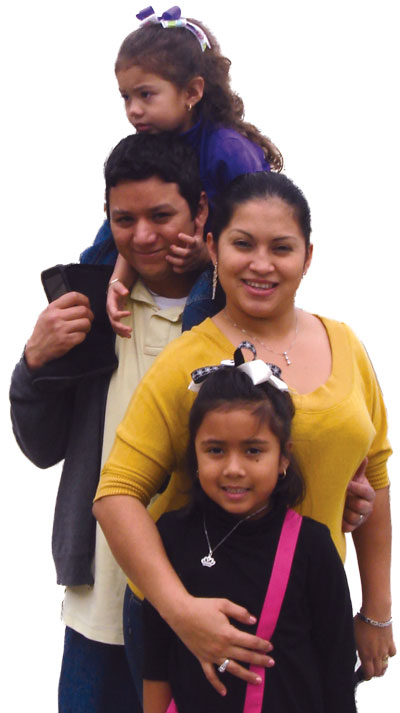
Juan Carlos Mondragon, 32, and his family participated in Dr. Barkin’s study from 2009 to 2011. He and his wife, Irma, and their two children, Leah, 7, and Shayla, 4, were given free access to and educated about their neighborhood recreation facility.
"Going to the center helped us exercise together, as a family," Mondragon said. "And we learned about eating healthier too. I know it’s going to help us in the long run so we don’t become overweight. There should be more programs like this one. And I hope to see more sidewalks, better parks and more bicycle paths in our neighborhood in the future, especially for our children."
Local study involves churches
In San Antonio, Meizi He, M.D., Ph.D., an associate professor of health and kinesiology at The University of Texas at San Antonio, conducted Salud America!research at nine churches on the city’s West Side. She and her team conducted interviews with Latino church leaders and church-attending children aged 10 to 17 and their parents. Researchers learned that church leaders and families were aware of the obesity epidemic and its dangerous health consequences. They identified the need to connect health education with a spiritual dimension through clergy role models; health sermons; Sunday school and Bible-study sessions; after-school and summer camp physical-activity programs; and healthy-cooking classes.
"We found that gathering the ideas and insights of Latino church leaders and congregation members on the issue of childhood obesity is the first step in developing effective faith-based, obesity-prevention strategies, as well as future policy and environmental changes that will help improve the health of Latino children," Dr. He said. She and her team shared their findings with the City of San Antonio Metropolitan Health District and other community stakeholders to encourage support. Their research has garnered additional funding from the San Antonio Life Sciences Institute and the Baptist Health Foundation of San Antonio to develop and implement the faith-based, obesity prevention program, "Building a Healthy Temple," in the predominantly Hispanic communities throughout the city.
Advocating for change
Dr. Ramirez said Salud America!, fueled by these research success stories, will unite a team of research experts, Internet news curators and multimedia content producers to produce a continuous stream of evidence-based information, news and training that researchers, policymakers and the public can use to advocate for changes toward reversing the obesity epidemic. The information will be provided in easily accessible formats such as an online advocacy support platform (with advocacy and policy news, templates, resources, role models and ways to get involved), e-communications, blogs, and social and mass media.
"We believe this platform will empower individuals and groups to advocate directly for evidence-based governmental and corporate policies addressing Latino childhood obesity," Dr. Ramirez said. "We’re excited to continue our work. We hope everyone will join our effort because ensuring a healthy future for America will depend largely on reversing the obesity epidemic in the Latino population."
Salud America! translates to Health America!
Building on its successful research, Salud America! is now turning its attention to a first-of-its-kind effort to deliver and interpret scientific evidence to empower Latinos to advocate for healthy policies. The Robert Wood Johnson Foundation (RWJF) focuses on six policy priorities that evidence suggests will have the greatest and longest-lasting impact on children.
To see the RWJF’s six policy priorities, visit rwjf.org/en/about-rwjf/program-areas/childhood-obesity/strategy.html.
Visit the IHPR online at ihpr.uthscsa.edu or follow its blog at saludtoday.com/blog.
For more information about Salud America!, visit salud-america.org.
Cliff Despress, in the Institute for Health Promotion Research (IHPR) in the Long School of Medicine at the UT Health Science Center, contributed to this story.
A letter from the president
Looking forward to a bright and healthy future

With a brand-new year soon to be upon us, we can look back with pride at the many accomplishments of our UT Health Science Center. Our new 190,000-square-foot South Texas Research Facility has been successfully operating for more than a year; we have recruited many new, outstanding scientists who are pioneering research and patient care modalities; and we broke ground on our $95 million Center for Oral Health Care & Research that, when opened in 2015, will provide state-of-the-art facilities for educating dental students and treating patients.
We are well positioned to meet the demands of the ever-changing landscape of health care, especially when it comes to our nation’s and our future’s most precious resource - our children.
A recent agreement with Vanguard Health Systems, owner of Baptist hospitals, allows us to build a new academic children’s hospital in San Antonio. The Children’s Hospital of Philadelphia, one of the best in the nation, will join Vanguard in the administration of our children’s hospital. The Health Science Center will provide the faculty members responsible for the hospital’s clinical care, research and training programs.
Our physicians and scientists are world renowned for their research and treatment of diseases that afflict children. Together, with the support of generous donors, community leaders and friends, we have made extraordinary advancements in treating and preventing deadly diseases in our pediatric population.
This issue of Mission highlights a few of these programs - and the faculty and donors who partner to make lives better for the children of San Antonio and South Texas. Dental decay, obesity, diabetes and cancer are among the major diseases plaguing children of our region, in particular.
Without your support and the generosity of donors such as Mr. Harvey E. Najim and the Najim Family Foundation, Methodist Healthcare Ministries of South Texas Inc., the Robert Wood Johnson Foundation and Hyundai Motor America, highlighted in this issue, this progress and these programs would not be possible.
We sincerely appreciate your continued support and look forward to an exciting new year of joining with you to make lives better for all in South Texas - and most especially for our children who are the promise of a bright and healthy tomorrow.
Sincerely,
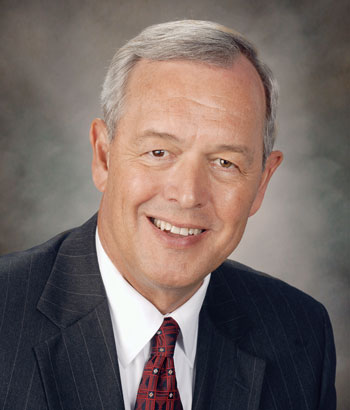
Kenneth L. Kalkwarf, D.D.S., M.S.
President ad interim
UT Health Science Center at San Antonio
Dental School breaks ground on new era of clinical practice
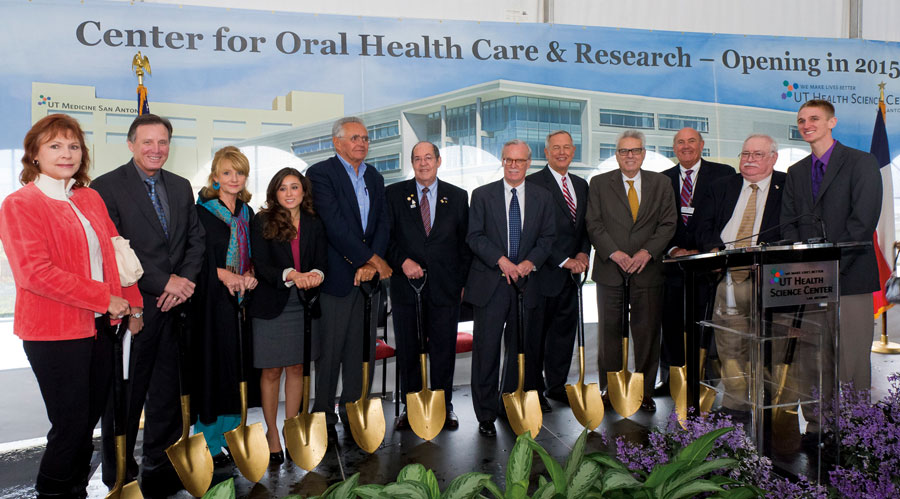
Leaders of The University of Texas Health Science Center at San Antonio broke ground Oct. 26 on the Center for Oral Health Care & Research. The $95 million Dental School facility to be located on Floyd Curl Drive in the South Texas Medical Center will serve as a modern venue for oral health care, education, training and research. The building will be four stories covering 198,000 gross square feet, along with a parking garage of more than 450 spaces. The current Dental School building is almost 40 years old and will be repurposed as existing clinical activities are moved to the new facility. The new center will be patient-friendly by design.
"Visitors will enjoy natural light in many areas and the building will be logically organized, with specialty clinics and a faculty practice clinic on the first and second floor, and student clinics on the third and fourth floors," said William W. Dodge, D.D.S.,dean ad interim of the Dental School.
"The delivery of oral health care is changing, and changing rapidly," said Kenneth L. Kalkwarf, D.D.S., M.S., president ad interim of the UT Health Science Center. He served as dental dean for 25 years. "The Center for Oral Health Care & Research will allow the Dental School to be flexible to accommodate new technologies as they emerge."
Architects on the project are Marmon Mok and Kahler/Slater. The general contractor is J. T. Vaughn Construction LLC. The building is expected to open in mid-2015.
The Dental School will make a significant investment in this building and anticipates a successful fundraising campaign that will be essential to bring the center to fruition.
For more information about the campaign and giving to the center, contact Sara Piety, director of development for the Dental School, at 210-567-6536 or piety@uthscsa.edu.
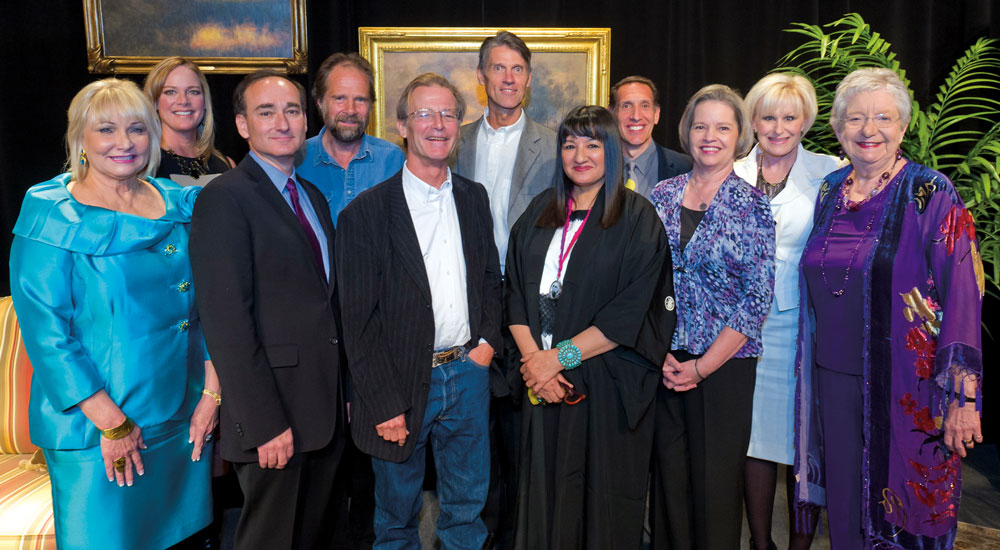
CTRC benefits from Book & Author Luncheon
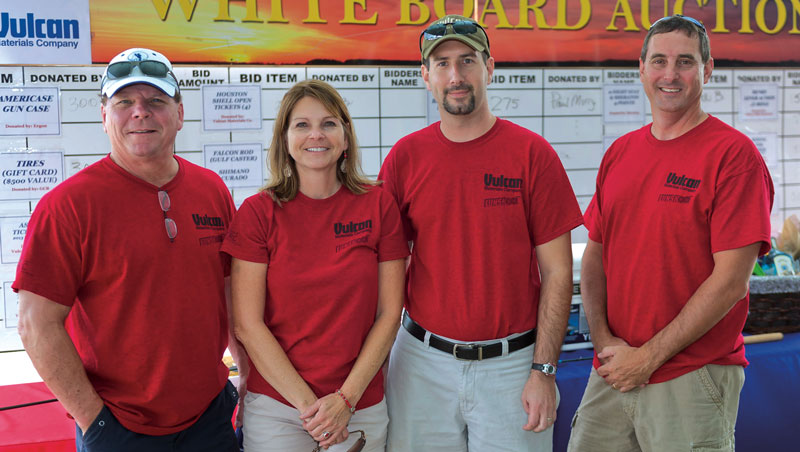
Vulcan Funshoot spells victory
More than 300 turned out this past fall for the 19th annual Vulcan Funshoot which, this year, raised more than $112,000 in net proceeds for the Cancer Therapy & Research Center (CTRC) at the UT Health Science Center. The sporting clay fundraiser has been a labor of love since 1994 for the employees and leaders of the materials company and has raised more than $1.8 million over the years to support the CTRC’s mission to conquer cancer through research, prevention and treatment.

Your legacy, our future
Gifts through estate planning benefit generations to come
"The road to becoming a physician would be infinitely more difficult for students like myself if it were not for generous people who go out of their way to help others. Generosity is infectious. It has been passed on to me and in the future will surely be passed on to somebody else. Thank you for your continued trust and support."
- Jorge A. Ramirez, M.D., Class of 2010 and current resident
Please consider a gift to the UT Health Science Center in your estate planning. Your gift will create a healthier future for generations to come.
Estate gifts provide for:
- World-class faculty
- Life-changing research
- Education of the next generation of health care professionals
Support may be provided in many ways. Perhaps you would like to create a scholarship fund for deserving students. Or, with a named endowment, honor a loved one by supporting diabetes, cancer or Alzheimer’s research.
We are here to help you with the sample language for your desired goals. Contact Kent Hamilton at hamiltonw@uthscsa.edu or 210-567-5001 for assistance.
Making seniors strong through geriatric research and clinical care
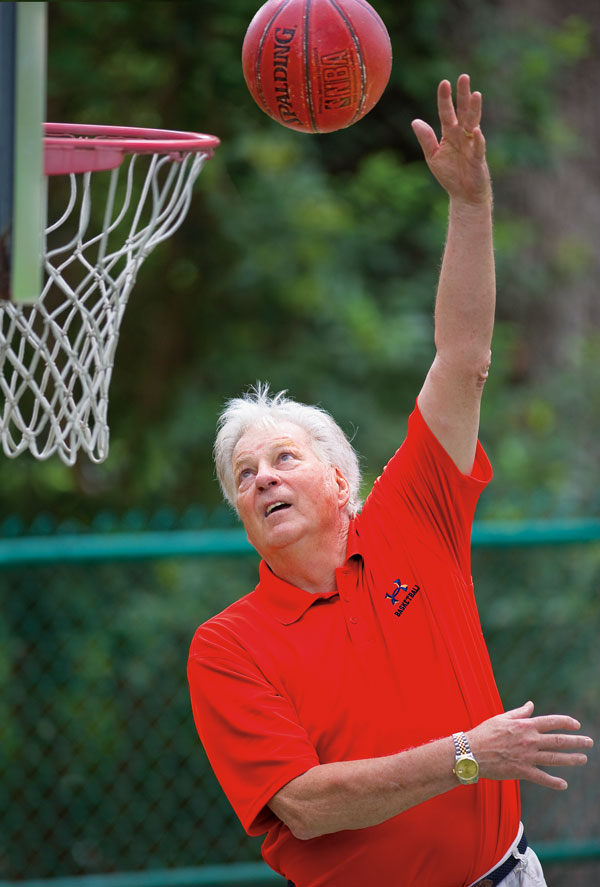
Ed Rapier, 79, loves to shoot hoops, golf and exercise regularly. In February this year, while hiking down a mountain trail in Manzanillo, Mexico, Rapier tore a muscle in his left knee. He was treated by Matthew Murray, M.D., an orthopaedic surgeon with UT Health Physicians, the clinical practice of the Health Science Center’s School of Medicine. Thanks to Dr. Murray’s specialized skills - and UT Health San Antonio Physical Therapy Services at the Medical Arts & Research Center (MARC) - Rapier is back to the activities he loves. He represents the seniors who benefit from the research and compassionate care of UT Health Science Center scientists and physicians who make lives better. To see a physician or physical therapist of UT Health San Antonio, call 210-450-9000; UTHealthPhysicians.org.
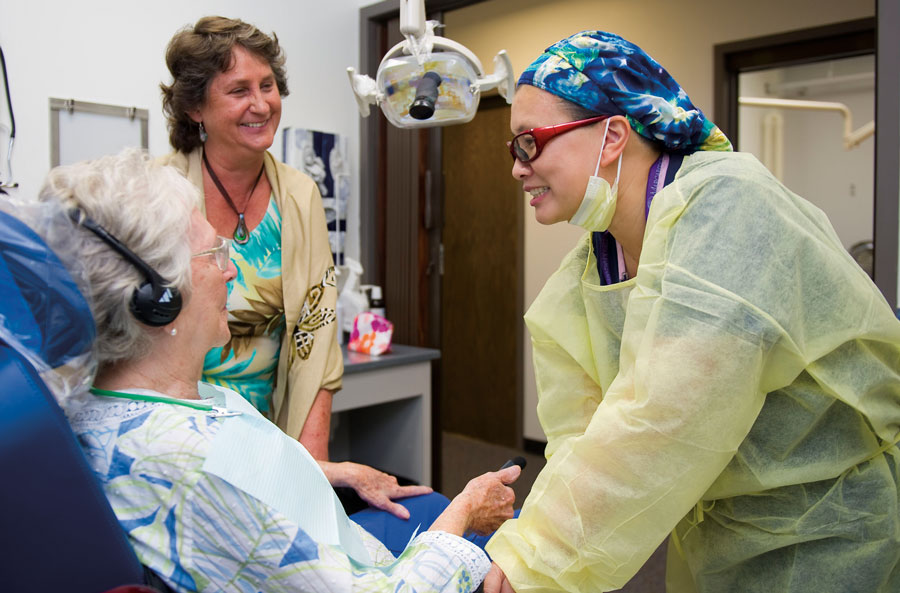
Tailored treatment Dental clinic caters to elderly
Priscilla Lane, 86, always prided herself on caring for others. She’d raised 10 children and worked in education for 25 years. After surviving breast cancer in 1999, a fall that fractured her left hip in 2009, and the loss of her husband of 66 years in 2010, Lane came home from the nursing home frail, fatigued but resilient. Confined to a wheelchair, Lane’s memory was fading as was her hearing. Not wanting to be a burden to her family, Lane failed to mention that something else was bothering her. She couldn’t chew. She couldn’t eat.
"My mom is tough, yet she is the kindest and most generous woman you’ll ever meet," said Lane’s daughter Casandra Zupancic, 55. "She didn’t want to trouble anyone with her problem. But my brother Chris and I knew something was wrong with her teeth and we needed to help her."
While seeking a dentist in private practice who could treat her fragile and ailing mother, Zupancic was referred to the Senior Care Dental Clinic at The University of Texas Health Science Center at San Antonio. The clinic is one of only a handful in the country dedicated to providing oral health care solely for patients aged 55 and older.
Tam Van, D.D.S., is director of the Senior Care Dental Clinic.

"The mission of our clinic is to enhance the quality of life for older adults by improving access to dental care, both physically and financially," she said. "We focus on elderly patients who have physical, medical, mental, social or pharmacological considerations that may present management issues for a private practice provider. Some of our patients have dementia or other diseases such as Parkinson’s, uncontrolled high blood pressure or diabetes. Some are disabled or take up to 25 different medications a day. Our staff recognizes the impact that age-related or other diseases can have on the elderly and their families. So we tailor dental treatment in the context of their lives and well-being."
Zupancic said the clinic was the right place for her mother.
"As soon as I brought my mom in, the staff immediately took great care of her. Dr. Van knew exactly what she needed."
Within two months, Lane was chewing and eating normally again with her new dentures.
Zupancic was so impressed with the care her mother received, that she, herself, decided to become a patient in the clinic. She had been diagnosed a few years earlier with a rare autoimmune disorder called Churg-Strauss syndrome or allergic granulomatosis. The disease, which has no cure, is marked by blood vessel inflammation, which can restrict blood flow to vital organs and tissues, oftentimes causing permanent damage. Over time, the disease damaged the bone in her jaw and Zupancic would need nine teeth, including some molars, removed. She also would need to undergo a surgical procedure called alveoloplasty in which the bone in the jaw is smoothed.
After a series of visits over the course of a year, Zupancic’s dental work was completed, and by the spring of 2012 she was fitted for new upper and lower partials.
"I wouldn’t have gone anywhere else," Zupancic said. "My mother and I are so grateful for the Health Science Center’s Dental Clinic. Dr. Van took the time to consider everything my mom and I needed. She was so patient. I trust her with my life."
The Senior Care Dental Clinic was established in 2000 by Eleanore Paunovich, D.D.S., M.S., associate professor in the Dental School, with funds from the Kronkosky Charitable Foundation.
When finances present a barrier to treatment, the clinic offers patients the opportunity to apply for a discount based on their income and national Federal Poverty Level guidelines. Funding and space provided by the Dental School, operational revenues as well as grants and philanthropic support, when available, keep the clinic and its services in operation.
The clinic operates seven dental exam rooms and is staffed by Dental School facultywho complete a geriatric dentistry fellowship. Third-year dental students rotate through the clinic providing faculty supervised care to patients.
Student Meagan Garcia completed her rotation in the clinic this past spring and later volunteered to continue working alongside Dr. Van.
"I was a little nervous at first because of the patients’ complex medical histories," Garcia said. "But Dr. Van was so thorough that I was always ready and prepared. After reviewing patient charts and making notes, Dr. Van met with us to discuss each patient and mapped out step-by-step the care we would provide. Spending time in Dr. Van’s clinic with patients who ask, ‘so how’s school been for you?’ was the highlight of my week. We call our patients ‘family.’"
Faculty members take pride in training the next generation of oral health care providers.
"Students appreciate learning from each other and from their patients in an environment that encourages understanding of the total patient needs," Dr. Van said. "Everyone deserves the best oral health care. It is our goal and privilege to provide it."
Excellent care for elderly
The Senior Care Dental Clinic is housed in the Dental School
at The University of Texas Health Science Center at San Antonio at
7703 Floyd Curl Drive.
Hours of operation are from 7:30 a.m. to 4:30 p.m.
Monday through Friday.
The clinic will move to the new Center for Oral Health Care & Research at 8300 Floyd Curl Drive in 2014. Expansion will include more parking and accessibility for the disabled.
For information about supporting the Senior Care Dental Clinic, contact
Sara Piety, director of Institutional Advancement for the Dental School, at
210-567-6536 or at piety@uthscsa.edu.
To make an appointment and to learn more about qualifying for financial assistance, call 210-567-0327.
A message from the president
Strong seniors, healthy futures for people of all ages
While I assist at the helm as president ad interim of our UT Health Science Center, my thoughts and prayers are with Bill Henrich and his family during this time of his medical leave. We all wish him the best of health and look forward to his return to the presidency this coming spring.
Although I am transitioning from the deanship in the Dental School, where I have served for 25 years, it is just not possible to completely fill Dr. Henrich’s shoes. I am proud and humbled to serve in this role during his absence. It is a privilege to work in this capacity, side by side, with the faculty, staff and students who make this university among the nation’s finest.
This Mission illustrates why our Health Science Center is world renowned in research, education, clinical care and community service. For those of us who are 55 and older, this issue is especially interesting. On the cover is Ed Rapier, 79, who is the picture of health, thanks to our UT Health Physicians orthopaedic physicians and physical therapists. Mr. Rapier went from suffering a debilitating muscle tear, to playing golf and basketball in a matter of months. He represents the many seniors who are benefiting from the outstanding research and clinical care of our UT Health Science Center physicians and scientists.
Also in this issue, you’ll learn of the research achievements at our internationally known Sam and Ann Barshop Institute for Longevity and Aging Studies, which has been called "the gold standard of aging research in the United States."
Barshop investigators are working to understand the mechanisms of aging by studying unlikely species such as clams and hydras; they are learning to preserve memory by analyzing a compound discovered on an island 2,000 miles from any population center; and they are preparing the next generation of scientists to enter the field of aging research through the nation’s first Ph.D. program focused on the biology of aging.
In other labs at the Health Science Center researchers are understanding how to prevent and better treat osteoporosis and cancer in the elderly. Specially designed hospital facilities accommodate elderly and, in the Dental School, our faculty, residents and students operate a superb dental clinic, one of only a handful in the country, that caters to seniors with special medical needs. I am especially proud to announce that the Senior Care Dental Clinic, along with our other dental clinics, will be greatly refreshed and expanded when they are relocated in 2014 to the new Center for Oral Health Care & Research to be built next to the Medical Arts & Research Center of UT Health San Antonio, at 8300 Floyd Curl Drive.
We deeply appreciate your support, as well as the generosity and leadership of our community partners and donors, many of whom are also spotlighted in this issue. Working together with you, we are able to make lives better for people of all ages.
Sincerely,
Kenneth L. Kalkwarf, D.D.S., M.S.
President ad interim
UT Health Science Center at San Antonio

ACE-ing elderly care
Hospitals save lives – no doubt about it. But for the elderly, they are full of hazards.
Fluorescent lights and round-the-clock activity make it difficult to sleep, which can cause delirium in elders. Shiny hospital floors contribute to falls, while staying in bed can lead to pressure ulcers. The elderly are susceptible to infections and often take many medications, opening the door to interactions.
UT Health Physicians has teamed up with CHRISTUS Santa Rosa Health System to create a specialized hospital unit for elderly patients at high risk for complications during inpatient stays. The Acute Care of the Elderly (ACE) Unit is the first of its kind in San Antonio.
"It’s designed to reduce all the complications that elders may suffer in hospitals," said UT Medicine geriatrician Robert Parker, M.D. "There are lots of processes we can use to improve delivery of care."

The difference starts with physical design. Non-reflective, non-slip floors help elderly patients stay surefooted. Every bed has an alarm, and patients at high risk for falls are identified with bracelets and a star outside their rooms. Thanks to steps like these, falls are a rarity in the ACE Unit, and injuries from falls are nonexistent.
Mattresses are designed to prevent pressure ulcers – important for elderly patients, whose skin is fragile and slower to heal. The ACE Unit uses soft lighting and decibel meters, which flash when the noise level gets high. A common room gives patients a place to share meals, encouraging them to move around and socialize.
The 2-year-old unit moved this summer from CHRISTUS’s downtown campus to CHRISTUS Santa Rosa Hospital – Medical Center. The new unit is being adapted to include the same amenities in an inviting, patient-centered atmosphere.
Beyond design flourishes, the medical staff has adopted many practices to improve patient care.
They have limited use of Foley catheters, which are often overused with elderly patients and can cause urinary-tract infections. They do not use physical restraints, which can heighten delirium. They also are alert to drug interactions and avoid certain commonly used medications that, in elderly patients, are known to have effects like confusion, sedation and convulsions.

"You can do harm to an elderly patient without realizing it," said Imelda Sanchez, R.N., B.S.N., director of the ACE Unit.
The ACE team attempts to give patients six or seven hours of uninterrupted sleep, which substantially reduces delirium. All patients receive daily visits from a restorative aide, who keeps them physically and mentally engaged.
New patients are screened for personal risk factors, which are closely monitored during their stay. Nurses may take preventive steps without waiting for a physician’s order. Also, the ACE team devotes a lot of time to families, educating them on their elders’ conditions and explaining how to care for them.
An interdisciplinary team that can include doctors, nurses, dietitians, social workers, pharmacists, chaplains and more meets daily to discuss every currently admitted patient, ensuring that all members of the ACE team are on the same page about treatment.
The ACE Unit’s success is reflected in the numbers: It has never had an injury fall or pressure ulcer, and its 30-day readmission rate for the same diagnosis is just over 3 percent, compared with the national rate of 14 percent.