

Appointments and awards
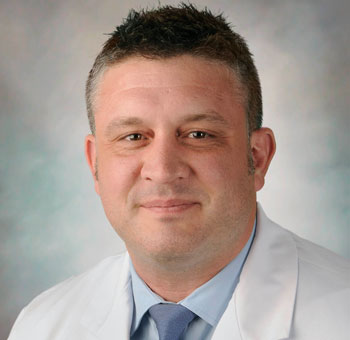
Ryan Bierle, PA-C, a specialist in emergency medicine, is one of only 108 certified physician assistants nationally to earn a specialty credential called a Certificate of Added Qualifications in Emergency Medicine from the National Commission on Certification of Physician Assistants. He is one of only 36 certified PAs in Texas and 530 PAs nationwide to earn the certificate since the program’s inception in 2011.
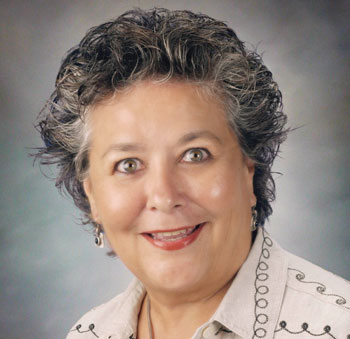
Norma Martinez Rogers, Ph.D., RN, FAAN, professor of nursing, has been appointed to a second three-year term as a commissioner for the Medicaid and CHIP Payment and Access Commission (MACPAC). Dr. Martinez Rogers was an inaugural member of MACPAC, which is a non-partisan federal agency charged with providing policy and data analysis to Congress on Medicaid and the Children’s Health Insurance Program. The commissioners make recommendations to Congress, the Secretary of the U.S. Department of Health and Human Services, and the states on a wide range of issues.
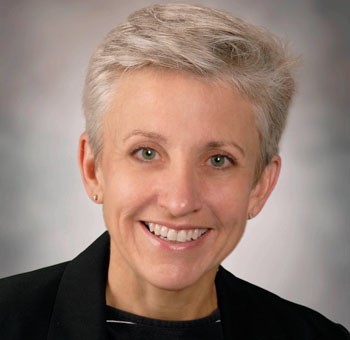
Stacey Young-McCaughan, Ph.D., RN,professor of psychiatry, was honored March 21 by the White House with its Women Veteran Leaders Champions of Change award. The award recognizes women who empower and inspire communities. Dr. Young-McCaughan serves as director of research for the STRONG STAR Consortium and the Consortium to Alleviate PTSD. The consortia together represent more than $100 million in research on post-traumatic stress disorder and related conditions, and are led by the UT Health Science Center San Antonio.

Inspiring hope: Greehey, donors model commitment to community

"To know even one life has breathed easier because you have lived; this is to have succeeded."
For decades, the verse of 19th century American poet Ralph Waldo Emerson has rung true for many who reach out to help others in need. Bill Greehey is among those. Some might say Greehey is the epitome of Emerson’s philosophy, making it his life’s work to lift up the less fortunate. At the UT Health Science Center, Greehey shines as a beacon of hope and a leader in advancing the university’s mission to "make lives better."
"We needed a champion back then, and we found one in Bill Greehey," declaredWilliam L. Henrich, M.D., UT Health Science Center president, at the university’s sixth annual President’s Gala, "An Evening of Hope," held this past fall in San Antonio. Dr. Henrich announced a $5 million gift that night from the Greehey Family Foundation to the university, which pushed the Health Science Center’s Campaign for the Future of Health over its goal of $500 million.
Dr. and Mrs. Henrich were joined by more than 1,500 community and academic leaders and students in attendance at the gala, which paid tribute to Greehey, one of the world’s most admired businessmen and philanthropists. Greehey is chairman of the board of NuStar Energy, L.P., one of the largest petroleum pipeline and terminal operators in America.
Greehey has been a longtime and steadfast supporter of the Health Science Center. In 2007, a historic gift of $25 million from the Greehey Family Foundation launched the momentum for the university’s Campaign for the Future of Health. In full circle fashion, the $5 million gift announced at the gala from the Greehey Family Foundation closed the campaign.
"It’s only fitting that our campaign culminates with a major gift from him," Dr. Henrich said.
Promoting community health
The 2013 community wide gala raised almost $600,000 to establish two funds named for honoree Bill Greehey and The Greehey Family Foundation.
The Greehey Family Foundation Endowment for Community Service will support faculty and student programs directly benefitting the health and well-being of the community.
The Greehey Family Foundation Fund for Community Service and Patient Needs, "The Hope Fund," will support the university’s mission of service by addressing patients’ urgent lifesaving medical needs.
With the foundation’s emphasis on supporting health and human welfare, children’s causes, education and the homeless, Greehey said the foundation’s partnership with the university allows both entities to make more lives better.
Providing for the poor and homeless
"We are proud of our partnership with the UT Health Science Center. By joining forces, the foundation and the university can continue to make a greater difference in the health and well-being of men, women and children - not just in San Antonio, but in communities across the world - thanks to the world-class research that is being done at the Health Science Center," Greehey said. "And, I am also proud of our collaborative work to provide health and dental care to the working poor and homeless in our community."
Dr. Henrich said the Health Science Center hosts the communitywide gala to showcase the university’s missions, raise funds to support the work of the faculty and students across the university, and honor exceptional leaders who work to make a difference locally, regionally and nationally.
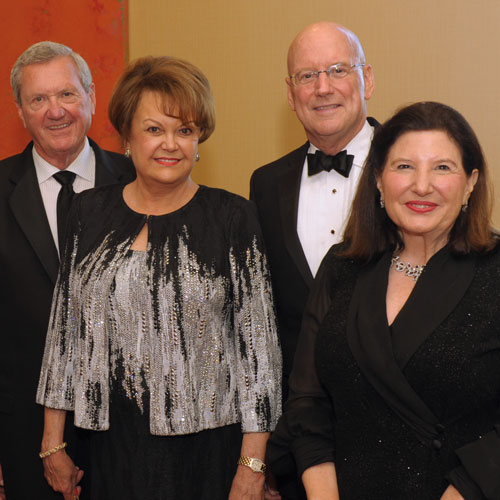
President Henrich and Mary Henrich (right) honor Bill and Louree Greehey at the sixth annual President’s Gala.
Click to see more gala photos.
Nationally ranked business leader
"We are especially proud to pay tribute to one of our most iconic and admired businessmen and philanthropists, Bill Greehey." Dr. Henrich said.
"Earlier this year, The Harvard Business Review ranked Bill near the top of its listing of The 100 Best-Performing CEOs in the world. This recognition of the tremendous success he has achieved as a chief executive officer also reflects Bill’s dedication to his employees, our city and all persons in need," Dr. Henrich said. "The Health Science Center is thrilled to honor Bill Greehey and The Greehey Family Foundation for their strong commitment to San Antonio and to our university."
The Greehey Family Foundation’s unwavering support has allowed Health Science Center scientists at the Greehey Children’s Cancer Research Institute to devote their time to understanding children’s cancer with the goal of creating new and better treatments.
In 2006, Greehey launched Haven for Hope in San Antonio, an innovative program to transform and save the lives of homeless individuals and families. Now, Health Science Center medical students and dental residents receive clinical training there while providing faculty-supervised care to patients who otherwise could not access or afford care.
Through Greehey’s selfless commitment and generosity, student scholarships, community outreach programs, and faculty recruitment and retention are made possible - all aimed at the goal of making lives better in San Antonio and the world.
Dr. Carl Raba supports lifesaving care
Retaining exceptional faculty physicians, who provide lifesaving care to patients, at the Health Science Center is the goal of Carl F. Raba Jr., Ph.D., chairman and CEO of Raba-Kistner Consultants Inc. of San Antonio. Dr. Raba joined Greehey and others in attendance at the gala and also joined them in advancing the university through philanthropic support.
A $500,000 gift from Dr. Raba established the Carl Raba Family Chair in Neuro-Oncology at the Cancer Therapy & Research Center at the UT Health Science Center.John R. Floyd III, M.D., assistant professor in the Department of Neurosurgery, is the holder of the chair. Dr. Raba said he made the gift because "San Antonio needs physicians like Dr. Floyd and his colleagues. I have witnessed their remarkable skills and compassion firsthand. They saved my daughter’s life."
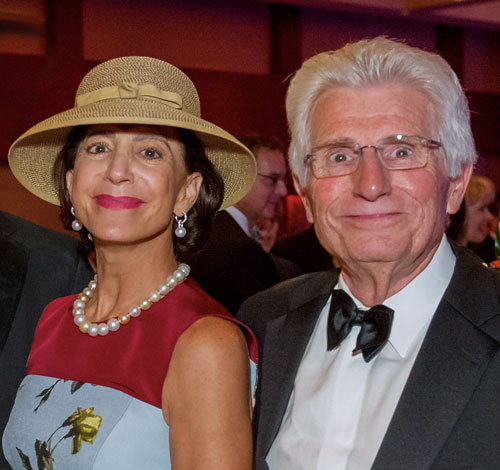
Cathy Raba Wolfe and her father Carl Raba Jr., Ph.D. Click to see video and to learn more about Bill Greehey’s and Cathy Raba Wolfe’s inspiring stories.
In the fall of 2011, Dr. Raba’s daughter, Cathy Raba Wolfe, the youngest of his five children, began suffering from severe headaches, problems with her vision and other unusual symptoms. What doctors at the Health Science Center found shocked Cathy, Dr. Raba and their entire family. A massive tumor had developed in her skull and sinus cavities and was placing painful pressure on her optical nerves. Subsequent biopsies revealed the tumor was cancerous. Cathy was diagnosed with Esthesioneuroblastoma (ENB), also known as olfactory neuroblastoma, a rare growth of cancerous tissue originating in the nasal cavity. Only about 1,000 cases have been identified since the first instance was described in 1924.
"I learned that about only 10 people a year in the world are diagnosed with this type of cancer," Cathy said. "I was in disbelief and, initially, felt desperate. Why and how could this have happened to me?" But Cathy said her husband, Bob, and her father never gave up hope and encouraged her to have faith. "They had complete confidence in the Health Science Center doctors and with good reason," she said. "They saved my life. After the initial shock of the diagnosis, I realized I needed to be an active participant in my treatment if I was to survive. Dr. Otto would call our home to check on me and my family. He reassured us that we were in good hands."
Collaborative, compassionate care
Dr. Randy Otto, M.D., is professor and chair and the Thomas Walthall Folbre, M.D., Endowed Chair in Otolaryngology at the Health Science Center. He joined Dr. Floyd,Andrew Brenner, M.D., Ph.D., medical oncologist at the CTRC; Tony Eng, M.D.,radiation oncologist; Howard T. Wang, M.D., associate professor and chief of plastic and reconstructive surgery; and Carlos Rosende, M.D., the Herbert F. Mueller Chair in the Department of Ophthalmology, in leading Cathy’s diagnosis, surgery and care.
On Feb. 24, 2012, as Cathy lay on the gurney at University Hospital ready to be rolled into her operation, Dr. Otto held her hand and told her he and the team and her family were all praying for her.
"After a 20-plus-hour surgery, four days in the Intensive Care Unit and two weeks at University Hospital recovering, Cathy was able to go home. She has undergone subsequent treatment and care and is now doing very well. Her life is returning to normal one step at a time." Dr. Raba said. "Her doctors are the best. We have been overwhelmed by their exceptional skills as surgeons as well as by their sensitivity and compassion. San Antonio needs more doctors like them. Patients, like Cathy, don’t have to travel outside of the city for this kind of care. It’s right here."
Inspired to help others
Dr. Raba, who earned his undergraduate and graduate degrees in civil engineering from Texas A&M University and is an avid Aggie and football fan, said a quote from the late UT Austin Longhorn football coach Darrell Royal has inspired his philosophy of giving.
"The late coach once said, ‘You’ve got to dance with the one who brung ya.’ I have always incorporated his wisdom in my philosophy of life. Remember those who have helped you along the way and find a way to help them in return. We can never repay the good doctors at the Health Science Center for saving Cathy’s life. But our gift is a small way we can help and inspire others to help keep them here in San Antonio where they can multiply their lifesaving care in future patients."
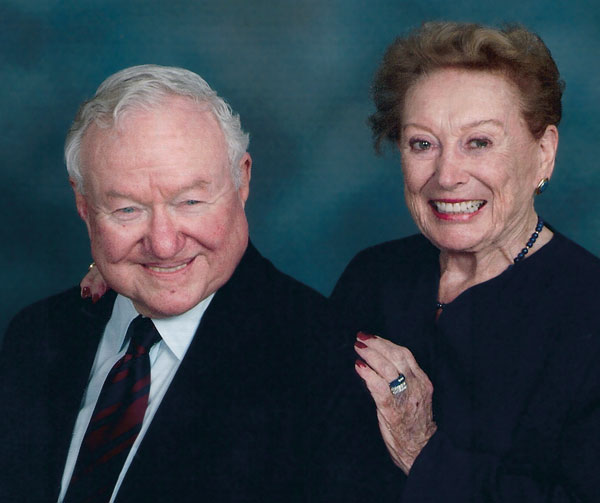
Family’s goal to beat cancer results in new endowment for hematology/oncology
It was during his treatment that McDonald met several fellows in the Division of Hematology/Oncology. A fellow in hematology/oncology is an M.D. who has completed three years of internal medicine residency upon entering the three-year hematology/oncology program.
McDonald enjoyed and appreciated the company of these "bright young people."
"The fellows were so compassionate and full of optimism," said his son John McDonald, D.D.S. "They buoyed his spirits and gave him hope."
In memory of their father and to honor their mother, Sara, and her loving support, the three McDonald children - Linda McDonald Rowe, Kathleen Herman and Dr. John McDonald - decided to create a permanent endowment bearing their parents’ names for the Division of Hematology/Oncology in the Long School of Medicine. This endowment establishes an award to support the fellows’ activities in oncology research. Each year an outstanding fellow will be named a McDonald Scholar.
Sara McDonald said, "We want to support the research of these brilliant and immensely talented doctors so they may apply their strengths in cancer research with opportunities for discovery that touch the lives of thousands."
Sara McDonald speaks highly of the award’s first recipient, Lindsay Peterson, M.D. Dr. Peterson studies pancreatic tumor suppression and increased chemotherapy response. "I am so impressed with Lindsay and all her accomplishments and research," she said.
Endowments such as the McDonald’s are crucial to the support of breakthrough research. Their gift not only advances the innovative research by outstanding, young investigators but also brings the promise of hope to future patients.

CTRC benefits from Book & Author Luncheon
Nearly 1,100 people — the largest group ever — attended the San Antonio Express News Book & Author Luncheon benefiting the Institute for Drug Development (IDD). IDD is the Phase I Clinical Research program of the Cancer Therapy & Research Center (CTRC), part of the UT Health Science Center San Antonio.
Preliminary figures show that the gross amount raised at this year’s luncheon was $298,884, which includes $40,075 from the sale of books — $6,400 more than the book sale at last year’s event.
Featured authors this year were world-renowned A. Scott Berg, former U.S. Senator Kay Bailey Hutchison, Scott Anderson, Jamie Deen, Bob Staake and Kathleen Kent.
Also among those attending the luncheon were legendary University of Texas football coach Fred Akers and his son, Dan Akers, who are both cancer survivors. The two men and their families were featured in an upbeat Health Science Center-produced video telling the stories of how Fred Akers overcame prostate cancer and his son beat renal cell carcinoma with the help of CTRC physicians and researchers.
CTRC is one of only four National Cancer Institute-designated cancer centers in Texas.
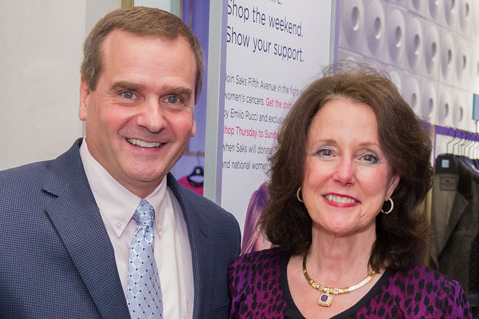
Key to the Cure supports CTRC

Saks donated a percentage of its store sales during the four days of shopping and 100 percent of the net proceeds from the sale of the 2013 Key to the Cure limited-edition T-shirt designed by Emilio Pucci.
Over the past four years, Saks has donated more than $70,000 to the CTRC to support breast cancer research and treatment. This year’s event was celebrated with a luncheon chaired by CTRC Board members Nancy Torgerson and Mertie Wood.
Saks presented three Key to the Cure awards in recognition of exemplary service. Award recipients were Pam Burdick, president of the Cancer Center Council; Lupita Martinez, LMSW, M.B.A., OSW-C, CTRC’s social worker; and Jessica McCray, RN, breast cancer survivor and neuro-oncology nurse at the CTRC.
Appointments and awards
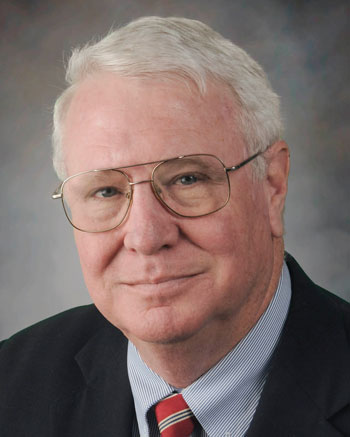
George Crawford, M.D., MACP, professor of medicine and associate director of the Internal Medicine Program, was elected governor of the Southern Texas Region of the American College of Physicians (ACP). He will be installed as the governor-elect at the national ACP meeting in April 2014. Dr. Crawford is board certified in internal medicine and infectious disease and has been a faculty member at the Health Science Center since 1997.
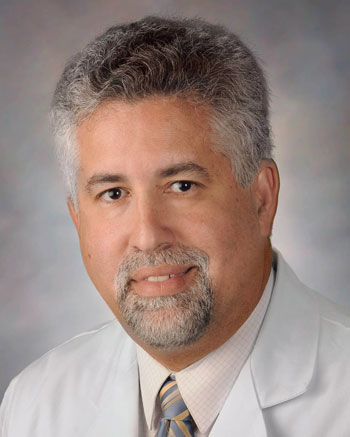
Carlos Roberto Jaén, M.D., Ph.D., FAAFP, professor and chair of the Department of Family and Community Medicine, was elected to the Institute of Medicine (IOM) in October. Election to the IOM is one of the highest honors in the fields of health and medicine. Dr. Jaén is a family physician whose research on improving patient-centered care and community health has drawn international acclaim.
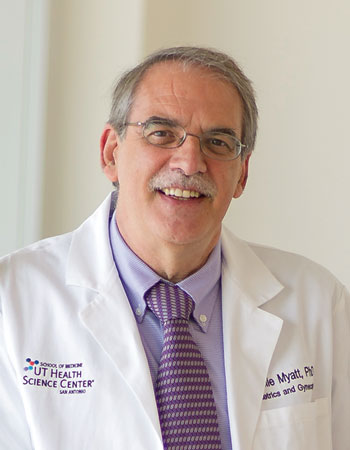
Leslie Myatt, Ph.D., professor of obstetrics and gynecology and director of the Center for Pregnancy and Newborn Research, was named a Fellow ad Eundem of the Royal College of Obstetricians and Gynecologists this fall in London, England. This prestigious designation is awarded to only five individuals per year who are not members of the college and have made outstanding contributions to the advancement of the science or practice of obstetrics and gynecology.
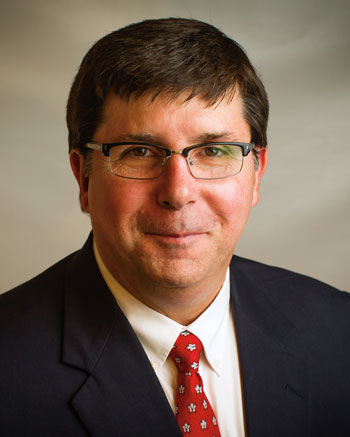
Ronald M. Stewart, M.D., FACS, professor and chair of the Department of Surgery, trauma surgeon at University Hospital, and physician with UT Health San Antonio, was appointed by the Board of Regents of the American College of Surgeons (ACS) as the next chair of the ACS Committee on Trauma. The committee is dedicated to all phases of injury care from prevention to rehabilitation.
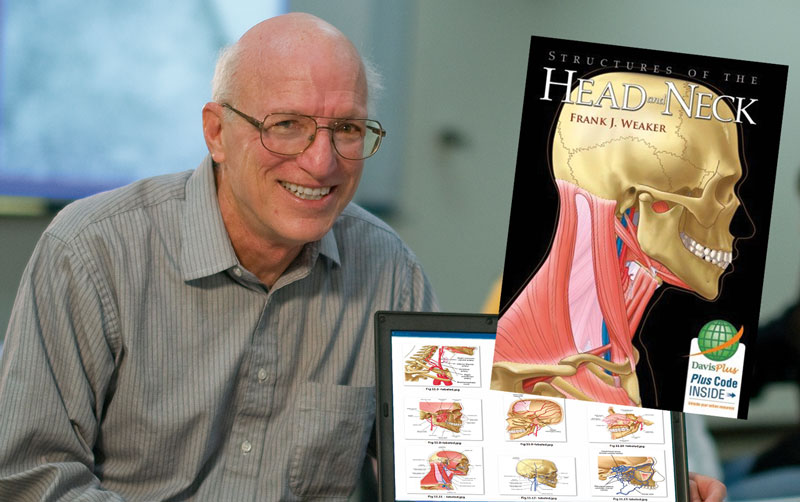
Teamwork produces outstanding book for students, teachers
Working with David Baker, medical illustration supervisor in Creative Media Services, who has worked at the Health Science Center for 18 years, Dr. Weaker developed the book over the course of three years, but "the textbook represents the culmination of 38 years of professional school teaching," Dr. Weaker said. "The thought that through this book I could be influencing the education of students outside the walls of the Health Science Center is a wonderful sense of accomplishment."
Baker said he has had opportunities to work with faculty members on a few books at the Health Science Center during his tenure.
"Faculty members who write books go above and beyond the call of duty as they are also tasked with teaching, conducting research and providing clinical care. There are very few who are able to accomplish it," Baker said. "It’s quite an achievement for both the author and the artist to see a book published and available."
The 512-page book, published by F.A. Davis Company, was printed in September and is available for purchase at the Health Science Center bookstore and worldwide online.

Vulcan Funshoot celebrates 20 years

What is an endowment?
An endowment is the most lasting way to support the UT Health Science Center San Antonio, one of the country’s leading health science universities.
An endowment is a permanent gift that provides one of the most secure sources of future revenue. It is a gift to the Health Science Center that is permanently invested and a steady stream of annual income is created every year to support a specific activity or program of the donor’s choice.
Endowments can be established to support student scholarships, recruit and retain distinguished faculty, provide lectureships or support world-class research.
The minimum gift amount level to establish an endowment is $10,000. Endowments can be funded in a variety of ways. Donors may choose to fund the endowment in its entirety or endowments may be pledged and paid out over a period of time up to five years. For example, an endowment at the $50,000 level may be created in installments of $10,000 per year for five years. Endowments may also be created through gifts of stock, a charitable trust or through a bequest in an estate plan.
An endowment is often named to recognize the donor, or to celebrate a loved one, a mentor, a colleague or a treasured friend. It is a thoughtful gift that creates a legacy of remembrance for you and your loved ones and makes a lasting, meaningful difference in the lives of others.
For more information or help with wording to create an endowment, contact Senior Director of Gift Planning Kent Hamilton at 210-567-5001 or Hamiltonw@uthscsa.edu.
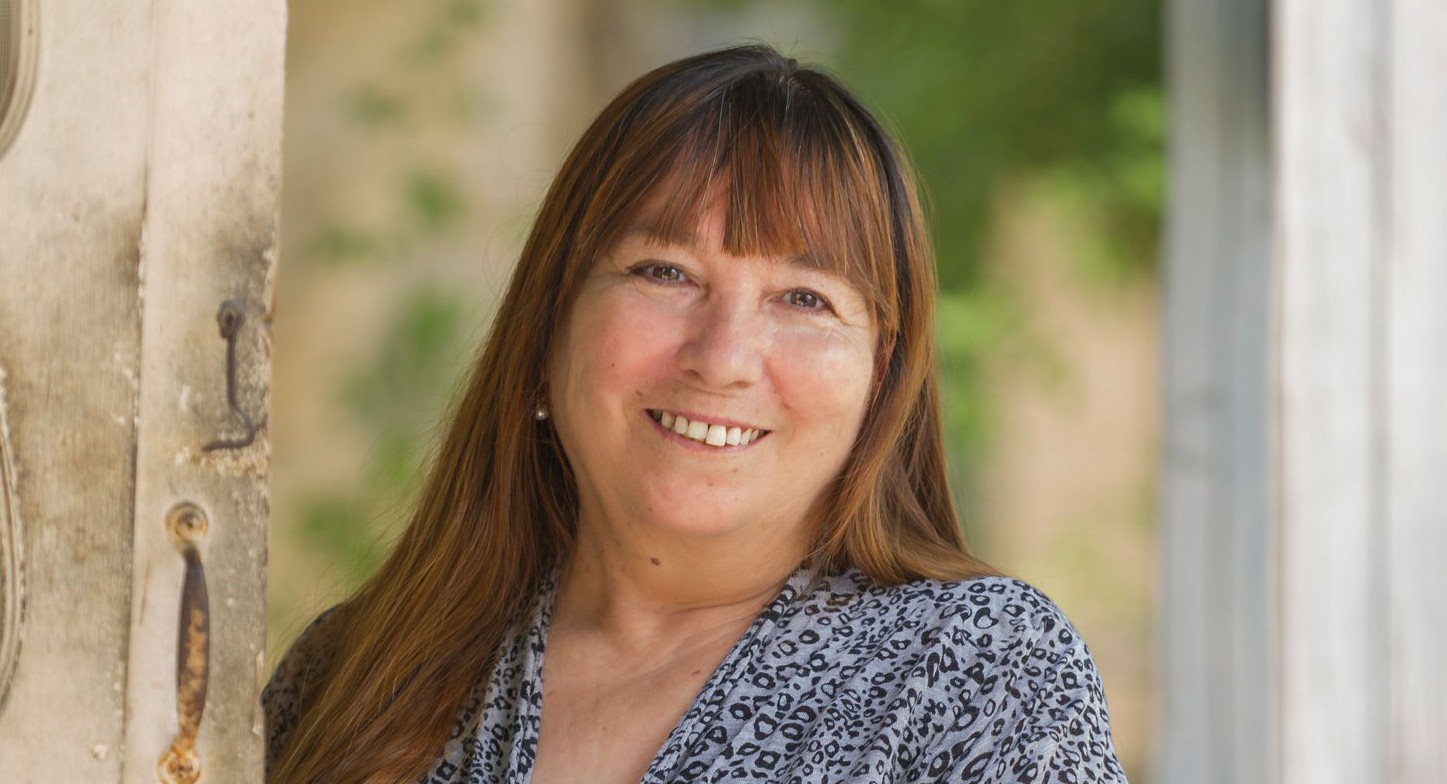
Guiding Latinas to good health
It was like a small, round bean; solid and smooth. Jovita De Leon, 62, described the lump she felt in her left breast. Over time as it grew, she felt something else deep in the pit of her stomach - fear. It was enough to scare her into seeking a doctor.
Visits to the doctor were not common for De Leon who doesn’t have health insurance and whose income is limited by the number of sewing jobs she can get. She works as a seamstress out of her home on San Antonio’s West Side. Without a vehicle, transportation to a doctor’s office is problematic. But this time she needed to get there. "What if the lump was cancer?" she thought to herself. As a mother, grandmother and caretaker of her 94-year-old ill father, De Leon couldn’t afford to be sick. Her family needed her.
It took two weeks, but with help from her grown children and money from her job, De Leon was able to gather the $75 needed for a visit to the doctor. After her clinical exam, De Leon still didn’t have all the answers. She knew it was serious when the doctor told her it was urgent she get a mammogram.
"He even gave me my money back," De Leon said. The physician sent her home with a list of phone numbers for clinics that offered low-cost scans. Even with $75 and clinic phone numbers, De Leon, who only speaks Spanish, had problems communicating her needs over the phone and trouble saving the $300 needed for the test.
Months passed and De Leon began to feel sick and listless. She had fever and intense pain. After several failed attempts to secure a mammogram, her morale was shot.
It was the fall of 2011 and Thanksgiving was quickly approaching. On one of De Leon’s many sleepless nights, she saw an advertisement on television for an upcoming free health fair to be held in front of San Fernando Cathedral. It seemed to be De Leon’s last hope. So her daughter, Gabriela Benavides, drove her downtown the next day. They arrived at 7 a.m. But to their dismay, police officers were closing down the streets. A fire that ignited in a building nearby caused the cancellation of the fair. Discouraged, desperate and in pain, De Leon prayed for help and hope.
Study shows Latinas left behind
A national research study conducted by the Institute for Health Promotion Research (IHPR) in the Long School of Medicine at the UT Health Science Center at San Antonio and the Redes En Acción: National Latino Cancer Research Network, which is funded by the National Cancer Institute, showed that the average time for Latinas’ to receive a definitive diagnosis of breast cancer was 60 days, compared with just 27 days for non-Hispanic white women. The study was published this year in the journal SpringerPlus.

Institute of Medicine member Amelie G. Ramirez, Dr.P.H., who leads the Institute for Health Promotion Research in the Long School of Medicine, has spent more than 30 years directing programs focused on reducing chronic disease and cancer health disparities affecting Latinos in South Texas. She is the Dielmann Chair in Health Disparities Research and Community Outreach and the Max and Minnie Tomerlin Voelcker Endowed Chair in Cancer Healthcare Disparities and Outreach at the CTRC.
"This lag time puts Latinas at greater risk of being diagnosed with larger tumors and more advanced-stage breast cancer. The delay can affect prognosis," said Amelie G. Ramirez, Dr.P.H., who is an author on the study and director of the IHPR and Redes En Acción. "With cancer being the leading cause of Latino death, this study also signals a greater need for ethnically and culturally appropriate interventions to facilitate Latinas’ successful entry into, and progression through the cancer care system."
For De Leon, the time delay was much longer. It was an entire year after she first discovered the lump in her breast that she learned about a University Health System financial assistance program for Bexar County residents, signed up and received the referral for the diagnostic mammogram she needed.
By then, she could see the lump protruding through her skin. The imaging revealed several more tumors that had developed. A biopsy was the next step and she was put in touch with doctors at the University Health System mammography Center at the Cancer Therapy & Research Centers (CTRC) at the UT Health Science Center San Antonio.
"As soon as I came to the CTRC, everything moved fast," De Leon said. Two days later, she underwent a seven-hour biopsy and finally received the news she’d waited so long for. De Leon had two types of cancer - invasive ductal carcinoma and ductal carcinoma in situ with focal micro-invasion. Invasive ductal carcinoma is the most commonly diagnosed breast cancer in women. It grows through the milk duct walls into the surrounding breast tissue and can spread to other parts of the body. Ductal carcinoma in situ is more contained, but is the precursor for invasive cancer.
Doctors told De Leon she’d need surgery immediately.
Two weeks before Christmas, on Dec. 9, 2011, De Leon underwent a complete mastectomy (surgical removal) of her left breast at University Hospital. Alfredo Santillan, M.D., performed the procedure. Dr. Santillan is a UT Health San Antonio surgical oncologist and assistant professor in the Long School of Medicine.
"My luck changed that day," De Leon said. "Dr. Santillan was very warm. He spoke to me in Spanish. He understood me. He was very kind and he saved me. I will always be grateful to him."
In addition to the care she received at the CTRC, De Leon was introduced to Guadalupe Cornejo - a woman she calls "mi ángel de la guardia," (my guardian angel). Cornejo is a patient navigator who works at the UT Health Science Center’s IHPR.
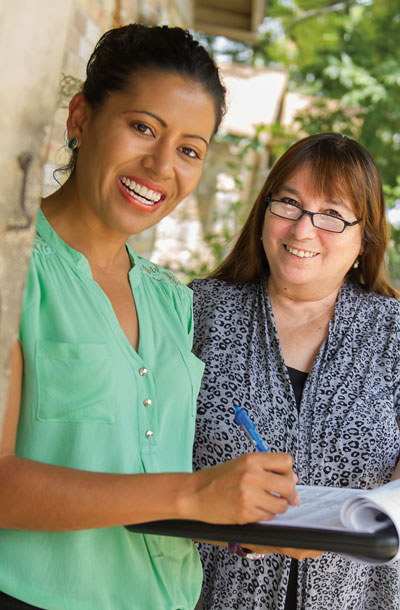
Patient Navigator Guadalupe Cornejo (left) pays a visit to patient Jovita De Leon at her home on the city’s West Side. Photo by Lester Rosebrock, Creative Media Services
Guiding patients to good health
Studies at the IHPR and its Redes En Acción network, led by Dr. Ramirez and her team, found that extra support for patients from trained patient navigators, like Cornejo, can lead to faster diagnosis and shorter time delays between an abnormal mammogram and definitive diagnosis - whether positive or negative for breast cancer - than those who did not receive navigation. Services provided by navigators include culturally sensitive support and help overcoming barriers related to transportation, child care, insurance, language and more.
"We’re now testing if patient navigation also can speed the lag time Latinas have from receiving that diagnosis to starting their treatment," Dr. Ramirez said. Her team includes Cornejo, Armida Flores, Arely Perez and National Study Coordinator Sandra San Miguel.
Cornejo follows up with De Leon on her doctor appointments, prescription renewals and connects her with accessible health care resources. Last year, Cornejo introduced De Leon to a community-based wellness center for women surviving cancer where she now receives counseling and participates in a support group for Spanish-speaking cancer survivors. There, De Leon was also fitted for a prosthesis and special bra, which she received at no cost.
"Jovita could have died if she hadn’t gotten help," Cornejo said. "She’s a strong woman. She just got lost in the system. I’m helping her find her way back."
De Leon said her future is brighter. "I feel loved and I have my self-esteem again. I learned that there are really good people out there who you can trust, who will listen to you and take good care of you. This is a very good program. There should be more like it."
For more information
Learn more about the Institute for Health Promotion Research and the patient navigator program at ihpr.uthscsa.edu. Visit the Cancer Therapy & Research Center at cancer.uthscsa.edu or call Sheri Ortiz at 210-450-5512.
Cliff Despres of the Institute for Health Promotion Research at the UT Health Science Center, contributed to this story.