
A sound solution to tremors: Focused ultrasound offers relief without surgery
High-frequency, focused ultrasound treatment gives a South Texas couple the stillness they’ve been seeking
For more than five decades, Deeann Hall learned to live with the vibration in her hands. It’s something that began as a faint tremor in childhood, but by her late fifties, became an exhausting daily challenge.
Drinking coffee meant using both hands and still spilling. Forkfuls of food fell away before reaching her mouth. Even signing her name or brushing her teeth felt like monumental battles against her own body.
Her husband and high school sweetheart, Rick Hall, watched as her frustration deepened year after year.
“It was getting to where I was going to have to start helping her with everything,” he recalled. “Seeing her struggle — it broke my heart.”
The culprit was a condition known as essential tremor, a neurological disorder that affects millions of Americans and is sometimes passed down in families. Unlike Parkinson’s disease, essential tremor doesn’t cause stiffness or slowed movements but leads to involuntary shaking, particularly during activity, and often worsens over time.
For Deeann Hall, whose condition ran through her father’s side of the family, the tremors had become a constant, unwelcome companion.
Searching for answers
A few years ago, the couple began looking for options beyond medications because Deeann Hall wasn’t seeing any improvement. One evening, while scrolling online, she came across information about a new therapy called focused ultrasound, described as an incisionless brain procedure that could reduce tremors without surgery.
“Nonsurgical is the word that caught my attention,” she said. “It claimed they wouldn’t have to cut anything.” The Halls were pleasantly surprised when their neurologist informed them that UT Health San Antonio would soon launch the region’s first focused ultrasound program under the direction of Alex Papanastassiou, MD, a neurosurgeon and director of stereotactic, functional and epilepsy neurosurgery.
Within a few months of first meeting Papanastassiou, Deeann Hall became the second patient the program scheduled after its launch.
“Deeann had essential tremor affecting both sides of her body,” Papanastassiou said. “Because she’s righthand dominant, we knew we needed to first treat the left side of her brain, which controls the right hand. The tremor made everyday tasks nearly impossible — writing, eating, even carrying a cup or a plate.”
In preparation for the procedure, Deeann Hall was informed she would have her hair shaved to prevent air bubbles from interfering with the ultrasound treatment. The night before surgery, her husband showed his support in an unforgettable way by shaving his own head.
“She told me I didn’t have to, but I told her I did. We’re in this together,” he said.
A procedure of precision
On Aug. 5, the team began before sunrise, shaving Deeann Hall’s head and fitting her with a head frame to keep her still during the MRI-guided procedure.
“Patients stay awake and aware during the procedure,” Papanastassiou said. “This is so we can test for tremor reduction, side effects and adjust the target if needed before making a permanent lesion.”
Once on the MRI table, cold water circulated through a specialized cap secured to the head frame to protect Hall’s scalp and allow the ultrasound waves to travel from the transducers to her brain.
Papanastassiou aimed for a tiny target in the thalamus called the ventral intermediate nucleus, or VIM, for delivery of focused high-frequency sound waves. The soundwaves converged to generate enough heat in the VIM to create a small lesion disrupting the abnormal electrical activity that caused the tremor.
“We can test the patient as we go, adjusting by fractions of a millimeter, if needed, to achieve tremor control, all without any incision or implant,” Papanastassiou explained.
Everything changed
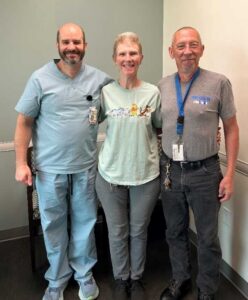
When Rick Hall walked into recovery, he saw his wife crying, but for the best possible reason.
“She held up her hands and said, ‘Look!’” he recalled. “Later, she picked up a cup of coffee without a lid, took a drink and set it back down. No shaking. It was like watching a miracle.”
The tremor in her right hand had quieted — 95% gone within minutes. Even her head and voice tremors, which improve in about half of patients, disappeared.
“Before treatment, she couldn’t even draw a spiral; it was just scribbles,” Papanastassiou said. “By the end, she was tracing it smoothly with almost no tremor. To watch her reaction in real time, right before our eyes, was incredibly rewarding.”
By lunchtime, Deeann Hall was eating with ease. That evening, she felt something far greater: freedom.
Life after tremors
According to Papanastassiou, unsteady walking may occur in about half of patients and typically resolves in two to four weeks, as it did for Deeann Hall.
“They told me I might be a little wobbly afterward,” Deeann Hall said, laughing. “I didn’t realize how true that was. I was so used to compensating for the tremor that when it was gone, I’d bump into walls because my body wasn’t used to being steady.”
In May, Deanne Hall will return for her second treatment to address the right side of her brain. Until then, she’s savoring all the activities she can now do.
“I can trim my plants again without breaking them,” she said. “I can drink my coffee, write my name and just do normal things.”
For her husband, the joy was doubled.

“She’s happy,” he said. “Seeing her do what she loves — it just brings so much joy to me.” Their family was equally moved.
“Our children cried,” Deeann Hall said. “They’d never known me without the shaking.”
‘A modern miracle’
Today, the Halls call the focused ultrasound procedure “a modern miracle,” and they have become unofficial ambassadors for the treatment, telling everyone they meet who might benefit.
“This kind of success is only possible because of the multidisciplinary team here at UT Health San Antonio’s Multispecialty and Research Hospital,” Papanastassiou said.
“Everyone on our team, including nursing, neurology, radiology, anesthesia, ENT, PMR, physical and speech therapy as well as our support staff, all play a role in helping patients feel safe and cared for throughout the process,” he added.
“When you see a patient’s hand become still after years of tremor, you know you’ve changed a life. That’s what keeps us motivated — the chance to give people back their confidence, their independence and their joy.”