
The piano that still plays: Donation brings music and comfort to others
How the gift of music can soothe heart and head
The grand piano in Ann Biggs’ living room was never just furniture. It was a centerpiece.
For nearly half a century, “Morning Has Broken” drifted through the house — the song her husband, Glenn Biggs, loved most, and the soundtrack of a life they built together. Glenn Biggs was a San Antonio banker, civic leader and philanthropist whose vision helped shape how Texas advances brain health today.
“That was his favorite song,” said Ann Biggs, 92. “It was always the first thing he wanted me to play. I still wake up at night and hear it in my mind, even now.”
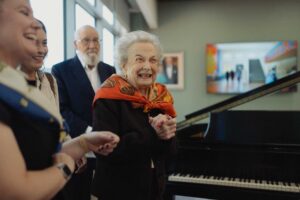
Today, the Biggs’ piano — a gleaming Chickering grand — sits inside the UT Health San Antonio Center for Brain Health, a $100 million facility that opened Dec. 10. It’s a place where science, patient care, music and community share the same space.
Glenn Biggs died of Alzheimer’s in 2015. When the time felt right, Ann Biggs donated the piano to bring comfort to others.
“Music is one of the last things to go,” she said. “I saw it firsthand.”
When Glenn Biggs was diagnosed with Alzheimer’s, she said, the disease advanced faster than either of them expected. Still, the signs were subtle enough that he could disguise them.
As the conversations grew shorter and the silences longer, music endured. In his final months at a San Antonio memory-care center, Ann Biggs often sat at the community piano. What happened next surprised her.
“Patients there who never spoke would sing along with the old hymns,” she said. “They remembered the words. It was remarkable.”
Scientists now understand what she witnessed. While Alzheimer’s can blur names and faces, the neural pathways that process rhythm and melody often remain intact.
“Music activates parts of the brain that connect emotion, memory and movement,” said Sudha Seshadri, MD, founding director of the Glenn Biggs Institute for Alzheimer’s and Neurodegenerative Diseases at UT Health San Antonio. “Even when language begins to fade, rhythm finds its way through. A familiar song can bring someone back, not just to a memory, but to themselves.”
A conversation sparks a movement
In 2014, after learning there were few options for comprehensive Alzheimer’s care in South Texas, Glenn Biggs called William L. Henrich, MD, MACP, then president of UT Health San Antonio, and asked to meet.
A few days later, Ann Biggs drove her husband to the university and waited in the car while the two met. When he returned, he told her, “I think I touched a nerve.”
That conversation planted the seed for what would become the nationally leading Biggs Institute and, a decade later, the new home for integrated brain-health research, care and teaching at the UT Health San Antonio Center for Brain Health.
When Henrich died in 2024, the impact of his partnership with Glenn Biggs was already evident across South Texas — not in plaques but in programs, research and patients whose lives are changing because of them.
“Dr. Henrich believed, as Glenn did, that if something needs to be done, you don’t ask why. You find a way to make it happen,” said Seshadri. “That spirit continues to guide every discovery and every patient we reach.”
Carrying a legacy forward
Francisco G. Cigarroa, MD, senior executive vice president for health affairs and health system at UT Health San Antonio, said the work ahead reflects not only the promise of science, but the responsibility to the region it serves.
Texas is home to more than 400,000 people living with Alzheimer’s disease, a number projected to rise by 22% in the next decade. And San Antonio sits at the heart of one of the state’s fastest-growing aging populations.
“In South Texas, we face some of the highest rates of Alzheimer’s and dementia in the nation, yet we also stand at the forefront of discovery and progress,” Cigarroa said.
“Through the Biggs Institute, the Center for Brain Health and the opportunity to advance research through the Dementia Prevention and Research Institute of Texas (DPRIT), our mission is clear. We strive to transform groundbreaking research into prevention, scientific understanding into compassionate care, and knowledge into hope for the patients and families we serve.”
DPRIT was approved by Texas voters in November through a state constitutional amendment establishing a $3 billion state fund to accelerate research, treatment and prevention of Alzheimer’s disease and related dementias.
Turning science into hope
Under Seshadri’s leadership, the Biggs Institute has become a hub for early-diagnosis research and clinical trials. For her, the Center for Brain Health is more than a milestone. It’s a promise realized.
“We want to find cures, but we also want to find opportunities for people to live their best lives, to keep bringing their unique personality, skill and knowledge,” she said. “The Center for Brain Health is designed with that same philosophy: that medicine must care for the whole person. Mind. Body. Spirit.”
Rising at the corner of Floyd Curl and Charles Katz drives, the center brings together specialists in Alzheimer’s, dementia, Parkinson’s disease and stroke. The team includes neurologists, psychiatrists, art and music therapists and researchers working side by side.
With 91 rooms for exams, testing and treatment, along with 12 infusion chairs, the center’s scientific heart is one of Texas’s first Siemens Magnetom 7-Tesla TerraX scanners, capable of capturing the brain in extraordinary detail.
“That MRI lets us see changes we couldn’t detect before,” Seshadri said. “It means catching the disease earlier, when we can still make a difference.”
The Center for Brain Health will also be one of a few sites in Texas offering new disease-modifying therapies.
“Three years ago, the FDA advisory panel voted to approve lecanemab, a new infusion therapy that removes amyloid from the brain, the toxic protein that damages neurons and helps slow the disease,” Seshadri said. “I learned of the approval on Glenn’s birthday. It felt like a gift. We now have more than 120 patients receiving these infusions.” The formal approval followed weeks later, on July 6, 2023.
The therapy, Seshadri explained, is not a cure but a start. It’s also a way to buy patients and families precious time.
“We call these medicines disease-modifying, not symptomatic,” she said. “Before, we could make memory a little better. Now, we can actually change what’s happening in the brain.”
For Ann Biggs, whose beloved piano now resides in the center’s Ann Biggs Community Room — its keys waiting for anyone moved to play — this moment is deeply personal, a reflection of the life and love that music once carried through her home.
For Seshadri, this generous gift is emblematic of what makes the new center different.
“I imagine someone getting their infusion while a volunteer plays the piano in the next room. It reminds us that if you can bring out joy in a person, you help keep their brain working longer,” Seshadri said. “Music and art aren’t extras. They’re medicine in their own way.”