
New research is advancing promising treatments to double the survival time for patients with brain cancer and to block tumor recurrence
If you are not familiar with glioblastoma, you might know some names of those it’s killed.
This most aggressive of brain cancers crosses political aisles, spans musical genres and touches sports, activism, media and beyond. U.S. Sens. John McCain and Ted Kennedy, Delaware Attorney General Beau Biden and U.S. Rep. Mia Love. Canadian rocker Neil Peart and Southern rocker Brit Turner. Major leaguers Gary Carter and Tug McGraw, reproductive rights advocate Cecile Richards and National Public Radio’s Neal Conan.
But university researchers are at the forefront of seeing that the insidious disease becomes less familiar, less deadly.
In just the last year, they have discovered a drug that could more than double survival time for glioblastoma patients, as well as a class of experimental drugs that could block the disease’s recurrence, a major clinical problem. Before that, they found that a drug effective in treating breast cancer showed promise in addressing brain metastases or recurrent glioblastoma that progress from breast cancer.
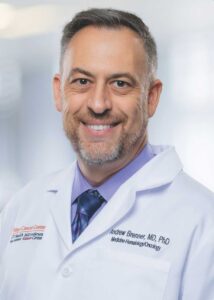
“As a disease with a pattern of recurrence, resistance to chemotherapies and [that is difficult] to treat, glioblastoma has needed durable treatments that can directly target the tumor while sparing healthy tissue,” said Andrew J. Brenner, MD, PhD, professor and chair of neuro-oncology research with Mays Cancer Center at UT Health San Antonio.
The median overall survival time for patients with glioblastoma after standard treatment with surgery, radiation and chemotherapy is only about eight months, Brenner said. And more than 90% of patients have a recurrence of the disease at its original location.
Brenner, who also is clinical investigator for the Mays Cancer Center’s Institute for Drug Development and co-leader of its Experimental and Developmental Therapeutics Program, said that new trials and research are providing new hope for a disease that is the most common primary brain tumor in adults and that can recur quickly and even more aggressively.
Extending survival time
One such trial revealed that a unique investigational drug formulation called Rhenium Obisbemeda more than doubled median survival and progression-free time — the duration from the start of a treatment to when a disease progresses or worsens — compared with standard median survival and progression rates. The drug also had no evident side effects serious enough to prevent increasing the dose.
Brenner was lead author of the trial’s study, published in March 2025 in Nature Communications. In this trial, scientists set out to determine the maximum tolerated dose of the drug, as well as safety, overall response rate, disease progression-free survival and overall survival.
After failing one to three other therapies, the 21 patients who were enrolled in the study between March 5, 2015, and April 22, 2021, were treated with the drug administered directly to the tumors using neuro-navigation, a computer-assistance guidance technology, and a specialized device called a convection catheter.
The researchers observed a significant improvement in survival compared with historical controls, especially in patients with the highest absorbed doses. The study patients had a median survival and progression-free time of 17 months and six months, respectively, for doses greater than 100 gray, which refers to the units of radiation.
Importantly, the researchers did not observe any dose-limiting toxic effects, with most adverse effects deemed unrelated to the study treatment. A phase 2 trial is underway.
Blocking recurrence
Brenner’s study came on the heels of another that discovered a way to delay or even block recurrence of glioblastoma, bringing new hope for survival. It came with a note of irony.
Scientists found that the customary treatment for the disease — ionizing radiation — can also cause tumors to recur by generating senescent, or aged, cells that secrete molecules that can spur growth of neighboring cancer cells.
When a tumor is radiated, a cancer cell can either die or remain alive but be permanently unable to divide further, a state called senescence, with both outcomes controlling tumor growth. However, researchers in this study discovered that senescent glioblastoma cells secrete large amounts of growth factors and other molecules that can act on persisting cancer cells and encourage them to re-proliferate.
But these researchers also discovered that a new class of experimental “senolytic” drugs given after radiation can kill those senescent cells while sparing normal ones, thereby stemming recurrence.
Senolytic gets its name from the words “senescence” and “lytic,” or destroying. A senolytic refers to a novel class of small molecules thought to selectively induce death of senescent cells.
“These findings lend credence to the ‘one-two punch’ approach to radiation therapy, where radiation or other agents are first used to induce senescence in a tumor, and then the senescent cells are removed by a senolytic,” said Sandeep Burma, PhD, professor and vice chair, research, of neurosurgery and co-leader of the Cancer Development and Progression Program of the Mays Cancer Center.
Burma and Bipasha Mukherjee, PhD, associate professor of neurosurgery at the university, were lead authors of this study, published in February 2025 in EMBO Molecular Medicine.
A double-edged sword
Burma’s lab has focused on understanding the forces driving recurrence and strategies to block the process. Specifically, they set out to understand whether senescence of cancer cells after radiation therapy — also called therapy-induced senescence — might counterintuitively be driving recurrence.
Burma said that ionizing radiation, which is routinely and, in many cases, effectively used to treat cancer, is a double-edged sword since radiation also is a powerful carcinogen.
For glioblastoma, radiation is still the most effective therapy. But radiation exposure also is the only known risk factor for its development and could perhaps also drive recurrence. What to do?
End of senescence
The researchers found that senescent glioblastoma cells rely on an anti-apoptotic protein, or one that slows or prevents cell death, known as cIAP2, for survival. They also found that targeting cIAP2 with a senolytic drug called birinapant in mouse tumor models after radiation could kill senescent cells while sparing normal cells.
They tested their approach in multiple mouse models of glioblastoma and found that, while the drug was not effective on its own, it was very effective at delaying or even preventing recurrence if given as an “adjuvant,” a secondary treatment after the primary treatment of radiotherapy.
“These pre-clinical results highlighting a novel senolytic approach for glioblastoma are very exciting from a clinical standpoint as they clearly indicate that significant improvement in patient survival may become possible by eliminating senescent cells arising after radiotherapy,” Burma concluded.
Nexus of breast and brain cancers
The year before, UT Health San Antonio researchers found that the drug sacituzumab govitecan, effective in treating breast cancer, was well-tolerated and showed signs of effectiveness for those whose breast cancers had metastasized to the brain. The scientists made the discovery from a “window trial,” or one in which patients agree to be treated with a novel drug before undergoing surgery.
About half of all women with the aggressive and advanced triple-negative form of breast cancer will be diagnosed with brain metastases, and the prognosis is poor, with a median overall survival of just more than seven months.
Brenner was lead author of the trial’s study, published in August 2024 in Nature Communications.
“We knew that the drug has been effective in the treatment of breast cancer, but its usefulness in treatment of resulting brain tumors has been unclear,” he said. “Our trial, however, revealed that it could achieve concentrations of inhibitors inside the tumors sufficient to benefit patients, and with minimal side effects, which is very promising for new therapy.”
Addressing an unmet need
Treatment for tumors originating from breast cancer typically involve surgery, radiotherapy and systemic therapies that target the entire body, though these measures are often unsuccessful. Aggressive glioblastoma represents about half of those brain malignancies.
This unmet need to address breast cancer with brain metastasis and recurrent glioblastoma has been limited by many factors. Unlike chemotherapy, sacituzumab govitecan is intended to target and kill tumor cells while sparing healthy cells.
The trial at UT Health San Antonio enrolled 25 patients, ages 18 or older, who had been diagnosed with breast cancer with brain metastases or recurrent glioblastoma. Each received a single intravenous dose of the drug one day before tumor-tissue removal and then again on days 1 and 8 of 21-day cycles following recovery. The timeframes were eight months for patients with breast cancer with brain metastases and two months for those with recurrent glioblastoma.
The researchers discovered significant penetration of SN-38, a potent anti-cancer agent, inside the tumors that was delivered by the drug to fight their development, and without unexpected adverse effects on the patients. The data would support investigation in a phase 2 clinical trial of the drug in recurrent glioblastoma.
Continuing research, trials
As the academic health center of The University of Texas at San Antonio, UT Health San Antonio conducts and participates in hundreds of clinical trials at any time across the spectrum of chronic disease and human health conditions. Within this broad context, the institution’s physician-scientists have helped improve brain tumor treatments in significant ways. And through continued research, they offer emerging therapies to eligible patients affected by early and advanced diseases, including glioblastoma.
“Our research can have a profound impact on families facing a brain cancer diagnosis,” Brenner said. “Just knowing that what we do can potentially extend lives and allow patients to have more time with their families makes all this worthwhile. It is why we do what we do.
“Glioblastoma has claimed the lives of countless individuals, famous and otherwise. Our patients aren’t famous, but our goal is for them not to become known or defined by this disease — and to cure or give them a new lease on life.”
Learn more about the cancer clinical trials and research at Mays Cancer Center.