
New Center for Brain Health pairs advanced research with clinical care of individuals facing neurological conditions
UT Health San Antonio’s Center for Brain Health, which opened Dec. 10, brings clinical care, innovative research and caregiver support together under one roof to revolutionize how diseases of the brain are understood and treated.
The $100 million, 103,000-square-foot center is designed to provide a comprehensive and hopeful experience for individuals facing neurological diseases while advancing the science behind diagnosis and treatment.

The idea for the new building began more than seven years ago, sparked by a vision to create a dedicated space for patient care and research. That vision resonated across the San Antonio community, prompting more than $40 million in philanthropic support to help make that dream a reality. And in November, Texas voters approved a state constitutional amendment establishing a $3 billion state fund to accelerate research, treatment and prevention of Alzheimer’s disease and related dementias.
“This center is the culmination of years of effort to build a space that not only meets the care needs of patients and families, but also expands our research capacity,” said Sudha Seshadri, MD, DM, neurology professor and founding director of the Glenn Biggs Institute for Alzheimer’s and Neurodegenerative Diseases at UT Health San Antonio.
“It’s deeply meaningful to me, both personally and professionally, to offer not just treatment, but respect for each person’s uniqueness. A diagnosis doesn’t define a person, and it certainly doesn’t stop their story.”
A new model for neurological care
The Center for Brain Health is set to redefine the treatment of conditions like Alzheimer’s, dementia, stroke, amyotrophic lateral sclerosis (ALS) and Parkinson’s. Multispecialty care teams include neurologists, therapists, counselors and support staff in one location, reducing the need for multiple appointments. The center features 75 exam rooms, 12 infusion chairs for newly approved and investigational treatments, and specialty spaces for therapy, diagnostics and wellness.
Other services include geriatric psychiatry, nutrition, neuropsychology, genetic counseling, physical therapy and mental health support for patients and caregivers.
Community spaces are available to host support groups and educational events, reinforcing the center’s role as a hub for families and anyone affected by neurological conditions.
“This is more than a building, it’s a new model for neurological care,” said Carlayne Jackson, MD, FAAN, chair of the Department of Neurology. “Our patients need comprehensive assessments, imaging, neuropsychology testing, family services and more. All of that is available here in a single, coordinated location.”
Jackson said what excites her most about the center is the integration of patient care and research.
“Being able to manage patients in the same space where research and clinical trials are happening is something we’ve never had before,” said Jackson.
The center includes a bridge to the institution’s Medical Arts and Research Center, is near the UT Health San Antonio Multispecialty and Research Hospital and is across the street from the Sam and Ann Barshop Institute for Longevity and Aging Studies, enhancing collaboration across research and clinical care teams.
“The Center for Brain Health represents hope — a place where care and discovery come together to preserve brain health, ensure early diagnosis and help people keep doing what they love for as long as possible,” Seshadri said.
Advanced imaging technology
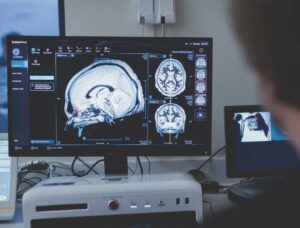 UT San Antonio’s 7-Tesla Terra.X magnetic resonance imaging (MRI) scanner — Texas’ first — housed within the Center for Brain Health, is one of the most powerful imaging technologies available. This system provides ultra-high-resolution brain scans to guide early diagnosis and novel research to aid the study of conditions like Alzheimer’s, Parkinson’s and other brain diseases.
Compared to standard MRI, the 7T offers dramatically improved resolution, especially in deep or complex regions such as the brain stem and temporal lobes. In clinical use, this can help distinguish between minute differences that are not visible with lower-powered scans. For example, the 7T can more accurately distinguish between a benign blood vessel and an aneurysm, potentially sparing a patient from unnecessary surgery. The level of detail provided, even without contrast, can reveal deep structures like the brain stem, where many diseases begin, and veins where amyloid is cleared.
By offering this cutting-edge MRI locally, UT Health San Antonio can reduce the burden of travel for patients and expand access to high-resolution imaging that might change the course of their diagnosis or treatment.