Music, movement and meaning filled the stage on Jan. 23 as students, faculty, staff and community members gathered for Night of the Arts, a student-led showcase celebrating the connections between art, medicine and healing.
The annual event highlights visual and performing arts while raising funds for the Student-Faculty Collaborative Practices (SFCP), a program that’s part of the Charles E. Cheever Jr. Center for Medical Humanities and Ethics at the Joe R. and Teresa Lozano Long School of Medicine. In 2005, Richard Usatine, MD, professor in the Department of Medicine, established the university’s first student-run free clinic, and started Night of the Arts in 2006. For more than 20 years, SFCP has operated free medical clinics across San Antonio, providing care for underserved populations while offering hands-on learning opportunities for future health professionals.
Celebrating the art of medicine
“Night of the Arts creates a space to honor artistry in medicine,” said Isabel Kilday, second-year medical student at the Long School of medicine and 2025-2026 president of the SFCP, who helped organize the event. “Quantitative skills, research skills and test-taking abilities are often more rewarded in medicine, but it is so important to make room for the humanities because it helps us to consider the ethics of what we are doing and the impact of our work. There are many aspects of human existence that cannot simply be fixed by a doctor or a drug.”
Proceeds from the evening directly support the six SFCP clinics serving diverse populations throughout the city: Travis Park and Haven for Hope, which provides dermatologic services; the San Antonio Metropolitan Ministries clinic for families experiencing homelessness; Alpha Home, a residential recovery center for women with substance use disorders; the Pride Community Clinic serving LGBTQ+ patients; and the San Antonio Refugee Health Clinic, which primarily serves Afghan refugees.
All clinics are staffed by volunteer medical students and physicians under faculty mentorship, and several operate with an interprofessional model offering volunteer opportunities for dental, nursing and other health professional students.
Learning through service
“Volunteering at the clinics is an amazing way for students to develop their clinical skills and gain hands-on experience,” Kilday said. “It’s very influential in our professional formation because we are prioritizing serving patients who need it most. We learn about the structural factors that limit access to care, and we learn from dedicated physicians who volunteer their time despite busy schedules to serve those most in need.”
She added that medical students often bring something invaluable to the clinic setting: time.
“We take very thorough histories and spend a lot of time with patients,” she said. “That is a resource medical students have that residents and faculty often have much less of. We can really get to know patients, listen to them, show empathy and understand them.”
The healing power of performance
The Cheever Center has long emphasized the importance of the arts and humanities in medical education, providing a home for students who are artistically inclined to explore how creativity intersects with healing.
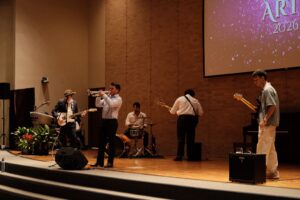
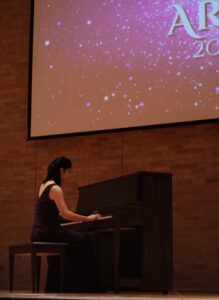
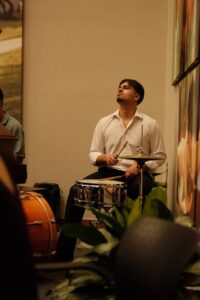
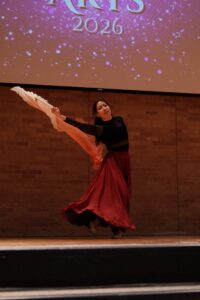
That spirit was on full display during the evening’s performances. The event opened with a silent auction featuring artwork created and donated by faculty, students and staff, followed by a buffet dinner provided by local businesses and vendors. Guests then enjoyed a full playbill of performances ranging from the School of Medicine rock band “Full Dose” to classical piano music and traditional Chinese dance.
Matthew Dacso, MD, MSc, director of the Cheever Center, said creating space for artistic expression is essential in medical training.
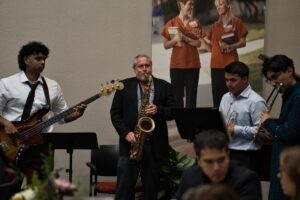
“I think events like this are extremely important because they give students an opportunity to engage a different part of their mind and brain,” he said. “They spend so much of their time in labs and classrooms, studying and working nonstop, and this gives them a chance to express themselves through art.”
Dacso, who has long balanced his medical career and his passion for music, played saxophone with Full Dose during the evening’s dinner and closed out the show with a a piano and vocal performance. He noted that many students across all health professions have deep connections to music and the arts that are important for them to hold onto.
“Creating opportunities like this is essential so they can continue to nourish that part of themselves and not lose it while they are learning how to become healers,” he said. “It also helps them take care of themselves. We always tell our students that there are many ways to heal. It’s not just about medicine or a stethoscope — music and art are among the most important ways we can help people heal.”
A night shared with the community
Community members served by the SFCP clinics were also invited to attend the event, including patients from Alpha Home and the San Antonio Metropolitan Ministries clinic.
Alpha Home, established in 1966, is the only women-specific long-term substance abuse recovery program in Bexar County. Since partnering with SFCP in 2005, UT Health San Antonio students and faculty have provided primary care, psychiatric services, physical therapy, women’s wellness exams and STI screenings for residents.
For many Alpha Home attendees, the evening was both emotional and affirming.
“It’s been an amazing night,” said J*, a resident of Alpha Home. “I love that we were given roses and had reserved seating up front. A lot of the performances have really moved me.”
Another attendee, L*, said it was fun seeing the students and doctors from the clinics perform.
“It’s great to see these doctors have an artistic side as well as compassion for the community,” she said. “We really appreciate the free clinic. Everyone is very knowledgeable and so caring and compassionate. I’ve been fortunate enough to do physical therapy and get services from the women’s wellness clinic. They’re all very kind and provide us treatment without any judgement. It’s really nice to see them tonight and that they’re here with the community.”
Another Alpha Home resident in attendance, B*, said the night offered a chance to connect with the students in a new way.
“The free clinics provide awesome care, and I think it’s a wonderful opportunity to just get out and see the students that work with us in a different light,” she said. “I used to dance, so I appreciated all the dance performances especially.”
Connection at the heart of care
For Esha Jampana, first-year medical student and incoming president of the SFCP, the evening reflected the deeper purpose of both the clinics and the arts.
“The arts can be such a healing process for so many people,” she said. “It’s also an act of bringing the community together, and that sense of connection is a big part of healing.”
She added that even first-year students can make a meaningful difference through presence and listening.
“Sometimes people just need someone to listen,” Jampana said. “Many times, that alone is a major part of the healing journey. That’s why events like this are so important. They bring people together, help them meet other like-minded individuals and provide a safe space for people, which makes it especially meaningful.”
*Full names are not disclosed to retain anonymity for Alpha Home residents.