How a clinical trial patient helped reshape pancreatic cancer treatment
Content provided by Susan Anasagasti
Author’s note: At this year’s Practical Applications of New Agents in Oncology conference, hosted by UT Health San Antonio’s Mays Cancer Center, keynote speaker Daniel Von Hoff, MD, reflected on a breakthrough that began in San Antonio.
In the early 1990s at San Antonio’s Audie L. Murphy Memorial Veterans’ Hospital, a pancreatic cancer patient had somewhere to be.
“You’re late again, Dr. Von Hoff,” the patient’s wife told the young oncologist. “I need to get my husband across the street to Kentucky Fried Chicken.”
Weeks earlier, he could barely eat. After enrolling in a phase 1 clinical trial, he had gained 15 pounds and was thinking about fried chicken — the first batch, hot from the fryer.
For a patient with a disease that often steals appetite long before it claims life, the craving was striking.
“If you listened to him, he was actually pain-free,” said Daniel Von Hoff, MD, who led drug development at the Cancer Therapy & Research Center (CTRC), now the Mays Cancer Center.
What he saw wasn’t on a scan. It wasn’t in the data. It was human.
He pushed for a larger trial.
“You expect us to spend $2 million on a phase 3 study based on one patient eating Kentucky Fried Chicken?” an executive asked.
“Yeah, that’s about it,” Von Hoff replied.
They did.
What began as a bedside observation led to a randomized study of 126 patients and, ultimately, the approval of gemcitabine, the first drug shown to extend survival and improve quality of life for patients with advanced pancreatic cancer.
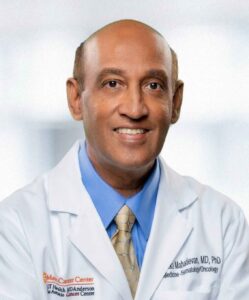
“Today, that same philosophy — listening closely to patients, observing remarkable responses in a phase 1 trial and moving promising therapies quickly into phase 2 trials — continues to shape the work at UT Health San Antonio,” said Daruka Mahadevan, MD, PhD, director of the Institute for Drug Development at Mays Cancer Center.
More than 25 years later, Von Hoff returned to San Antonio — not to a clinic, but to a meeting, where more than 200 oncologists and hematologists gathered to hear him speak.
Leading a legacy of discovery
“It’s great to be back in San Antonio,” Von Hoff said at the 2026 Practical Applications of New Agents in Oncology (PANAO) conference. “Much of the work that led to gemcitabine began here, with colleagues and collaborators in this room.”
In the audience, the next generation of drug developers sat, quietly listening. Von Hoff did not begin with statistics. He began with instruction.
“The best translational investigators are those who really embrace patient care,” he said. “You need to spend as much time as possible with patients and their families, because if you listen, they will teach you. It’s not artificial intelligence. This is real intelligence.”
Von Hoff returned to a question that has shaped decades of cancer research: Where, exactly, are tumors most vulnerable?
Cancer cells, he told the audience, live under constant biological stress, dividing rapidly and adapting to therapies designed to destroy them. That pressure, he said, may also expose their weaknesses.
“Because of stress on the tumor cells, they’re actually on the verge of collapsing,” Von Hoff said. “The question is how to push them over the edge.”
Over the course of the two-day conference, researchers shared findings that reflect how quickly the field is evolving. Presentations highlighted new approaches, from antibody-drug conjugate therapies targeting resistant tumors to artificial intelligence tools helping researchers find new cancer targets faster and match patients with targeted therapies.
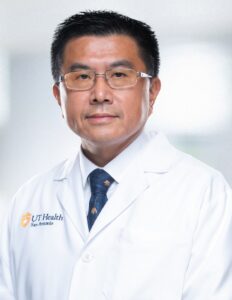
“That progress reflects a broader shift in oncology,” said Lei Zheng, MD, PhD, executive director of the Mays Cancer Center. “Our focus is not only to develop better therapies, but to detect cancer earlier and intervene when treatment can have the greatest impact for patients.”
Building early-phase research at UT Health San Antonio
Von Hoff’s connection to San Antonio stretches back decades. In 1979, the National Cancer Institute recruited him to help expand the research mission at the CTRC, then a small radiation clinic founded in 1974 to serve local patients.
The need was urgent. South Texas carries one of the nation’s heaviest cancer burdens. Researchers at the CTRC set out to change that by bringing new treatment options to patients in the region who often had few.
“By 1988, the CTRC was investing nearly $8 million each year in cancer research,” Zheng said. “That investment helped launch a phase 1 clinical trials program, enrolling 40 patients in its first year. It was an early step in establishing San Antonio as a proving ground for new cancer therapies.”
Out of that momentum came the Institute for Drug Development, launched in 1991 with Von Hoff as its founding director. The program helped bring new cancer drugs into early testing, including gemcitabine.
The CTRC eventually evolved into what is now the Mays Cancer Center at UT Health San Antonio, the region’s only National Cancer Institute–designated Cancer Center.
“When we started, we were trying to build something that didn’t really exist yet,” Von Hoff said. “But the spirit that defined those early years has remained the same.”
Since then, UT Health San Antonio has grown with new research programs, expanded facilities and a new cancer-focused hospital serving patients across the region.
Von Hoff has mentored dozens of physicians, many of whom returned for the conference. Others now lead cancer programs around the world, including Lillian Siu, MD, president of the American Association for Cancer Research and Manuel Hidalgo, MD, PhD, a leader in oncology drug development. Both trained as clinical research fellows at UT Health San Antonio.
“Our time working together at UT Health Science Center San Antonio and the CTRC was special because of the people in San Antonio who made so many good things happen,” Von Hoff said. “There were no egos — just doctors, nurses and an incredible staff focused on helping patients and advancing new treatments.”
Currently a Distinguished Professor at the Translational Genomics Research Institute in Arizona, Von Hoff shows no signs of slowing down. “We’re still bringing two new agents every week to consider for therapy,” he said. “There’s still so much work to be done. Every new trial is another step toward better options for patients.”
A legacy still in motion
In many ways, PANAO reflects that legacy — a gathering of investigators still asking the same question that shaped those early trials: Which new therapies might change what happens next for patients?
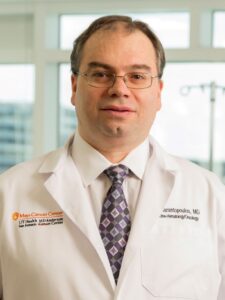
“Early-phase trials are where possibility begins,” said John Sarantopoulos, MD, a Mays Cancer Center medical oncologist and PANAO conference co-chair. “What you see across these presentations is how many different approaches scientists are pursuing at once.”
Nearly three decades after its founding, PANAO remains a place where scientific ambition meets clinical urgency, where new ideas are tested, challenged and refined in the search for better cancer care.
While many breakthroughs begin in a laboratory, others begin at the bedside. And some may even emerge from a patient’s craving for fried chicken.